


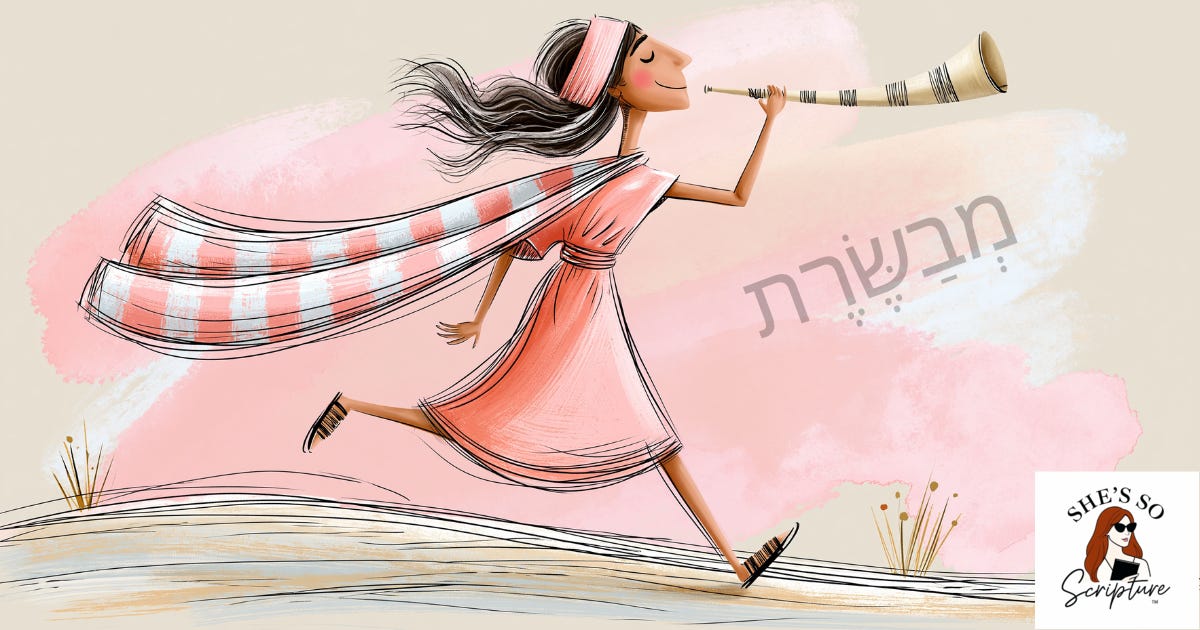
Picture a city under siege. People on the walls, watching the horizon the way you watch a phone that hasn’t buzzed in hours. Somebody spots movement. A figure running. And nobody on that wall asks who it is. They ask what he’s carrying.
That question is the whole logic behind today’s word. The root ב־ש־ר (B-S-R) has the sense of bringing joyful news, often news of victory, deliverance, or God’s saving reign.
Long before the New Testament writers used the Greek word euangelion, Hebrew already had besorah. The herald wasn’t there to inspire anybody. He didn’t create the victory. He didn’t negotiate it or improve it. He announced it. His authority didn’t come from himself. It came from the King who sent him.
Here’s the family this root produces:
בְּשׂוֹרָה (besorah, buh-so-RAH), the good news itself.
מְבַשֵּׂר (mevaser, meh-vah-SER), the herald, masculine.
מְבַשֶּׂרֶת (mevaseret, meh-vah-SEH-ret), the herald, feminine.
לְבַשֵּׂר (levaser, leh-vah-SER), the verb, to proclaim it.
You already know besorah if you’ve spent any time in Messianic teaching. It’s the word Rabbi Russ Resnik built an entire book around (a reader-friendly exploration of themes that are developed more fully in Dr. Mark Kinzer's, Jerusalem Crucified, Jerusalem Risen), and it’s a beautifully Hebrew way to frame the gospel. Not information. A royal announcement.
Where The Word Gets Messy First
The earliest big appearances of this root aren’t clean at all.
Rechab and Baanah, two commanders under Saul’s son Ish-bosheth, snuck into his house at midday and murdered him in his own bed. They cut off his head and ran it to David, sure a rival king would call that good news. David reminded them of a similar afternoon after Saul’s death, when a different messenger showed up expecting a reward:
“As Adonai lives, who redeemed my soul out of all distress, when someone informed me saying, ‘Look, Saul is dead!’ thinking he was a bearer of good news, I seized him and killed him in Ziklag, instead of rewarding him for his news.” (2 Samuel 4:9-10, TLV)
Rechab and Baanah were executed too.
Not everything that calls itself good news is actually good news. Sometimes it's just violence with a better publicist.
Then there’s Absalom. Two runners race toward David after the battle. Ahimaaz arrives first, out of breath, proud of his speed, and completely useless, because he doesn’t actually know what happened. The Cushite gets there second and tells the truth. David asks both of them the same question:
“Is it well with the young man Absalom?” (2 Samuel 18:32, TLV)
The answer means his son is dead. Victory over the rebellion and grief over his child show up in the same sentence. Good news, even here, costs something.
Isaiah Won’t Let This Word Stay Small
By chapter 40, the word has stopped being a battle report.
“Get yourself up on a high mountain, you who bring good news to Zion! Lift up your voice with strength, you who bring good news to Jerusalem! Lift it up! Do not fear! Say to the cities of Judah: ‘Behold your God!’” (Isaiah 40:9, TLV)
Here’s a translation wrinkle for you word nerds.
Mevaseret is feminine, and Hebrew cities are grammatically feminine too. The Hebrew construction itself allows more than one reading. It could be a herald running to bring Zion the news, or Zion herself, commissioned to shout it.
The TLV reads it as a herald bringing news to Zion. Other translations, like the ESV and the NET Bible, let Zion be her own herald.
The NET Bible, Full Notes Edition gives this reason for why their translators rendered it the way they did:
“The second feminine singular imperatives are addressed to personified Zion/Jerusalem, who is told here to ascend a high hill and proclaim the good news of the Lord’s return to the other towns of Judah. Isaiah 41:27; 52:7 speak of a herald sent to Zion, but the masculine singular form, מְבַשֵּׂר (mevaser) is used in these verses, in contrast to the feminine singular form מְבַשֶּׂרֶת (mevaseret) emplotyed in 40:90, where Zion is addressed as a herald.”1
The good news and a woman’s voice are tangled together in one of Isaiah’s most famous uses of the word, whichever way you read it.
Twelve chapters later, the picture sharpens (and shows us the NET Bible’s reference):
“How beautiful on the mountains are the feet of him who brings good news, who announces shalom, who brings good news of happiness, who announces salvation, who says to Zion, ‘Your God reigns!’” (Isaiah 52:7, TLV - Emphasis mine)
And by chapter 61, we find out exactly what the good news includes:
“The Ruach Adonai Elohim is on me, because Adonai has anointed me to proclaim Good News to the poor. He has sent me to bind up the brokenhearted, to proclaim liberty to the captives, and the opening of the prison to those who are bound.” (Isaiah 61:1, TLV)
Forty says your God is coming. Fifty-two says your God reigns. Sixty-one says the poor get lifted and the captives go free. Isaiah keeps reaching for the same word and it keeps getting bigger in his hands.

Yeshua Fulfills The Herald
Centuries later, Yeshua walks into His hometown synagogue in Natzeret, unrolls the scroll, and reads Isaiah 61 out loud. Then He sits down and says the one sentence that should have stopped every heart in the room:
“Today this Scripture has been fulfilled in your ears.” (Luke 4:21, TLV)
Yeshua fulfills the role of that herald. He doesn’t just deliver Isaiah’s announcement. He IS what Isaiah announced.
The same word echoes backward too, at the very start of His life. An angel shows up to shepherds in a field at night:
“Do not be afraid! For behold, I proclaim Good News to you, which will be great joy to all the people. A Savior is born to you today in the city of David, who is Messiah the Lord.” (Luke 2:10-11, TLV)
Luke wrote in Greek, but every Jewish ear in that field was standing inside a story Isaiah had been telling for centuries. The herald had arrived. Again.
A Town Living Inside A Prophecy
There’s an actual town outside Jerusalem named straight out of Isaiah 40:9. Mevaseret Tziyon. Herald of Zion. People wake up there every morning inside a piece of Scripture, and somewhere in that town there’s a resident with a return address that translates to Good News to Zion. That is, without competition, one of the best facts I know. I want THAT address!
Why The Feet Are Beautiful
Paul picks the word back up in Romans:
“And how shall they proclaim unless they are sent? As it is written, ‘How beautiful are the feet of those who proclaim good news of good things!’” (Romans 10:15, TLV)
Nobody’s feet are actually beautiful. Mine are no exception… just ask my kids. They will be more than happy to tell you. They show me no mercy! I have perpetually dry feet, pedicures and all.
Feet are cracked and calloused and covered in road dust, and Paul knew that better than most, given how much of his ministry happened on foot between cities. Paul isn’t handing out a compliment about pedicures.
A messenger’s feet are beautiful the same way a hospital hallway is beautiful the moment someone finally walks out and says the surgery worked.
Gospel Is Not Advice
The good news was never advice.
Modern preaching can drift toward a self-improvement seminar with a cross on the wall. Here’s how to fix your marriage. Here’s how to manage your anxiety. Here’s how to become a better version of yourself. None of that is worthless, but none of it is the Besorah either.
The Besorah doesn’t open with instructions. It opens with an announcement. A King has come. A victory has been won. A reign has begun. Respond accordingly.
That’s the difference between a mevaser and a life coach. A life coach tells you what you could do. A herald tells you what already happened.
One More Thing
The Hebrew word for flesh, בָּשָׂר (basar), shares the same three consonants as בשר, apart from the vowel points underneath them. They’re different lexical entries, so modern linguistics doesn’t treat them as etymologically related. Hebrew readers notice it anyway. John writes:
“And the Word became flesh and tabernacled among us. We looked upon His glory, the glory of the one and only from the Father, full of grace and truth.” (John 1:14, TLV)
The Word became basar. And what did He bring? The besorah. Consider that one a coincidence of spelling with excellent timing.
My Final Thoughts
We don’t invent the Besorah. We don’t improve it, and we certainly don’t become it. What we get to be is heralds. The message first announced by Isaiah and fulfilled in Yeshua is now entrusted to those He sends, and a herald doesn’t get to renegotiate the king’s message. He just announces it.
The mevaser never ran because the battle might be won. He ran because it already had been. That’s why the Besorah is called good news. It isn’t advice about how to save yourself. It is the announcement that God has acted. The King has come. God reigns. His kingdom has begun.
Now run. Tell somebody.
If this study stirred something in you, share it with a friend who needs to hear that the good news was never something they had to fix themselves into. They just have to carry it.
And if it left you wanting to go slower and deeper into the Word, I’ve got you! Paid subscribers get access to live Bible studies, extended studies, devotionals, theological teaching, spiritual formation practices, and a community of people who want depth without pressure or performance. If you’re ready to step further into the Word, you’re welcome inside.
If a paid subscription isn’t feasible right now but this space has blessed you, you can leave a one-time tip here. Every gift helps sustain this work. 💕

About the Author
Diane Ferreira is a Jewish believer in Yeshua, a published author, speaker, seminary student, wife, and proud mom. She is the founder of She’s So Scripture and She Opens Her Bible. She is the author of several books, including The Proverbs 31-ish Woman, which debuted as Amazon’s #1 New Release in Religious Humor, as well as Holy, Hormonal and Holding On.
She is currently pursuing her graduate degree in Jewish Studies in seminary, with her favorite topics being the early church and Biblical Hebrew. Diane writes and teaches from a unique perspective, bridging her Jewish heritage with vibrant faith in the Messiah to bring clarity, depth, and devotion to everyday believers.
When she’s not writing, studying, or teaching, you’ll find her curled up with a good book, crocheting something cozy, traveling, or playing her favorite video games.
Tree of Life (TLV) – Scripture taken from the Holy Scriptures, Tree of Life Version*. Copyright © 2014,2016 by the Tree of Life Bible Society. Used by permission of the Tree of Life Bible Society.
Footnotes
Biblical Studies Press. NET Bible Full Notes Edition. 2nd ed. Richardson, TX: Biblical Studies Press, 2019, translator's note on Isaiah 40:9.
Thank you so much! Another great word study. I am really enjoying these as I feel that the Hebrew scriptures are neglected in the current Christian environment.
This article struck me as I have been looking at "good news" in Isaiah. I also appreciate the book links in your article. Keep up the good work!
I loved this so much!!!