


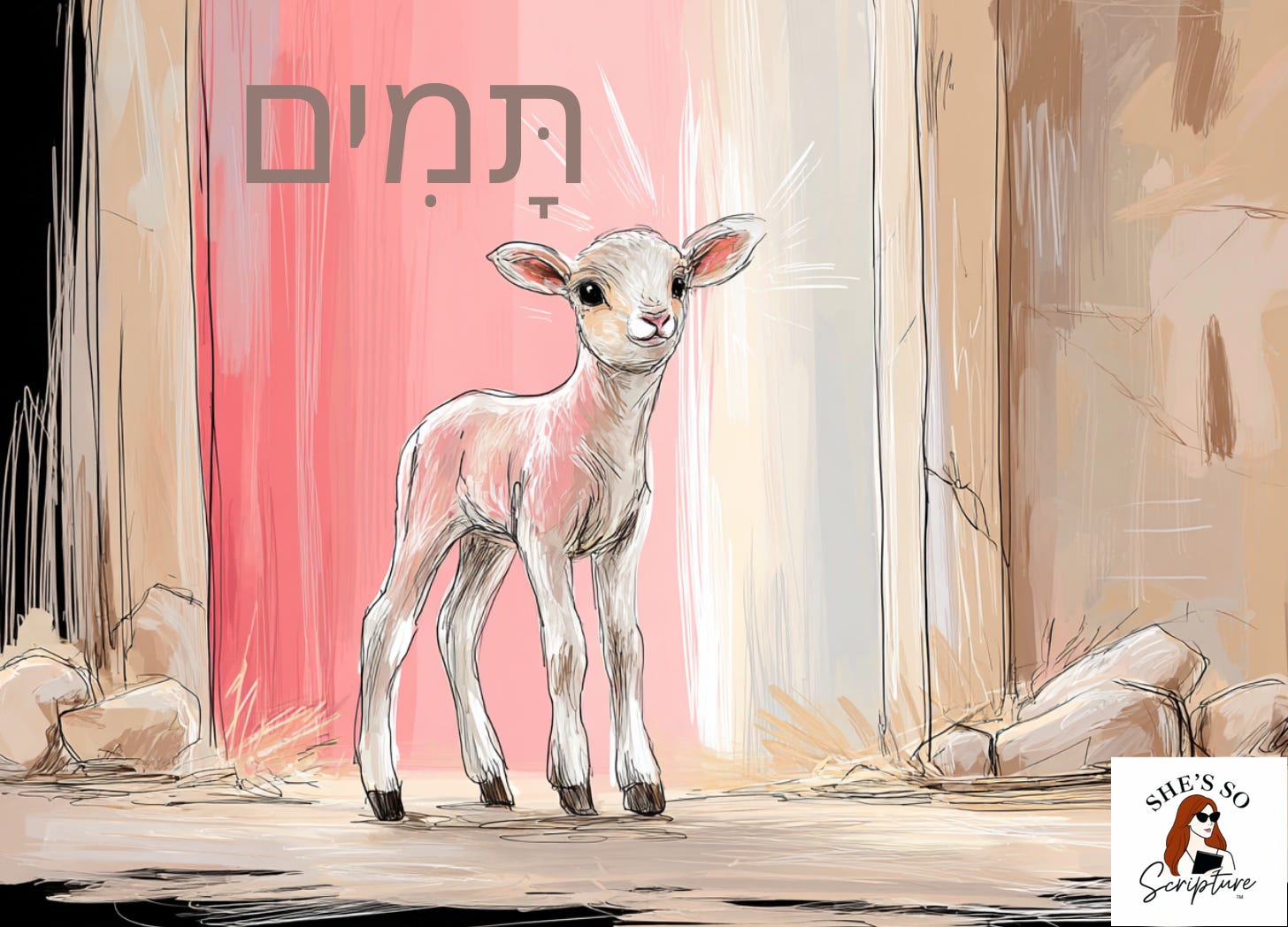
Pronunciation: tah-MEEM
Meaning: whole, complete, undivided, blameless in integrity
Most English Bibles translate tamim as “blameless” or “perfect.” And the second we hear “perfect,” half the room shuts down. Perfection sounds exhausting, unattainable. Polished beyond humanity.
That’s totally NOT what this word is doing.
Tamim doesn’t describe flawlessness. It describes wholeness.
It’s used in Genesis 6:9 to describe Noah.
“Noah was a righteous man. He was blameless among his generation. Noah continually walked with God.”
Genesis 6:9 (TLV)
That word “blameless” is tamim. Noah wasn’t sinless. He was undivided. His loyalty wasn’t fractured across competing allegiances. In a generation bent toward corruption, he remained intact.
The word also appears in sacrificial language throughout Leviticus. Animals brought for offering were to be tamim, without defect. This isn’t because God needed aesthetic perfection, but because divided or damaged offerings symbolized divided devotion.
Integrity is visible.
The Shape of the Word
The shoresh or root carries the sense of completeness. Something tamim is not fragmented. It holds together and is aligned internally.
When Psalm 15 asks who may dwell on God’s holy hill, the answer begins with the one who “walks with integrity.” The Hebrew word there is tamim.
Integrity in Scripture is not about image management, it’s about coherence. What you say aligns with what you do. What you confess aligns with how you live. Your inner life and outer life aren’t competing stories.

Tamim and Covenant
In Genesis 17:1, God tells Abraham:
“I am El Shaddai. Continually walk before Me and you will be blameless.”
Genesis 17:1 (TLV)
Again, tamim.
God isn’t demanding sterile perfection. He’s calling Abraham into undivided covenant loyalty. The command comes in the context of promise. Walk before Me. Live with your whole self oriented toward this relationship.
Tamim describes our posture more than our performance.
Why This Word Still Matters Today
We live in an age of fragmentation, compartmentalized faith, curated spirituality. Some churches protect their brand more carefully than their character and polish their Instagram images while neglecting their spiritual substance. Public conviction and private contradiction.
Tamim refuses that split.
It invites a life that holds together under pressure. A faith that does not morph depending on the room. A heart that does not divide itself between covenant and convenience.
That kind of integrity is not flashy, it’s steady.
My Final Thoughts
Perfectionism chases image. Tamim pursues wholeness.
It is possible to appear polished and still be fractured. Scripture’s concern is not polish. It is alignment.
Tamim is the quiet strength of a life that is internally consistent. Not because it never struggles, but because it refuses to live divided.
And that kind of wholeness is what carries weight.
Bible Study Questions
How does the use of tamim in Genesis 6:9 shape your understanding of Noah’s character?
In Genesis 17:1, what does it mean for Abraham to “walk before” God in connection with being tamim?
How does the sacrificial requirement of a tamim offering in Leviticus deepen the meaning of integrity?
What connection do you see between tamim and covenant loyalty throughout Scripture?
How does Psalm 15 frame integrity as a lived reality rather than a theoretical virtue?
Reflection Questions
Where in your life do you feel internally divided?
How does cultural pressure encourage fragmentation rather than wholeness?
What would it look like for your public convictions and private habits to align more fully?
In what situations are you tempted to present polish instead of integrity?
Action Challenges
Read Psalm 15 and identify the characteristics of someone who walks in integrity.
Choose one area of your life this week where you will practice visible alignment between belief and behavior.
Ask God to reveal any hidden fragmentation in your heart and invite Him to restore coherence.
If this study stirred something in you, share it with a friend who might need it too.
And if it left you wanting to go slower and deeper into the Word, I’ve got you!
Paid subscribers get access to extended studies, devotionals. theological teaching, spiritual formation practices, and a community of women who want depth without pressure or performance.
If you’re ready to step further into the Word, you’re welcome inside.
If a paid subscription isn’t feasible right now but this space has blessed you, you can leave a one-time tip here. Every gift helps sustain this work. 🤍

About the Author
Diane Ferreira is a Jewish believer in Yeshua, a published author, speaker, seminary student, wife, and proud mom. She is the author of several books, including The Proverbs 31-ish Woman, which debuted as Amazon’s #1 New Release in Religious Humor, as well as Holy, Hormonal and Holding On.
She is currently pursuing her graduate degree in Jewish Studies in seminary, with her favorite topics being the early church and Biblical Hebrew. Diane writes and teaches from a unique perspective, bridging her Jewish heritage with vibrant faith in the Messiah to bring clarity, depth, and devotion to everyday believers.
When she’s not writing, studying, or teaching, you’ll find her curled up with a good book, crocheting something cozy, or playing her favorite video games.
Tree of Life (TLV) – Scripture taken from the Holy Scriptures, Tree of Life Version*. Copyright © 2014,2016 by the Tree of Life Bible Society. Used by permission of the Tree of Life Bible Society.
Always good! And just the right length for folding laundry!
This brings a good thought to place whole heartedness above perfectionism.
That must be why G-d states His displeasure with sacrifices done out of duty rather than love.
One thing I’ve learned by my walk in Judaism is the meaning of the term hesed. It can be written 5 different ways.
Each has a slight differentiation in meaning and yet, they all are dependent on the attitude of the heart.