


Ok. So here’s where I want to start, because I think it’s funny (in an ironic way).
Genesis 2:5 describes the land before the garden narrative gets going: no shrub, no plant, nothing had sprouted yet, because it hadn’t rained and there was no one to work the ground.
"...no shrub of the field had yet grown, and no plant of the field had yet sprung up, for ADONAI Elohim had not caused it to rain on the earth, and there was no man to work the ground..." - Genesis 2:5, TLV
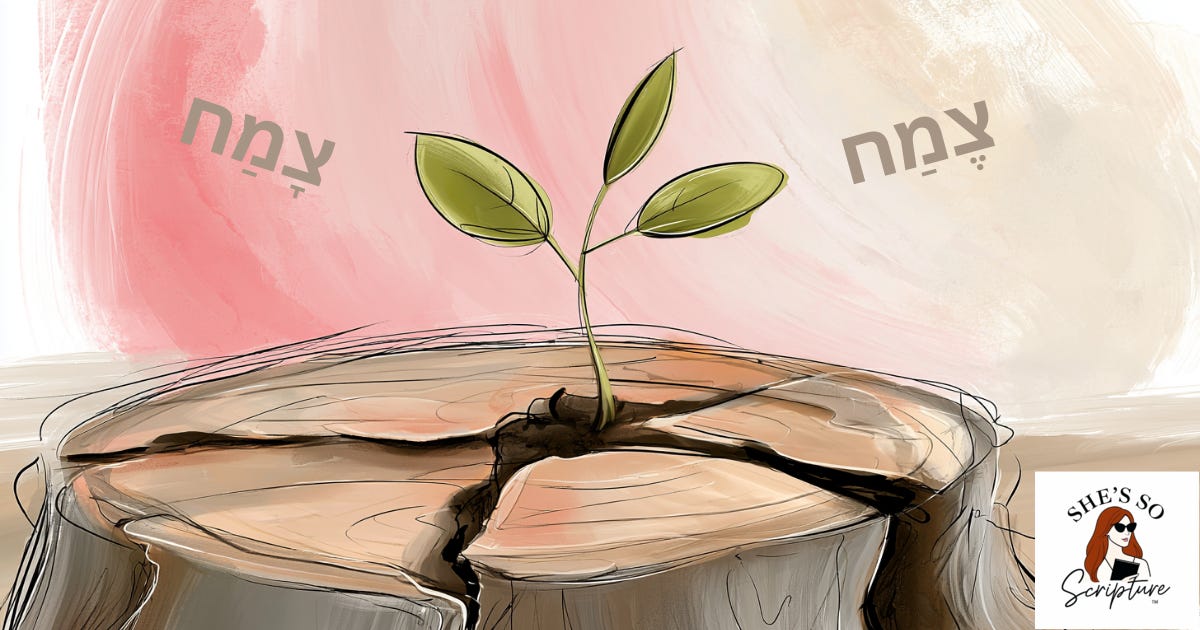
God doesn’t plant the actual garden until verse 8, so we’re a few verses early, standing in a field that hasn’t done a single thing yet. The word for sprouted is צְמָח, from the root צמח, tzamach. Dirt, waiting.
Genesis 3 picks the same root back up after the fall, but it’s not gentle anymore.
"Thorns and thistles it will cause to sprout for you..." - Genesis 3:18, TLV1
Same verb but different vibe.
By the time we get to the prophets, that ordinary agricultural verb has become charged with royal and messianic significance. Somebody took a word about seeds pushing up through soil and gave it to a king.
What Tzamach Actually Does
Tzamach is a verb before anything else. It means to sprout, to grow out of the ground… basically it’s dirt vocabulary. Trust me, no one is writing poetry about a weed.
Now, I see other word studies make a mistake all the time. Psalm 92 has this gorgeous line about the righteous flourishing like a palm tree, right after a line about the wicked sprouting like grass before God cuts them down. Some will tell you that’s the same word, tzamach, for both. It’s not.
That’s parach, a different Hebrew root that also means to sprout or flourish. It’s like your eyebrows… they’re sisters, not twins.
I am telling you this because if you ever see someone claim the Bible uses the identical word for the wicked sprouting and the righteous flourishing in Psalm 92, you now know that’s not quite accurate.
Isaiah Gets His Hands On It
Isaiah 61:11 is where I want us to focus for a minute. The image is so specific, and it uses our actual root, twice in the same verse.
"For as the earth brings forth its sprouts, and as a garden causes things sown to spring up, so ADONAI Elohim will cause justice and praise to spring up before all the nations."
- Isaiah 61:11, TLV2
Seeds go into soil. Something invisible (at least to us) happens underground. Then, without anyone forcing it, green pushes up into the light, and Isaiah puts justice and praise in the same picture.
The word itself doesn’t lock in anything about speed, and plants get used elsewhere in Scripture for things that happen suddenly too. But I just can’t shake the feeling that whatever God is growing here isn’t the kind of thing you rush.
Then…the Noun Steps In
There’s a noun that belongs to the same root family, צֶמַח, tzemach, a sprout or a growth. We see it in Jeremiah and Zechariah but it’s not something they invented. A Hebrew reader wouldn’t have to go looking for the connection. It’s as obvious as “growth” and “grow” are to us in English.
It also shows up in other places in the prophets as well, including a debated appearance in Isaiah 4:2. What Jeremiah and Zechariah do is pick up that ordinary noun and use it in royal prophecy.
Jeremiah gives us one of its clearest royal uses.
"Behold, days are coming, declares Adonai, when I will raise up for David a righteous Branch, and He will reign as king wisely, and execute justice and righteousness in the land."
- Jeremiah 23:5, TLV3
In Hebrew, tzemach tzaddik, a righteous Sprout. It’s not exactly a proper name but more like a title given to whoever this coming king turns out to be.
Jeremiah 23 comes from the final stretch of the monarchy, while there were still kings on the throne. Kings this chapter calls out by name for wrecking the flock. The dynasty is collapsing in real time and judgment and exile are looming large!
It hasn’t fallen yet.
Into that mess, God promises a Tzemach tzaddik is coming. Keep in mind, because it matters… this isn’t a promise that is spoken over rubble. It’s a promise spoken while the roof is still on fire.
The stump image people usually reach for here, the famous one, actually belongs to a different prophet. Isaiah 11:1 talks about a shoot from the stump of Jesse, a branch bearing fruit from the roots. Isaiah uses different Hebrew words there; choter and netzer, not tzemach.
So here’s a little Word Nerd bonus for you: the English word “Branch” is actually covering at least three different Hebrew plant words across these prophets; tzemach, choter and netzer.
I’m still going to bring Isaiah’s stump picture in alongside Jeremiah’s Tzemach because both prophets are kind of working the same idea… new growth out of David and Jesse as the promise of royal restoration, Just know they’re not using the same vocabulary to say it.
Zechariah Pushes Even Further
Zechariah uses the word twice and he takes it somewhere Jeremiah hadn’t quite gone.
"Behold, I will bring forth My servant the Branch." — Zechariah 3:8, TLV4
My servant, Tzemach.
"Behold, a man, Tzemach is his name." — Zechariah 6:12, TLV5
NOW the imagery has become very name-like. Not that a prophetic naming works the same way a birth certificate does BUT you can feel the shift. An ordinary word for a sprout has become something more.
Why I Love This One
I have a note in my Bible next to Zechariah 3:8 that just says “grown, not built”. A building is something you construct. A branch is something you wait for.
There is a real, well-documented linguistic link to the Gospel of Luke, and I want to avoid overselling it just because it might sound cool. The Greek translation of the Hebrew Bible (the Septuagint/LXX) translates Zechariah’s Tzemach, in both 3:8 and 6:12, with the Greek word anatole. Then in Luke 1:78, Zechariah the priest, a different Zechariah entirely, sings over his newborn son about “the Sunrise from on high” visiting us:
"...because of the tender mercy of our God, by which the Sunrise from on high will visit us..."
- Luke 1:78, TLV6
That same Greek word, anatole. Part of what makes this so beautiful is that anatole is a word of rising. It can describe the rising of light and can also be used for vegetation springing up. So Luke’s line reads naturally as dawn breaking while settling on the very Greek word the LXX had already used for Zechariah’s Tzemach.
Now to be clear, that doesn’t prove Luke sat down intending to resonate with Zechariah. But it gives us a legit reason to ask whether he did!
A field where nothing had sprouted yet. Thorns after the fall. Justice pushing up out of the ground like something planted. And then a title edging toward a name, given to a promise that was spoken as a kingdom was still coming apart at the seams.
Verse Mapping Aid
Tzamach (צָמַח) — verb, “to sprout, spring up, grow.” Genesis 2:5, Genesis 3:18, Isaiah 61:11.
Tzemach (צֶמַח) — noun from the same root, “sprout, growth, branch.” Appears in Isaiah 4:2 (disputed reference), and as a royal, increasingly title-like designation in Jeremiah 23:5 and Zechariah 3:8, 6:12.
My Final Thoughts
We tend to picture the Messiah arriving like an announcement. A trumpet, a throne, something that just can’t be missed. In Jeremiah and Zechariah, Tzemach paints a picture of the promised ruler arriving the way everything alive actually arrives and out of a family tree that looked like it was still burning down when the promise was first spoken.
Dig Deeper
Isaiah 11:1, Isaiah 4:2, Zechariah 6:12-13, Psalm 92:7-13, Luke 1:78-79
Isaiah 4:2 is worth your own time this week. It uses the exact phrase Tzemach Adonai, the Branch of the LORD, and scholars debate whether it’s describing a person or just renewed fertility for the land. Keep in mind that it’s not a flaw in the word study. That’s the whole point.
Tzemach doesn’t automatically mean Messiah every time the noun appears. Context is what turns ordinary growth language into a royal promise. Remember that the next time you see the word “Branch” capitalized in your Bible. I would even highlight the word everytime you come across it.
If this one stirred something in you, send it to a friend who needs to know a promise spoken in the middle of collapse is still a promise. And if it left you wanting to go slower and deeper into the Word, I've got you! Paid subscribers get access to live Bible studies, extended studies, devotionals, theological teaching, spiritual formation practices, and a community of people who want depth without pressure or performance. If you're ready to step further into the Word, you're welcome inside.
If a paid subscription isn’t feasible right now but this space has blessed you, you can leave a one-time tip here. Every gift helps sustain this work. 💕

About the Author

Diane Ferreira is a Jewish believer in Yeshua, a published author, speaker, seminary student, wife, and proud mom. She is the founder of She’s So Scripture and She Opens Her Bible. She is the author of several books, including The Proverbs 31-ish Woman, which debuted as Amazon’s #1 New Release in Religious Humor, as well as Holy, Hormonal and Holding On.
She is currently pursuing her graduate degree in Jewish Studies in seminary, with her favorite topics being the early church and Biblical Hebrew. Diane writes and teaches from a unique perspective, bridging her Jewish heritage with vibrant faith in the Messiah to bring clarity, depth, and devotion to everyday believers.
When she’s not writing, studying, or teaching, you’ll find her curled up with a good book, crocheting something cozy, traveling, or playing her favorite video games.
Notes
Hebrew: וְקוֹץ וְדַרְדַּר תַּצְמִיחַ לָךְ, “thorns and thistles it will cause to sprout for you.” Same root, צמח.
Hebrew uses the root צמח twice in this verse: the noun צִמְחָהּ (tzimchah, “its growth”) and the verb תַצְמִיחַ (tatzmiach, “cause to spring up”).
Hebrew: וַהֲקִמֹתִי לְדָוִד צֶמַח צַדִּיק, tzemach tzaddiq, “a righteous Branch/Sprout.” This oracle is set during the final period of the Davidic monarchy, before the exile, not after the throne had already fallen. The precise military stage of Babylon’s advance at the time of this specific oracle isn’t independently datable; the broader setting is the judgment and coming exile of Judah’s final kings.
Hebrew: הִנְנִי מֵבִיא אֶת־עַבְדִּי צֶמַח.
Hebrew: הִנֵּה־אִישׁ צֶמַח שְׁמוֹ, “Behold, a man, Tzemach is his name.”
Greek: ἀνατολὴ ἐξ ὕψους. The Septuagint renders tzemach with ἀνατολή (anatolē) specifically in Zechariah 3:8 and 6:12, which is what makes Luke’s word choice notable. Whether Luke intentionally invokes the prophetic usage is a scholarly proposal, not a settled fact.
Tree of Life (TLV) – Scripture taken from the Holy Scriptures, Tree of Life Version*. Copyright © 2014,2016 by the Tree of Life Bible Society. Used by permission of the Tree of Life Bible Society.
I wrote a poem once about Genesis 2:5 - I was in a Genesis 2:7 rabbit hole over adamah — because I am a soil scientist, these dirt-related passages really get me going!
I need to go dig out the link and reread it!
Thank you for these nerdy Wednesdays 🙏🏽
Love to learn Hebrew and Greek but my brain……