


I used to think salvation was a decision I made once and then filed away in a drawer somewhere, like a diploma. Prayed the prayer, got the certificate, moved on with my life.
Scripture rarely leaves salvation sitting like that though. It keeps putting salvation in motion, in songs, in stories, in water, in worship. So today we’re doing a word study that’s going to open that whole picture back up. The word is yeshuah, and it might be one of the most beautiful nouns in the entire Hebrew Bible.
Say It With Me
Yeshuah (יְשׁוּעָה) is pronounced yesh-oo-AH. It is a feminine noun that appears about 77 times in the Hebrew Bible, though some concordances count 78 depending on how derivatives are totalled up.
It gets translated salvation, deliverance, victory, health, and welfare depending on where you land, and it comes from the root yasha, to save or deliver. That is the core sense of the root.
But biblical imagery around this word family often moves the picture further, from distress and constriction into freedom and spaciousness. You can see that same imagery all over Psalm 18, where a cramped, suffocating situation gets described almost physically before God brings the psalmist into open space.
Yeshuah carries some of that flavor with it. It is not only being pulled out of danger. It often comes packaged with room to breathe.
Waiting, Seeing, Singing
Here is something I didn’t expect when I went digging. The very first time yeshuah shows up in the whole Bible is not a triumphant shout. It is a dying man’s quiet hope.
“For your salvation I wait, Adonai!” Genesis 49:18, TLV
That is Jacob, blessing his sons, and right in the middle of it he stops and confesses that he is still waiting on God to save. Just hope, held onto in the dark.
Fast forward to Exodus, and the next stop is Moses telling a terrified, cornered nation what to do with their fear.
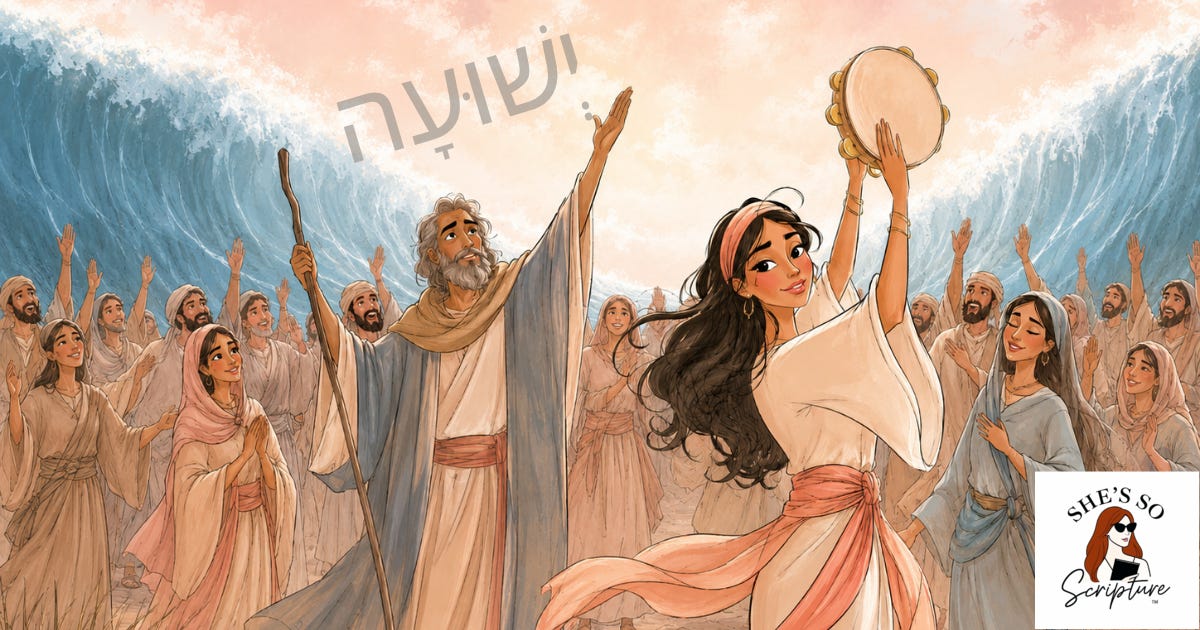
“But Moses said to the people, ‘Don’t be afraid! Stand still, and see the salvation of Adonai, which He will perform for you today.’” Exodus 14:13
Waiting becomes seeing. And once the sea closes and the people are standing safely on the other side, seeing becomes singing.
“Adonai is my strength and song, and He has become my salvation. This is my God, and I will glorify Him, my father’s God, and I will exalt Him.” Exodus 15:2
Wait, see, sing. That is the movement yeshuah takes you through, and it is worth noticing that none of those stages skip the others. You do not get to the song without first standing in the waiting.

A Well You Return To
Isaiah picks up that exact song language on purpose. In Isaiah 12, right after a section promising future restoration, we get this.
“Behold, God is my salvation! I will trust and will not be afraid. For the Lord Adonai is my strength and my song. He also has become my salvation. With joy you will draw water from the wells of salvation.” Isaiah 12:2-3
That first line isn’t a coincidence. Isaiah is deliberately echoing the Song of the Sea, the same “strength and song” language from Exodus 15:2, and Psalm 118:14 picks up that identical line again in worship generations later. This isn’t three unrelated pretty verses about salvation. It is one song that keeps getting sung back to God across exodus memory, prophetic hope, and temple worship.
And then Isaiah adds something new to it. Wells, plural, drawn from with joy. Later Jewish tradition connected this verse to Sukkot and the Simchat Beit HaShoevah, the water drawing celebration held during the festival, which doesn’t change what Isaiah originally meant but shows how deeply this verse shaped Jewish worship long after Isaiah wrote it.
Salvation, in this picture, is not something you visited once. It is a well you keep returning to and drawing from, and it keeps producing joy every time you do.
A Cup You Lift
Then there is Psalm 116, where the psalmist asks a question most of us have asked God in our own words. What do I even give back for everything He has done for me.
“How can I repay Adonai for all His bounties to me? I will lift up the cup of salvation, and call on the Name of Adonai.” Psalm 116:12-13
Scholars are not fully unanimous on what that cup actually was. It may gesture toward a drink offering associated with a thanksgiving sacrifice, or toward a public cup lifted during a communal meal of gratitude.
Psalm 116 also belongs to the Hallel, Psalms 113 through 118, sung at Passover, which is part of why later readers hear an echo of this cup at the table where Yeshua lifted His own cup and spoke of a new covenant. Salvation here is something lifted, tasted, and toasted to God in front of other people. It’s going to matter in a minute.
The Name Behind the Word
Yeshuah shows up across a wide range of situations in the Hebrew Bible. Sometimes it is military rescue. Sometimes it is national deliverance, healing, or preservation through a hard season. Not every single occurrence is a conscious pointer toward Messiah, and it would overstate things to claim otherwise.
What IS true, and what Matthew is showing us, is bigger than any one verse. When Yeshua arrives, His very name embodies the salvation God had been promising, celebrating, and accomplishing throughout Israel’s Scriptures. He does not merely bring salvation, He is its embodiment of it in human form.
Matthew 1:21 already does the explanatory work in Greek.
“You shall call His name Yeshua, for He will save His people from their sins.”
The connection becomes even clearer when you recognize that Yeshua and yeshuah come from the same Hebrew root. Yeshuah is a feminine noun. Yeshua is a personal name built from that same root, one that shows up in late biblical Hebrew as part of the Joshua name family. Different words, same root, same story.
And once that name is spoken over Him, the rest of the New Testament will not let it sit quietly. Philippians 2 says God gave Him the name above every name, so that at the name of Yeshua every knee will bow. That line is doing something audacious, because it is deliberately echoing Isaiah 45, a passage that is entirely about the LORD Himself declaring that every knee will bow to Him and Him alone.
Paul is not being careless there. He is placing the name Yeshua directly inside language that used to belong exclusively to the covenant name of God. And then Peter, standing in front of the very council that condemned Him, says there is no other name under heaven given among men by which we must be saved, using that same yasha root one more time, salvation itself bound up entirely in this one name.
In Luke 4:18-19, Yeshua stands in the synagogue at Nazareth, reads Isaiah 61, and then makes a staggering declaration: "Today this Scripture is fulfilled in your hearing." That's quite a claim if you're just another rabbi.
But Yeshua isn't merely quoting Isaiah. He is identifying Himself as the One through whom Isaiah's promised yeshuah has finally arrived. The wells of salvation are no longer a distant hope waiting somewhere on the horizon. They are standing in the synagogue reading the scroll.
Through His death and resurrection, Yeshua brings the Exodus pattern to its fullest expression. He enters the narrow place of death, emerges into the spaciousness of resurrection life, and establishes the New Covenant through which Israel's covenantal yeshuah is extended to the nations.
Verse Mapping Aid: יְשׁוּעָה (Yeshuah)
Root: ישע (yasha), to save, to deliver
Part of speech: feminine noun
Appears: about 77 times in the Hebrew Bible (some concordances count 78)
First occurrence: Genesis 49:18
Key texts: Genesis 49:18, Exodus 14:13, Exodus 15:2, Isaiah 12:2-3, Psalm 116:13, Psalm 118:14
Bonus nugget: the prophet Isaiah’s own name, Yeshayahu, means “God is salvation.” It is not a coincidence that Isaiah 12 becomes one of the richest salvation texts in the whole book.
My Final Thoughts
Somewhere along the way, we reduced salvation to little more than "where I go when I die." That wasn't always the way God's people understood yeshuah. Over the centuries, particularly in the post-Reformation period and the evangelical movements that followed, the emphasis gradually shifted toward the salvation of the individual soul.
That truth is precious, but it is only one part of the biblical picture. In Scripture, yeshuah is God's intervention in history. He delivers His people from real danger, brings them out of the narrow place into a spacious one, and restores them to covenant life with Him. The New Testament never abandons that picture. It expands it.
If salvation in your mind has become something quiet, something private, something you settled once and stopped thinking about, I want to hand you back the fuller picture Scripture actually gives us. Yeshuah starts in a dying man’s hope, moves through a nation standing still to watch God work, and ends up sung, drawn from, and lifted in a cup where other people can see it. And underneath all of it is a name that God had already placed into His people’s vocabulary long before Bethlehem.
Bible Study Questions
Read Genesis 49:1-28. What does it tell you that Jacob’s confession of waiting for salvation is tucked into a blessing over his sons rather than set apart as its own moment?
Read Exodus 14 in full. What is the difference between the people’s panic in verses 10-12 and Moses’s instruction in verse 13 to stand still and see?
Read Isaiah 12 in full alongside Exodus 15:1-2. What do you notice once you see Isaiah is deliberately echoing the Song of the Sea?
Reflection Questions
Where in your life right now are you still in the “waiting” stage of Genesis 49:18, hoping for salvation you have not yet seen?
Is there an area where you have been treating God’s deliverance as something private rather than something to sing about openly?
What difference does it make to you personally to know that Yeshua’s name and the Hebrew word for salvation share the same root?
Action Challenges
This week, write out one specific way God brought you from waiting, to seeing, to singing. Say it out loud to Him, even if you feel silly doing it.
Share this word study with a friend who has never heard the connection between Yeshua and yeshuah, and watch their face when it clicks.
If this study stirred something in you, share it with a friend who is still in the waiting part of their story and needs to be reminded the singing part is coming. And if it left you wanting to go slower and deeper into the Word, I’ve got you! Paid subscribers get access to live Bible studies, extended studies, devotionals, theological teaching, spiritual formation practices, and a community of people who want depth without pressure or performance. If you’re ready to step further into the Word, you’re welcome inside.
If a paid subscription isn’t feasible right now but this space has blessed you, you can leave a one-time tip here. Every gift helps sustain this work. 💕

About the Author
Diane Ferreira is a Jewish believer in Yeshua, a published author, speaker, seminary student, wife, and proud mom. She is the founder of She’s So Scripture and She Opens Her Bible. She is the author of several books, including The Proverbs 31-ish Woman, which debuted as Amazon’s #1 New Release in Religious Humor, as well as Holy, Hormonal and Holding On.
She is currently pursuing her graduate degree in Jewish Studies in seminary, with her favorite topics being the early church and Biblical Hebrew. Diane writes and teaches from a unique perspective, bridging her Jewish heritage with vibrant faith in the Messiah to bring clarity, depth, and devotion to everyday believers.
When she’s not writing, studying, or teaching, you’ll find her curled up with a good book, crocheting something cozy, traveling, or playing her favorite video games.
Tree of Life (TLV) – Scripture taken from the Holy Scriptures, Tree of Life Version*. Copyright © 2014,2016 by the Tree of Life Bible Society. Used by permission of the Tree of Life Bible Society.
Wonderful article! I like your application that salvation is more than just saving one’s soul. Interestingly, the word “salvation” is rarely on Jesus’ lips. As you point out, however, it is His in His name and, thus, is His identity. All that Jesus does is salvific—He is with Emmanuel “God with us”. Thank you.
Thank you so much for this.