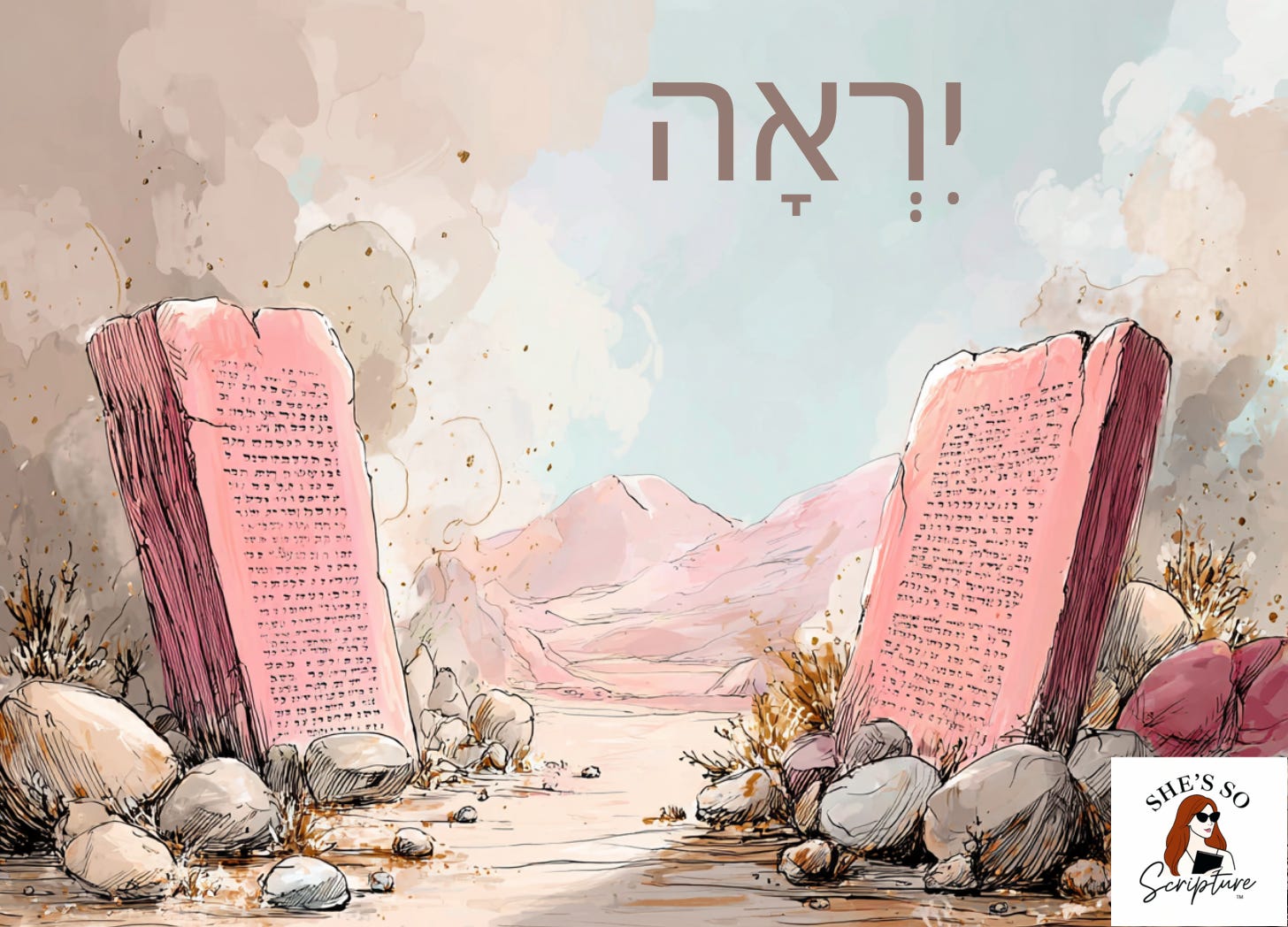
Pronunciation: yee-RAH Meaning: fear, awe, reverence, trembling awareness
Some words get absolutely flattened in translation, and yirah is one of the casualties.
When English speakers hear “fear,” we tend to go one of two directions. Either we picture panic, the kind that makes your hands shake and your tummy spin, or we picture something closer to polite respect, the way you might feel toward a boss you’d rather not disappoint.
Scripture’s yirah rejects both of those options. It’s bigger than dread and deeper than courtesy. It’s the kind of thing that makes your knees slightly weak and your posture slightly straighter at the same time.
Yirah is what happens when holiness gets close enough to feel.
And honestly? We don’t talk about it nearly enough.
The Word Itself
The root behind yirah is י־ר־א (y-r-ʾ), and its range is wide. Fear. Reverence. Awe. Trembling. The word shows up in contexts ranging from a child fearing a parent to a nation trembling before a conquering army to a prophet completely undone in the presence of God.
What holds all of those uses together is the idea of recognized weight. Something of enormous magnitude has entered the room, and the appropriate response is not to pretend otherwise.
In Proverbs 9:10, the word appears in its most famous address:
“The fear of Adonai is the beginning of wisdom, and knowledge of the Holy One is understanding.” (TLV)
The construct form used here is יִרְאַת (yirat). Wisdom in Scripture doesn’t begin with information or intellectual achievement. It begins with orientation. Yirah positions you correctly before God before you ever open your mouth to speak or your mind to reason. It establishes proportion. It reminds you, at a level deeper than cognition, who is Creator and who is creature.
That’s the foundation everything else gets built on.
The Moment at Sinai
Exodus 20 gives us one of the most layered and honest uses of this word in all of Torah.
The people have just heard the Ten Words (Commandments) spoken directly from God. The mountain is smoking. There’s thunder and lightning and the sound of a ram’s horn (shofar) growing louder. And the people, understandably, are falling apart.
They back away from the mountain and tell Moses they’d rather he speak to them than God, because they’re afraid that if God keeps speaking, they’ll die.
Honestly? Relatable.
Moses responds with something that sounds almost like a riddle:
“Do not be afraid, for God has come to test you, so that the fear of Him may be before you, so that you may not sin.” (Exodus 20:20, TLV)
Do not be afraid, so that fear may be before you.
Two different things are happening in that sentence, and the Hebrew makes it visible. The first fear, the one Moses tells them to release, is the collapsing, paralyzing dread that makes a person want to run.
The second fear, the one God is cultivating in this very moment, is covenantal yirah. The reverent awareness that steadies rather than scatters. The trembling that doesn’t send you running from God but keeps you turned toward him.
Sinai wasn’t designed to traumatize Israel. It was designed to form them. The thunder and fire and the voice that shook the mountain weren’t God showing off. They were pedagogy (my hubby is a college provost so pedagogy is a word I hear on the daily).
God was teaching his people what it felt like to be in the presence of genuine holiness, so that the memory of that weight would stay with them and shape their choices long after they walked away from the mountain.

Fear and Love Together
One of the places where Western readers often stumble is in thinking that fear and love are opposites, that a more mature faith eventually outgrows yirah and settles into something warmer and more comfortable. Like yirah is the spiritual training wheels you eventually don’t need anymore.
Deuteronomy 10:12 pushes back on that directly:
“Now, Israel, what does Adonai your God require of you? Only to fear Adonai your God, to walk in all His ways, to love Him...” (TLV)
Fear and love appear in the same breath, in the same list of requirements, without any suggestion that one supersedes the other.
The Hebrew worldview doesn’t treat awe and affection as competing forces. It treats yirah as the thing that keeps love from becoming casual. Intimacy without reverence drifts toward the familiar. Yirah anchors love so that closeness never loses its sense of wonder.
Psalm 19:9 adds one more dimension worth sitting with:
“The fear of Adonai is clean, enduring forever.” (TLV)
Clean. The Hebrew word there is טָהוֹר (tahor), a word used throughout Torah for ritual purity. Yirah is described in the same terms as something that’s been made fit for God’s presence.
It clarifies perception. It removes the distortion that puts us at the center of the story (spoiler… we are not). And it endures. It’s not a feeling that comes and goes with spiritual seasons. It’s a stable orientation that, once formed in a person, holds.
Vault Members and Founders… keep on scrolling down past my signature for a deeper dive into Yirah and how we can cultivate it!
My Final Thoughts
Yirah isn’t anxiety about punishment. It’s clarity about holiness.
It steadies your voice. It humbles your ego. It sharpens your obedience without suffocating intimacy. And perhaps most importantly, it protects you from the subtle drift that happens when God gradually becomes manageable, familiar in the wrong way, reduced to the size of your preferences and your comfort.
We do that more than we’d like to admit.
If wisdom begins with yirah, then the question worth asking isn’t just whether we have the right theology. It’s whether our theology still has any weight to it. Whether we’ve preserved a sense of the magnitude of the one we’re actually talking about.
Sometimes what we need isn’t more information.
Sometimes we need awe.
If you made it this far, you already know you’re not looking for a quick devotional fix. You want the weight of it. The full picture.
Vault and Founding Members, keep scrolling. We’re going deeper into how yirah was actually cultivated in Israel, not as a feeling to chase but as a practice to build, and what that means for how we read and teach Scripture today.
Not a member yet? The deeper dive, along with extended studies, theological teaching, and a community of women who want depth without pressure or performance, is all waiting for you inside.
If a paid subscription isn’t in the cards right now but this study blessed you, a one-time tip helps keep this work going and I’m genuinely grateful for every gift. 🤍