


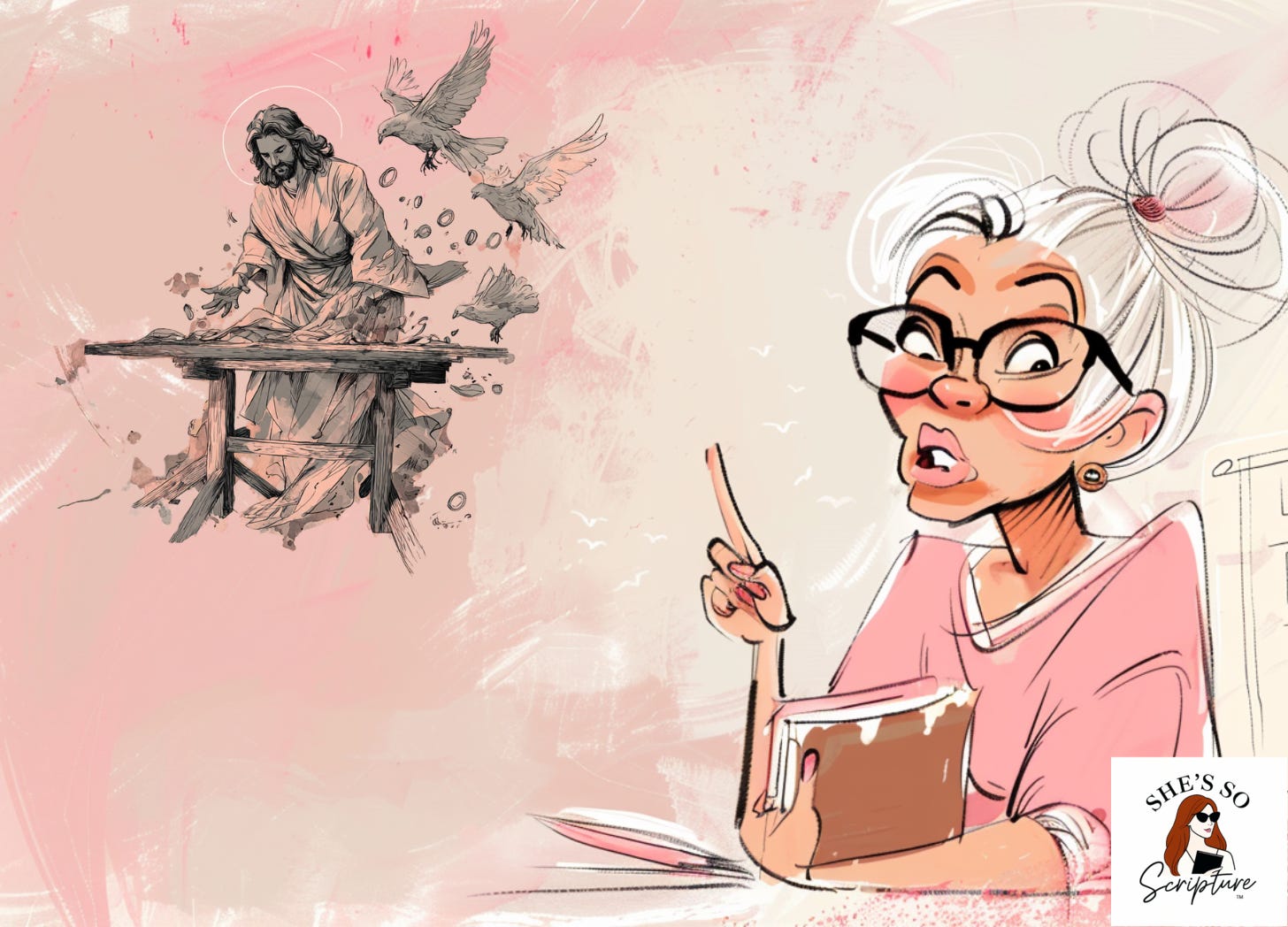
The temple cleansing is one of the most misunderstood moments in the Gospels.
If the only takeaway you ever got from this passage was Miss Patty in Sunday school, Aqua Net helmet firmly in place, telling you that even Jesus flipped tables, and you've been using that to justify every strongly worded email you've ever sent, we need to talk.
Because Yeshua didn’t walk into the temple and have an outburst. He walked into the temple and performed a prophetic act. One that every Jewish person present would have understood as a direct challenge to the temple authorities. One that quoted two specific prophets. And one that essentially sealed His own death warrant.
This wasn’t a tantrum. This was a calculated, theologically loaded confrontation. And He knew exactly what it would cost Him.
“Then Yeshua entered the Temple and drove out all those selling and buying in the Temple. He overturned the tables of the moneychangers and the seats of those selling doves. And He said to them, ‘It is written, “My house shall be called a house of prayer,” but you are making it “a den of thieves”!’” Matthew 21:12–13 (TLV)
What Was Actually Happening in the Temple
First, we need to understand what Yeshua walked into, because it wasn’t an open-air flea market that randomly popped up in the wrong location.
The buying and selling in the temple courts served a real function. Pilgrims traveling long distances to Jerusalem for Passover couldn’t always bring their own sacrificial animals. So merchants sold the approved animals on site. Moneychangers were there because the temple tax had to be paid in a specific currency, the Tyrian shekel, which had a higher silver content than Roman coins. On paper, these services helped people worship.
So what was the problem?
The problem was WHERE it was happening and who was profiting from it.
These operations were set up in the Court of the Gentiles, the outermost court of the temple, the only area where non-Jewish people were permitted to come and pray. The one space designated for the nations to draw near to the God of Israel had been converted into a marketplace.
If you were a Gentile who traveled to Jerusalem because you’d heard about the God of Israel and wanted to seek Him, you’d arrive at the temple and find a livestock auction where your prayer space was supposed to be.
And the profits from this entire operation were controlled by the family of the high priest. The Sadducean aristocracy ran the temple commerce. This wasn’t a grassroots market that got out of hand. This was an institutional system that enriched the priestly elite at the expense of both the poor who were being overcharged and the Gentiles whose access to God was being literally and physically blocked.
Yeshua walked into that and started flipping those tables. And He knew exactly what He was doing.
Verse Mapping Aid
When Yeshua speaks during this moment, He quotes two Hebrew prophets, and the combination is devastating.
The first quote, “My house shall be called a house of prayer,” comes from Isaiah 56:7. But the full verse reads:
“My house shall be called a house of prayer for all peoples.”
This is the part most of us miss. For all peoples. For the nations. The part that gets cut off in most sermons is the part that explains WHY Yeshua is angry. The Court of the Gentiles was supposed to be the fulfillment of that Isaiah vision, the place where the nations could come. And it had been turned into a shopping center.
The second quote, “den of thieves,” comes from Jeremiah 7:11, which is part of Jeremiah’s temple sermon. And if you know that sermon, you know this reference is a metaphorical grenade with the pin pulled.
In Jeremiah 7, God speaks through the prophet to confront Israel for treating the temple like a talisman. The people commit injustice, oppress the vulnerable, worship other gods, and then walk into the temple and say “We are safe.”
The temple had become a hideout for people who thought its presence guaranteed God’s protection regardless of their behavior. God’s response through Jeremiah was to warn that He would destroy the temple the way He destroyed Shiloh.
So when Yeshua quotes Jeremiah 7 inside the temple courts, He’s not just calling the merchants thieves. Again, those merchants being at the temple itself was not the problem. He’s invoking an entire prophetic tradition of temple judgment. He’s saying this institution has become what it was before God destroyed it the first time. Every Torah-literate person in that courtyard would have felt the ground shift under their feet.
Why This Matters More Than “Righteous Anger”
Yeshua’s action in the temple is what the prophets of Israel did. Jeremiah smashed a clay jar. Ezekiel lay on his side for over a year (and I can’t even make it through one night!). Isaiah walked around barefoot and barely clothed for three years.
Prophetic acts weren’t emotional outbursts, they were embodied messages. They communicated through action what words alone couldn’t convey.
Yeshua overturning the tables is a prophetic sign act. He’s enacting judgment on a system that has corrupted the very purpose of the temple. And He’s doing it during Passover week, when Jerusalem is packed with pilgrims, when the temple is at its most visible and its most profitable.
The timing is deliberate. The location is deliberate. The Scripture quotations are deliberate.
And the response from the authorities confirms it. Matthew tells us that immediately after this, the blind and the lame came to Him in the temple and He healed them. The very people the system had marginalized were now being restored in the space that was supposed to serve them.
And the ruling kohanim and Torah scholars became indignant. But not at the corruption… at the healing. At the children crying out “Hoshia-na to Ben-David.” At the fact that Yeshua was acting with authority in their building.
That tells you everything about what was really at stake. This was never about merchandise. This was about who had authority over the house of God and what that house was supposed to be for.
The Cost
Here’s the part that often gets skipped in the retelling.
This act is what triggered the final plot to kill Him.
In Mark’s account, which gives us a slightly different timeline, the temple cleansing happens and then immediately the text says the chief priests and scribes began seeking a way to destroy Him (Mark 11:18).
This single act of prophetic confrontation was the tipping point. The temple authorities could tolerate a popular teacher. They could not tolerate someone who challenged their institutional power, their revenue stream, and their theological legitimacy in front of the entire Passover crowd.
Yeshua knew that. He did it anyway. That’s not a man losing his temper. That’s a man walking deliberately into the confrontation that would end His earthly life because the prophetic word demanded it.
My Final Thoughts
The temple cleansing is not a story about anger management or righteous indignation.
It’s a story about a prophetic confrontation with an institution that had lost its purpose. The temple was supposed to be a house of prayer for ALL nations, and it had become a profit center for the powerful. The people who needed access to God the most, the Gentiles, the poor, the blind, the lame, were the ones being squeezed out.
Yeshua didn’t flip tables because He couldn’t control Himself. He flipped tables because the system was broken and the people in charge had no intention of fixing it. And He quoted the prophets while He did it so that everyone watching would understand exactly what this was.
Sometimes the most loving thing you can do is overturn what shouldn’t be standing.
And sometimes that costs you everything.
Bible Study Questions
How does understanding the Court of the Gentiles as the location of the temple commerce change the way you read this passage?
What is the significance of Yeshua quoting both Isaiah 56:7 and Jeremiah 7:11 together during this confrontation?
How does Jeremiah’s temple sermon (Jeremiah 7) provide context for what Yeshua is declaring about the temple’s condition?
What does it reveal that the blind and the lame came to Yeshua for healing in the temple immediately after the cleansing?
How does the prophetic sign act tradition of Israel’s prophets reshape your understanding of what Yeshua is doing in this scene?
Reflection Questions
Where have you seen institutions or systems that were meant to bring people closer to God become barriers instead?
How does knowing that this act cost Yeshua His life change the way you think about confronting injustice?
What would it look like for the spaces you worship in to truly be “a house of prayer for all peoples”?
Where in your own faith community have the most vulnerable people been quietly squeezed out, and what would it look like to notice that?
Action Challenges
Read Matthew 21:12–17, Mark 11:15–19, and John 2:13–17 side by side and note the differences in detail and timing across the accounts.
Study Isaiah 56:1–8 and Jeremiah 7:1–15 in full and sit with the prophetic tradition Yeshua is invoking in this moment.
Pay attention this week to who has easy access to your faith community and who doesn’t. Consider what barriers might exist that you’ve never noticed.
Reflect on one area of your spiritual life where something functional has quietly replaced something formational, and ask God what needs to be overturned.
If this study stirred something in you, share it with a friend who’s been quoting “even Jesus flipped tables” as a personality trait and needs to hear what He was actually doing.
And if it left you wanting to go slower and deeper into the Word, I’ve got you!
Paid subscribers get access to live Bible studies, extended studies, devotionals, theological teaching, spiritual formation practices, and a community of women who want depth without pressure or performance.
If you’re ready to step further into the Word, you’re welcome inside.
If a paid subscription isn’t feasible right now but this space has blessed you, you can leave a one-time tip here. Every gift helps sustain this work. 🤍
About the Author
Diane Ferreira is a Jewish believer in Yeshua, a published author, speaker, seminary student, wife, and proud mom. She is the founder of She’s So Scripture and She Opens Her Bible. She is the author of several books, including The Proverbs 31-ish Woman, which debuted as Amazon’s #1 New Release in Religious Humor, as well as Holy, Hormonal and Holding On.
She is currently pursuing her graduate degree in Jewish Studies in seminary, with her favorite topics being the early church and Biblical Hebrew. Diane writes and teaches from a unique perspective, bridging her Jewish heritage with vibrant faith in the Messiah to bring clarity, depth, and devotion to everyday believers.
When she’s not writing, studying, or teaching, you’ll find her curled up with a good book, crocheting something cozy, or playing her favorite video games.
Thank you so much for all of the lessons you write and I have saved. I’m 70 years old and I teach a Sunday School class of elderly women, many in their 80’s and mostly widows who have been in church all their lives . I’ve used several of your lessons and we are all simply amazed at the things “we thought we knew”. If only for us…keep writing. ❤️
Sometimes the most loving thing you can do is overturn what shouldn’t be standing.
And sometimes that costs you everything. Powerful!