


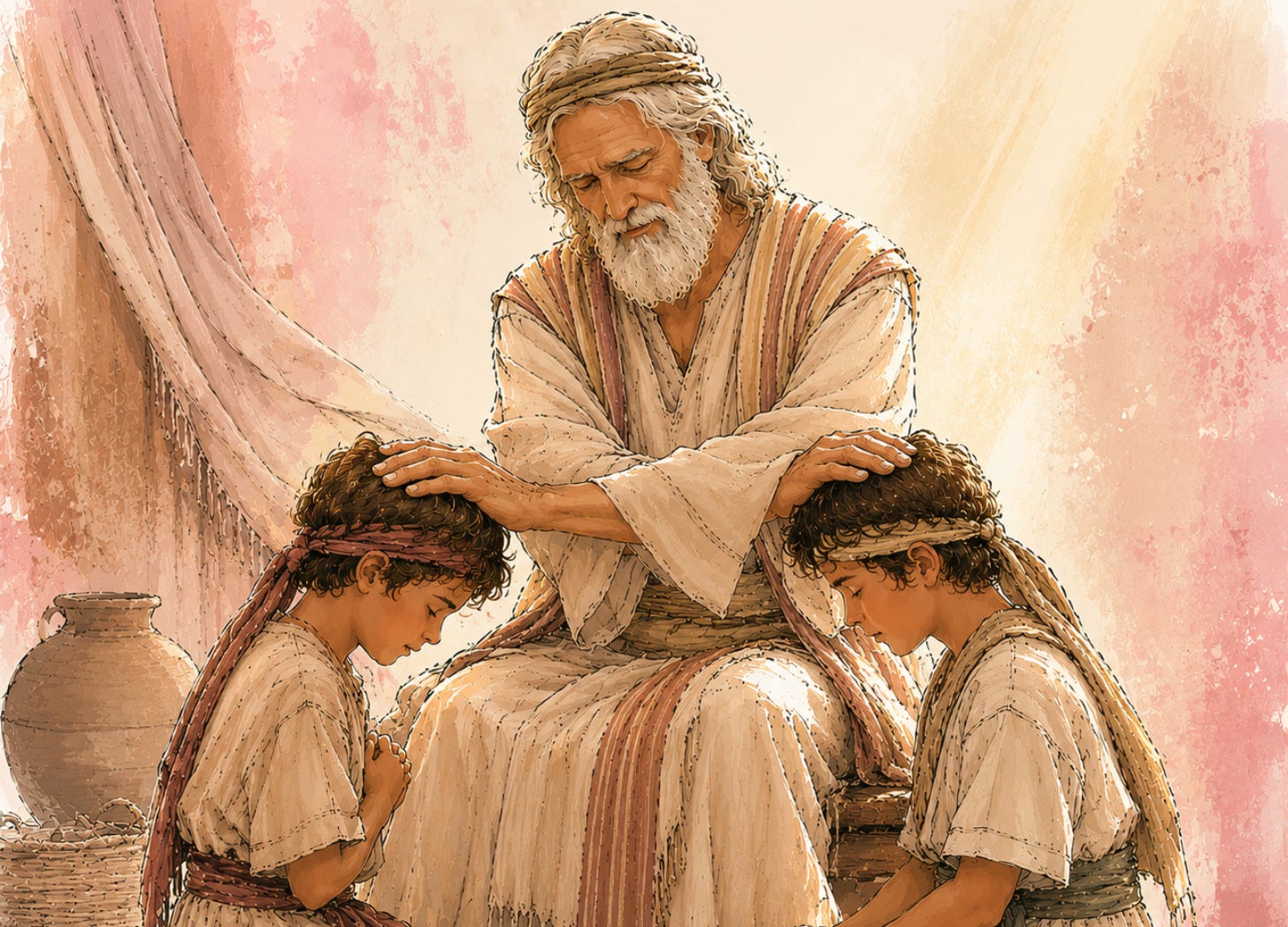
God has a problem with birth order. Nah… maybe we do.
You’d think that after the first time He scrambled the succession line, someone in the patriarchal family tree would’ve caught on. But no. It happens again. And again. And again. By the time you’re deep into Genesis, you start to realize this isn’t a series of divine accidents. It’s a pattern. A deliberate, theologically loaded pattern that tells you something essential about the God of Israel.
He keeps choosing the younger one.
Ishmael was Abraham’s firstborn. Isaac carried the covenant anyway. Esau came out of the womb first, red and hairy, holding every legal right primogeniture offered. Jacob received the blessing. Joseph’s sons stood before a dying Jacob in birth order so the right hand would land on the right head. Jacob crossed his arms on purpose. Younger Ephraim received the stronger blessing. And Reuben, Jacob’s actual firstborn? First Chronicles 5:1 tells us the birthright passed to Joseph’s line because of Reuben’s failure.
What Primogeniture Actually Meant
Before we can appreciate what God keeps doing, we have to understand what He keeps undoing.
In the ancient Near Eastern world, the law of the bekhor (בְּכוֹר, beh-KOR) carried enormous significance. The bekhor was the firstborn son, and the word itself comes from the root B-K-R, meaning “early” or “first.” The bekhorah (בְּכוֹרָה, beh-ko-RAH) was the birthright attached to that status, and it was not merely sentimental.
The bekhor received a double portion of the inheritance and was generally expected to assume leadership within the household after the father’s death. In a number of biblical passages, firstborn sons also appear connected to sacrificial or representative responsibilities before the establishment of the Levitical priesthood. The bekhorah was a legal, familial, and spiritual reality.
So when God starts rearranging it, He’s not just tweaking the family seating arrangement at Shabbat dinner. He’s disrupting the assumption that covenant inheritance flows automatically according to human systems of status, strength, or precedence.
And the reason He keeps doing it matters… alot!
Isaac Over Ishmael - The First Reversal
Ishmael was born first. There’s no dispute about that. He was thirteen years old when Isaac was even born. He was circumcised alongside Abraham. He was, in every earthly sense, Abraham’s son.
But God said something to Abraham that changes everything about that position. In Genesis 21:12, He says:
“For through Isaac shall your seed be called.”
Not through the firstborn. Through Isaac. Through the son who wasn’t supposed to exist, born to a woman who literally laughed at the announcement.
Paul picks this up in Romans 9 and makes the theological point clear. The covenant line unfolds according to God’s promise and calling, not merely according to human expectation or natural inheritance.
That doesn’t mean Ishmael was rejected or abandoned. Scripture goes out of its way to show the opposite. God heard him in the wilderness. God blessed him. God made him into a great nation. The choice of Isaac was not the erasure of Ishmael. It was the continuation of a particular covenant line through which blessing would come to the world.
Not because Isaac earned it. Not because Ishmael failed.
But because God chose.
Jacob Over Esau: The Reversal Before Birth
The Ishmael situation at least had the appearance of human complication. Sarah insisted. Abraham grieved. The whole thing felt messy and painfully human.
But Jacob and Esau remove even that ambiguity.
Before the twins were born, before either of them had done anything good or evil, God told Rebekah:
“The older will serve the younger.” (Genesis 25:23)
Esau had done absolutely nothing wrong. Jacob had done nothing right. Yet the covenant line was already marked out.
Romans 9 walks directly into this tension:
“So that God’s purpose according to His choice might stand, not because of works but because of Him who calls.”
Paul’s point is not that God arbitrarily loves one people and rejects another. Nor is he revoking Israel’s covenant identity. In fact, Romans 9–11 repeatedly insists that God remains faithful to Israel even in the midst of human failure and mystery.
The point is this: divine election is not reduced to human merit or social expectation.
The bekhorah meant you were first. And God kept saying: in My kingdom, first does not mean what you think it means.

Joseph and His Brothers: The Reversal Inside the Reversal
Now we arrive at the reversal nested inside another reversal.
Joseph was not Jacob’s firstborn. Reuben was. But Reuben forfeited his position through catastrophic failure, and First Chronicles 5:1–2 tells us the birthright passed to Joseph’s line.
Fine. The reversal has already happened.
But then Joseph has two sons: Manasseh the firstborn and Ephraim the younger. Joseph brings them before his dying father carefully arranged in birth order. Manasseh stands at Jacob’s right hand so the stronger blessing will land where convention says it belongs.
Then Jacob flips the script and crosses his arms.
“But Israel stretched out his right hand and laid it on Ephraim’s head, though he was the younger.” (Genesis 48:14)
Joseph thinks his father is confused. He reaches out to correct him:
“No, my father, this one is the firstborn.”
And Jacob responds with one of the most understated and powerful lines in Genesis:
“I know, my son, I know.”
He wasn’t confused or making a mistake.
He was doing it on purpose.
Jacob had lived this story before. He knew exactly what the crossed hands meant.
And God keeps crossing them.
The Theological Thread
So what is God actually doing here? Because it’s a fair question and it deserves a real answer.
He’s not abolishing birth order as a concept. He’s not running some ancient campaign against eldest sons. What He’s doing is far more pointed than that. Every time He overturns the firstborn expectation, He’s making the same declaration: the covenant belongs to Him. It moves according to His purposes and His promises, not according to whoever showed up to the party first.
And He has a particular habit of choosing in ways that make human boasting impossible. That’s the whole design.
None of us stand before God because we were the obvious pick. Not the patriarchs. Not Israel. Not the nations grafted in. Nobody in this story earned their way into the covenant line by virtue of position or precedence.
The biblical narrative just keeps coming back to this: God’s grace, God’s faithfulness, and God’s sovereign freedom to call imperfect people into relationship with Himself regardless of where they fell in the birth order of human expectation.
There’s also something deeply, distinctively Jewish in this pattern that I don’t want us to miss. The God of Israel has a long and documented history of working through the unlikely. The barren woman. The younger son. The shepherd nobody thought to invite when Samuel showed up at Jesse’s house. The exile who becomes second in command of an empire.
The overlooked, the passed over, the one everyone else already counted out. Scripture returns to this again and again, not because God has a soft spot for underdogs as a personality quirk, but because it is the clearest possible demonstration that His power operates through divine faithfulness, not human hierarchy.
The firstborn didn’t lose. The covenant just never belonged to birth order in the first place.
The Rabbis Noticed the Pattern Too
Here’s the thing: the rabbis saw this coming long before most of us did. And honestly, good for them, because the rest of us spent centuries acting surprised.
Rabbi David Kasher observed that by the time we arrive at Jacob and Esau, the reader has already been trained to expect the firstborn to lose his place. Abel’s offering is accepted over Cain’s. Isaac carries the covenant instead of Ishmael. The Hebrew root b-k-r, the bekhor pattern, develops what Kasher calls a “pattern of failure” across Genesis.
So when the Torah calls Ishmael Abraham’s bekhor, the attentive reader already suspects he won’t be carrying the covenant forward. The text has basically been clearing its throat and saying “you see what God does here, right?” since chapter four.¹
But here’s where it gets interesting. The rabbis didn’t all agree on why God kept doing this, which should surprise exactly no one, because the rabbis agreed on almost nothing and that’s actually one of the things I love about them.
Some went the moral route. Rashi, who was drawing from earlier tradition, taught that while still in the womb Jacob strained toward houses of Torah study while Esau pulled toward idolatry.² Other traditions paint Ishmael as an idol-worshiper, a man of violence, someone who tried to harm Isaac under the guise of play.
Esau gets a similarly unflattering portrait in the midrashim.³ In that reading, the younger son wins because the older one forfeits. God’s choice gets explained, boxed up neatly, and filed away. Problem solved, everyone go home.
Except Rabbi Jonathan Sacks wasn’t buying it.
Sacks pushed back against the tidy explanation and pointed out that the Torah itself never actually calls Ishmael violent or Esau evil. Ishmael “laughed.” That’s it. Esau sold his birthright because he was hungry and impulsive, which, honestly, same.
Sacks argued the Torah portrays the unchosen sons with real sympathy on purpose. Ishmael is heard by God in the wilderness and promised a great nation. Esau’s grief after losing the blessing is raw and it’s right there on the page. The Torah holds divine election and divine compassion in the same frame and doesn’t rush to clean it up for you.⁴
There’s also a midrashic tradition that goes even further in Esau’s defense. One source teaches that Esau actually had a fabulous destiny. He was meant to destroy idolatry and could have stood alongside Jacob as one of the patriarchs. The two of them were supposed to partner in perfecting the world. Esau traded that for soup. Actual soup. And so Jacob had to pick up the whole assignment himself.⁵
Which, if you’ve ever had to cover for someone who bailed on their calling, feels personally offensive in the best possible way.
The rabbis also paid close attention to Jacob’s crossed hands in Genesis 48, because… of course they did.
The medieval commentator Malbim read the gesture symbolically. The right hand represented overt divine power and direct spiritual intervention. The left represented blessing unfolding through ordinary historical means.
Ephraim receives the right hand. Manasseh receives the left. He isn’t rejected, but the younger son gets the greater prominence, and Jacob does it deliberately while his son Joseph is standing right there trying to fix what he thinks is an old man’s mistake.⁶ Jacob’s response to the correction is my favorite four words in this whole narrative (as quoted earlier): “I know, my son, I know.”
He wasn’t confused. He was done explaining himself. He was over it.
One Chasidic tradition adds one more layer worth noting. Jacob never moved the boys themselves during the blessing. Manasseh stayed on the right side physically, which some interpret as a signal that Manasseh still has a role in completing Israel’s glory at the end of days.⁷ The crossed hands weren’t a demotion. They were a different assignment with a different timeline. God wasn’t finished with the firstborn. He just wasn’t starting there. I love that.
The rabbis landed in the same place across centuries of spirited disagreement about the details. Being first doesn’t guarantee being chosen. The God of Israel is not impressed by birth order, family rank, or the title your parents gave you. He sees differently than we do, and Genesis has been making that point with almost aggressive consistency since the very beginning.
Verse Mapping Aid: Bekhor (בְּכוֹר)
The Hebrew word bekhor (בְּכוֹר, beh-KOR) comes from the root B-K-R, carrying the sense of “first” or “early.” It refers specifically to the firstborn son and carried immense legal and covenantal significance in the ancient world.
What’s remarkable is how the title develops across Scripture.
Exodus 4:22 calls Israel God’s firstborn son.
Jeremiah 31:9 calls Ephraim God’s firstborn even though Ephraim was the younger grandson.
And the New Testament applies this language to Yeshua Himself, calling Him the “firstborn of all creation” (Colossians 1:15) and the “firstborn” brought into the world (Hebrews 1:6).
This is not replacement language. Yeshua does not erase Israel’s identity as God’s firstborn people. Rather, the Messiah represents and embodies Israel’s calling and vocation before the nations. The pattern in Genesis was always pointing somewhere.
The one who humbled Himself is exalted and the one who took the servant’s place receives honor.
The crossed hands were never random.
My Final Thoughts
God doesn’t explain Himself every time He crosses His arms. He doesn’t have to.
Jacob crossed his. God has been crossing His from the beginning of the story.
And every time He does, He says the same thing:
The inheritance doesn’t flow merely according to human expectation.
It flows according to divine faithfulness and promise.
That’s either terrifying or deeply comforting, depending on where you’re standing.
If you’ve been relying on position, pedigree, or spiritual seniority, Genesis destabilizes all of it.
But if you’ve ever felt unlikely, overlooked, disqualified, or impossible, the crossed hands of Genesis 48 are for you.
The God who said, “Through Isaac shall your seed be called,” was speaking to a man staring at a ninety-year-old woman and deciding whether to trust God anyway.
The covenant line repeatedly ran through the unexpected ones.
And by God’s grace and mercy, it still does.
Bible Study Questions
In Genesis 25:23, God tells Rebekah about her sons before they’re born. What does this tell us about the relationship between divine foreknowledge and human responsibility?
Paul quotes the Jacob and Esau story in Romans 9 to make a theological argument about divine election. What is the core claim he’s making, and how does the Genesis account support it?
How does the transfer of Reuben’s birthright to Joseph in 1 Chronicles 5:1-2 fit the broader pattern we see throughout Genesis?
When Jacob crosses his arms in Genesis 48, Joseph tries to correct him. What assumptions about blessing and inheritance drove Joseph’s response?
How does the figurative use of “firstborn” in Exodus 4:22 (Israel as God’s firstborn) connect to the physical inversion of primogeniture throughout Genesis?
Reflection Questions
Have you ever assumed God’s favor follows natural order? Where did that expectation come from, and how has Scripture challenged it?
Jacob tells Joseph “I know, my son, I know” when Joseph tries to stop him from crossing his arms. Where in your life might God be saying something similar when you try to correct the unexpected direction He’s moving?
The bekhor was supposed to carry the covenant. But God kept re-routing the line. How does this reshape the way you understand your own role in God’s purposes, especially if you’ve ever felt like you weren’t the obvious choice?
Action Challenges
Read Romans 9:6-18 in full this week. Just sit with the discomfort of it. Write down what it says and what you notice yourself wanting to argue with, and why.
Trace the firstborn inversions through Genesis on your own: Cain and Abel, Ishmael and Isaac, Esau and Jacob, Reuben and Joseph, Manasseh and Ephraim. Write a short reflection on what the cumulative pattern tells you about the character of God.
Identify one area of your life where you’ve been waiting for God to move “in order” and consider that He may already be crossing His arms over something you’re not expecting.
If this study stirred something in you, share it with a friend who has ever felt like they weren’t the obvious choice for what God is asking of them.
And if it left you wanting to go slower and deeper into the Word, I’ve got you! Paid subscribers get access to live Bible studies, extended studies, devotionals, theological teaching, spiritual formation practices, and a community of women who want depth without pressure or performance. If you’re ready to step further into the Word, you’re welcome inside.
👉🏻 Join The Vault.
If a paid subscription isn’t feasible right now but this space has blessed you, you can leave a one-time tip here. Every gift helps sustain this work. 💕

About the Author
Diane Ferreira is a Jewish believer in Yeshua, a published author, speaker, seminary student, wife, and proud mom. She is the founder of She’s So Scripture and She Opens Her Bible. She is the author of several books, including The Proverbs 31-ish Woman, which debuted as Amazon’s #1 New Release in Religious Humor, as well as Holy, Hormonal and Holding On.
She is currently pursuing her graduate degree in Jewish Studies in seminary, with her favorite topics being the early church and Biblical Hebrew. Diane writes and teaches from a unique perspective, bridging her Jewish heritage with vibrant faith in the Messiah to bring clarity, depth, and devotion to everyday believers.
When she’s not writing, studying, or teaching, you’ll find her curled up with a good book, crocheting something cozy, traveling, or playing her favorite video games.
Tree of Life (TLV) – Scripture taken from the Holy Scriptures, Tree of Life Version*. Copyright © 2014,2016 by the Tree of Life Bible Society. Used by permission of the Tree of Life Bible Society.
Footnotes
¹ Rabbi David Kasher, “From Birthright to Blessing,” Hadar Institute.
² Rashi on Genesis 25:22, as cited in classical rabbinic commentary.
³ Rabbi Jonathan Sacks, summarizing classical midrashic tradition in his commentary on the Torah portions of Lech Lecha and Toldot.
⁴ Rabbi Jonathan Sacks, Torah commentary on Toldot.
⁵ Midrashic tradition cited by Aish.com, drawing on aggadic sources.
⁶ Malbim (Rabbi Meir Leibush ben Yehiel Michel Weiser, 19th century) on Genesis 48:14-19.
⁷ Bnei Yissachar, Hasidic commentary, as cited in rabbinic sources on Genesis 48.
Love this! Good reminder not to lead with competency but instead lead with God’s Spirit.
"And the first will be last, and the last will be first".