



Somewhere around age seven I decided Satan was a first name. Like Bob. There was a red guy with horns and a pitchfork, his name was Satan, and he lived in the basement of the universe doing evil full time. Nobody taught me this in so many words. I absorbed it from cartoons, church hallway posters, and one particularly committed Halloween costume.
Then I learned Hebrew, opened Job, and found a definite article sitting in front of his name.
You can’t put “the” in front of a name. Nobody calls me “the Diane.” Although honestly, some days I’ve earned it.
So let’s talk about satan (sah-TAHN), because the word was already doing a job in Scripture long before anybody printed it with a capital S.
A Word Before It Was a Villain
In Hebrew, satan is a common noun. It means adversary, opponent, accuser. There’s even a verb form that means to accuse or oppose.¹ It’s vocabulary, the way “prosecutor” or “opponent” is vocabulary in English.
And Scripture uses it that way for ordinary people.
In 1 Samuel 29:4, the Philistine commanders refuse to let David march with them into battle because they’re afraid he’ll turn on them halfway through the fight and become a satan to them.
In 1 Kings 11, God raises up Hadad the Edomite and Rezon son of Eliada as adversaries against Solomon.
The Hebrew word behind “adversary” in those verses is satan, both times. Two flesh-and-blood men, doing adversary work.
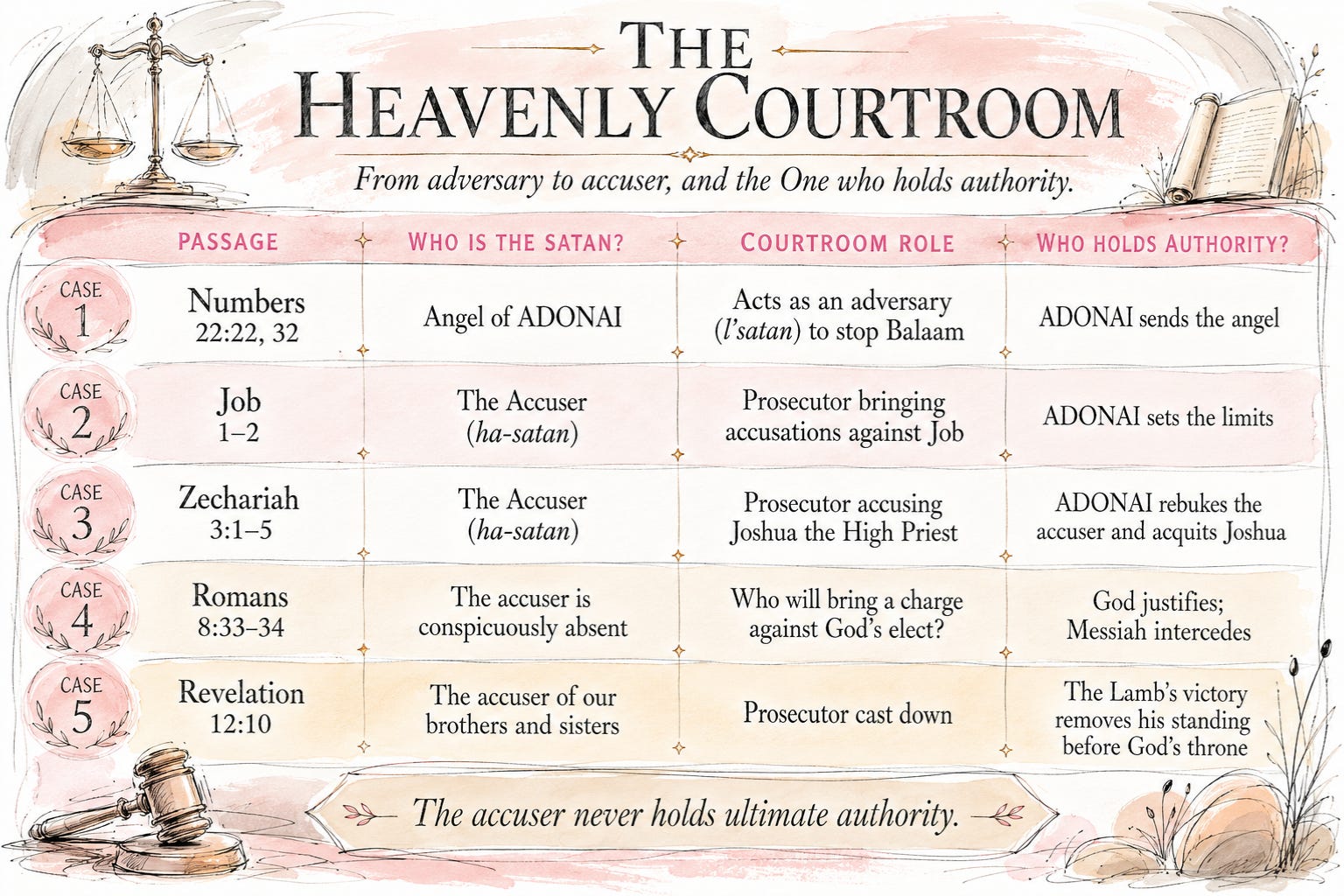
Then there’s the verse in Numbers 22. Balaam is riding his donkey toward a paycheck he was told not to collect, and the angel of the LORD blocks the road. When Balaam’s eyes are finally opened, the angel explains His mission:
“Why have you beaten your donkey these three times? Behold, I came as an adversary because your way before Me is a reckless one!” (Numbers 22:32, TLV)
“As an adversary” translates the Hebrew l’satan. The angel of the LORD, standing in the road with a drawn sword, describes His own assignment with the word satan. The word names the role the angel is filling on that road, an assignment with a start and an end.
I sat there with my Hebrew dictionary open for a hot minute on that one.
So before we ever meet a specific figure, the word already has a résumé.
The word existed before the villain did.
By the time Job opens, satan has already covered a Philistine commander’s worst-case scenario, two men nursing grudges against Solomon, and an angel standing in a road on assignment from God Himself.
The Accuser Checks In
Now Job. The TLV translated this passage with its Hebrew showing, and I am here for it!
“One day the sons of God came to present themselves before Adonai, and the satan also came with them. Adonai said to the satan, ‘Where have you come from?’ The satan responded to Adonai and said, ‘From roaming the earth and from walking on it.’” (Job 1:6-7, TLV)
The satan. Lowercase, with the article, exactly as the Hebrew has it: hasatan (hah-sah-TAHN), the ha being Hebrew’s word for “the.”
In normal Biblical Hebrew, the definite article is not used with personal names.² You will never read about “the Moses” or “the Abraham.” When a Hebrew noun has the article, it’s functioning as a title or a role. The king. The priest. The accuser.
Which means the figure in Job is being identified by his job description and not his name. He shows up when the sons of God present themselves before the LORD, like a staff meeting he’s required to attend that he thinks could have been an email.
He answers questions when asked. And when he wants to touch Job’s life, he has to make his case and receive permission, with limits attached:
“Everything he has is in your hand. Only do not extend your hand against him!”
(Job 1:12, TLV)
The scene reads like a courtroom because it IS one. The accuser brings charges, the Judge sets the terms, and the accuser operates inside those terms, and not an inch beyond them.
My seven-year-old theology had invented some rival god running the basement of the universe. Job handed me a prosecutor on a very tight leash.

Standing at His Right Hand
Zechariah gives us the same courtroom, about a thousand years of history later.
“Then he showed me Joshua the kohen gadol standing before the angel of Adonai and the satan, standing at his right hand to accuse him. Adonai said to the satan, ‘Adonai rebukes you, the satan. Indeed Adonai, who has chosen Jerusalem, rebukes you. Is not this man a brand plucked out of the fire?’” (Zechariah 3:1-2, TLV)
There’s the article again. And he’s standing in a particular spot. The right hand was the accuser’s position in an ancient legal proceeding; Psalm 109:6 uses the same picture, an accuser stationed at a defendant’s right side. Joshua the high priest is on trial, standing there in filthy garments, and hasatan is right where a prosecutor belongs.
But the accusation never even gets read into the record. The LORD interrupts, rebukes the accuser, and orders clean garments for the defendant. The charges may have been technically accurate. Joshua’s garments really were filthy. It didn’t matter. The Judge had already chosen mercy.
That’s the accuser’s whole tragedy, honestly. He can be right about the facts and still lose the case. I love that for him.
The One Verse Without the Article
Now for the wrinkle!
“Then satan stood up against Israel and incited David to count Israel.”
(1 Chronicles 21:1, TLV)
No article this time. In the Hebrew, it’s just satan, bare. And that opens a genuine question scholars STILL argue about.
Many modern interpreters read this as the first place where Satan functions as a proper name.³ Others argue it should be read the way 1 Kings 11 reads, as “an adversary” stood up against Israel, possibly even a human one.
It is important to point out that Hebrew does not have an indefinite article. Since satan in this verse is lowercase, it could be either ‘adversary’, or ‘an adversary’. Hebrew also has no capital letters like English, so there is no reason to assume this is a proper name, in my humble opinion.
The parallel account in 2 Samuel 24:1 complicates it further, because there the text says the anger of the LORD incited David to take the census. Same event, two inspired angles, and the Chronicler chose the word satan for his telling. What exactly he meant by it, the text doesn’t stop to explain.
I have my leanings. But I’d rather give you a live question than a manufactured answer.
From Hebrew Courtroom to Greek Slanderer
When Jewish translators translated the Scriptures into Greek a couple of centuries before Yeshua, they translated hasatan in Job and Zechariah as ho diabolos, slanderer or accuser.⁴ That Greek word makes its way right into your New Covenant as “the devil.” So even your English word “devil” is carrying the old courtroom language in its briefcase. A diabolos is someone who hurls accusations.
By the first century, many streams of Jewish thought had developed a fuller picture of this figure, and the Apostolic Writings speak of him with real personal force. Yeshua calls him a liar and a murderer. Peter says he prowls like a lion. And when Revelation 12 announces his defeat, it grabs ahold of the oldest job title in his file: the accuser of the brothers and sisters, thrown down.
The TLV, by the way, keeps satan lowercase all the way through the New Covenant books. If you have the TLV, flip to Matthew 16:23 and look. Or you can have a look here on Bible Gateway.
That’s a translation decision, and I think it’s a calculated one. Every time you read it, the text is there to remind you that this figure is defined by what he does. He accuses. It’s the entire job. That is it.
And Revelation announces that the prosecutor has been disbarred from heaven’s courtroom. A disbarred lawyer can still stand in the parking lot yelling about your case. He just can’t approach the bench.
Verse Mapping Aid
The word: satan (שָׂטָן), pronounced sah-TAHN. With the definite article: hasatan (הַשָּׂטָן), “the adversary” or “the accuser.”
Root meaning: To oppose, to accuse, to act as adversary.¹
Used of humans: David (1 Samuel 29:4), Hadad and Rezon (1 Kings 11:14, 23).
Used of the angel of ADONAI: Numbers 22:22, 32 (”as an adversary,” l’satan).
With the article (a title, a role): Job 1-2; Zechariah 3.
Without the article (the debated verse): 1 Chronicles 21:1.
Greek trail: The Septuagint renders it ho diabolos, “slanderer or accuser,” which becomes “the devil” in English New Testaments. The Greek ho satanas transliterates the Hebrew directly.
My Final Thoughts
Studying this word did something I didn’t expect. It shrank him.
The picture I inherited from cartoons and hallway posters as a kid was practically God’s opposite, a dark power running his own kingdom on equal footing. It was like God was the good God and Satan was the bad god. I thought they were equal in power.
The figure in Scripture attends meetings he didn’t call, answers questions he didn’t ask, and files requests he can’t grant himself. He needs permission in Job. In Zechariah he barely gets a sentence out before the rebuke. The Hebrew Bible first introduces him by a job title, and Revelation announces the accuser has been thrown down.
I still take him seriously. Scripture does, and so do I. An accuser can do real damage, especially when the accused doesn’t know the verdict is already in.
The rival god is gone, though. What’s left in my head is a disbarred prosecutor who lost, still shouting objections at a Judge who has stopped listening, about defendants already vindicated.
You think somebody should tell him? Actually, Zechariah already did.
Dig Deeper
Read Job 1-2 and Zechariah 3:1-5 side by side this week and circle every action hasatan takes in each scene, then circle every action the LORD takes. Notice who initiates and who responds. Then read Romans 8:33-34 and ask where the accuser has gone in Paul’s courtroom, and who is standing at the right hand now.
If you’re journaling, write out the accusations you replay against yourself most often, and next to each one, write what the Judge has actually said. Zechariah 3:4 is a good place to borrow His words.
Let’s Talk in the Comments
Where did your childhood picture of Satan actually come from? Scripture, tradition, or a Halloween costume like mine?
Does knowing hasatan is a title rather than a first name change how you read Job’s opening chapters?
What do you make of 1 Chronicles 21:1 next to 2 Samuel 24:1? I’d genuinely love to hear where you land.
If this study stirred something in you, share it with a friend who still pictures the red suit and the pitchfork, or pictures an evil god with equal power. She deserves the courtroom.
And if it left you wanting to go slower and deeper into the Word, I’ve got you! Paid subscribers get access to live Bible studies, extended studies, devotionals, theological teaching, spiritual formation practices, and a community of people who want depth without pressure or performance. If you’re ready to step further into the Word, you’re welcome inside.
If a paid subscription isn’t feasible right now but this space has blessed you, you can leave a one-time tip here. Every gift helps sustain this work. 💕

About the Author
Diane Ferreira is a Jewish believer in Yeshua, a published author, speaker, seminary student, wife, and proud mom. She is the founder of She’s So Scripture and She Opens Her Bible. She is the author of several books, including The Proverbs 31-ish Woman, which debuted as Amazon’s #1 New Release in Religious Humor, as well as Holy, Hormonal and Holding On.
She is currently pursuing her graduate degree in Jewish Studies in seminary, with her favorite topics being the early church and Biblical Hebrew. Diane writes and teaches from a unique perspective, bridging her Jewish heritage with vibrant faith in the Messiah to bring clarity, depth, and devotion to everyday believers.
When she’s not writing, studying, or teaching, you’ll find her curled up with a good book, crocheting something cozy, traveling, or playing her favorite video games.
Notes
Brown, Driver, Briggs, A Hebrew and English Lexicon of the Old Testament, s.v. שָׂטָן and שָׂטַן. BDB defines the noun as “adversary” and the verb as “be or act as adversary,” and distinguishes the ordinary adversary uses from הַשָּׂטָן in Job and Zechariah.
Gesenius, Hebrew Grammar, §126; cf. BDB, s.v. הַ. In normal Biblical Hebrew, true personal proper names are inherently definite and do not ordinarily take the definite article. BDB specifically contrasts הַשָּׂטָן, “the Adversary,” with bare שָׂטָן in 1 Chronicles 21:1.
Sara Japhet, I & II Chronicles: A Commentary, Old Testament Library (Louisville: Westminster John Knox, 1993), 374–75. Japhet argues that שָׂטָן in 1 Chronicles 21:1 should be understood as “an adversary” rather than automatically as the proper name Satan. See also the NET Bible note on 1 Chronicles 21:1, which summarizes and cites her argument.
The Septuagint renders הַשָּׂטָן in Job and Zechariah with ὁ διάβολος, “the slanderer” or “the accuser.” See, e.g., Job 1:6 LXX; cf. BDB, s.v. שָׂטָן.
Tree of Life (TLV) – Scripture taken from the Holy Scriptures, Tree of Life Version*. Copyright © 2014,2016 by the Tree of Life Bible Society. Used by permission of the Tree of Life Bible Society.
A beautiful reminder as this popped up in my email on this glorious Wednesday. Of just how small the accuser is compared to God!!
Thank you so much for this study. I love the picture of “the accuser” standing in the parking lot yelling at the Judge who has stopped listening. I need to be like the Judge.💕