


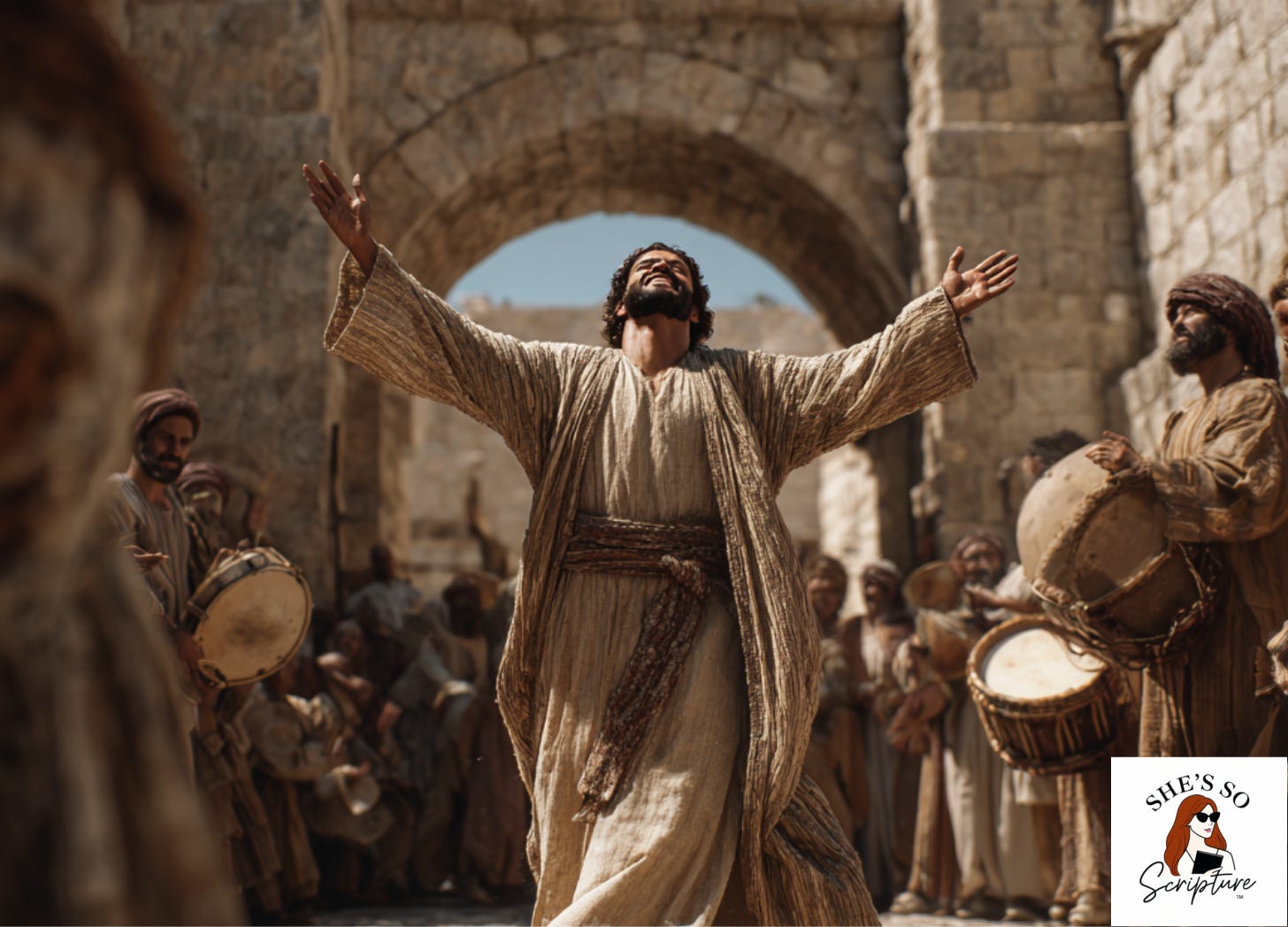
Seven days. Seven days of preparation, consecration, and waiting. Aaron and his sons had done everything right. They followed every instruction, completed every ritual, stayed in the Tent of Meeting for the entire ordination period without leaving. They didn’t rush it. They didn’t improvise. And on the eighth day, Moses summoned them to begin.
Then it happened. Aaron lifted his hands toward the people, blessed them, and fire came out from before the Lord and consumed the burnt offering and the fat on the altar. All the people saw it. They shouted and fell on their faces.
The glory of God had come home to Israel.
And then two of Aaron’s sons did something unauthorized, and everything changed.
Parashat Shemini holds two things in the same hand: the breathtaking arrival of God’s glory and the terrifying weight of His holiness. It doesn’t flinch from either. If you came here looking for a comfortable week in the Word, I need you to know upfront that this portion is not that. But if you actually want to understand what it means to live in the presence of a holy God, you’re in the right place.
You can download a printable version of this portion at the end of the post.
Word Study: Eish Zarah (Strange Fire)
Hebrew: אֵשׁ זָרָה (eish zarah)
Pronunciation: aysh ZAH-rah
The word eish means fire. You’ll recognize it from Leviticus 9, where the fire of God came out and consumed the offering on the altar, the same fire the people saw and fell on their faces before. That was eish, holy fire, fire authorized and initiated by God Himself.
Zarah comes from the root zar, meaning strange, foreign, or unauthorized. In Leviticus 22:13, the same root describes someone who is an outsider, not in their proper place. The phrase carries the sense of something displaced, out of its rightful context, something that doesn’t belong where it’s being offered.
Here’s what’s significant: eish zarah appears in the Hebrew Bible only in connection with Nadab and Abihu. This wasn’t a category that needed to exist before that moment. There is authorized fire and there is this. Fire that was never commanded, never invited, never asked for. Not necessarily malicious fire. Just fire that was never God’s to begin with. And I want you to sit with that, because it’s going to keep coming up.
Leviticus 10:1-3 (TLV):
“Now Aaron’s sons Nadab and Abihu each took his own fire pan, put fire in it, and laid incense on top. Then they offered strange fire before Adonai, which He had not commanded them. Fire came out from the presence of Adonai and consumed them, so they died before Adonai. Then Moses said to Aaron, ‘This is what Adonai spoke of, saying: Through those who come near Me, I will be sanctified, and before all the people I will be glorified.’ So Aaron was silent.”
Three words in Moses’s response stop everything: “Through those who come near Me, I will be sanctified.” The closer you are to God’s presence, the higher the standard. This is the nature of holiness itself. Those who stand nearest the fire have the least margin for carelessness.
Torah: The Eighth Day and What It Cost
The structure of this portion is deliberate. It opens with the most glorious moment Israel had experienced since the crossing of the sea. The tabernacle was complete, the priests were consecrated, and on the eighth day the whole system came online. Aaron followed Moses’s instructions exactly. He made the sin offering, the burnt offering, the grain offering, the peace offerings. He lifted his hands and blessed the people. And then fire came from God and consumed everything on the altar.
All the people saw it and fell on their faces.
This is the moment Israel had been building toward since Exodus 25, when God first told Moses to build a sanctuary so that He could dwell among them. The shekinah, the manifest glory of God, had come to rest among His people. The tabernacle was no longer just an elaborate tent in the desert. It was His house, and He had just moved in.
Then Nadab and Abihu took their censers.
The text doesn’t tell us exactly what motivated them, and that silence is part of the teaching. Were they drunk, as the command about priestly sobriety immediately following suggests? Were they overeager, rushing to add to the holy moment they’d just witnessed? Were they innovating, assuming that God would welcome more fire, more incense, more devotion? The text refuses to pin it down cleanly because the point isn’t specifically about them. The point is about the fire.
They offered fire that God had not commanded. Not fire He had forbidden. That’s an important distinction and I need you to catch it. Just fire He had never asked for.
And that was enough.
Aaron’s response is one of the most haunting phrases in the Torah. The Hebrew says vayidom Aharon, which most translations render as “Aaron was silent.” But the root is closer to stood still, transfixed, unable to move. It’s the same root used in Joshua 10 when Joshua commanded the sun to stand still. Aaron didn’t speak. Aaron couldn’t speak. He just stood there while his two oldest sons were carried out of the sanctuary by their tunics.
Moses told him not to mourn. He told him not to leave the door of the Tent of Meeting. He explained that God’s holiness required this. And Aaron stood still.
I don’t think we give Aaron enough credit for that.
The portion doesn’t leave us there, though. It pivots almost immediately to the dietary laws, the long section on clean and unclean animals in Leviticus 11. The connection isn’t random.
After the deaths of Nadab and Abihu, God’s very next words to Aaron are about distinguishing between holy and common, between clean and unclean. The priests have to teach the people to make these distinctions. The ability to tell the difference matters, and it starts with the one serving in the sanctuary.
There’s a kind of mercy in the structure here. God doesn’t abandon His people after the tragedy. He doesn’t withdraw His presence. He doubles down on the instruction, giving Aaron and his surviving sons, Eleazar and Ithamar, everything they need to serve faithfully. The glory hasn’t left. But the rules for approaching it haven’t changed either.
Haftarah: David Brings the Ark Home
The connection between the Torah portion and the Haftarah is one of the most stunning typological pairings in the entire Jewish lectionary. If you understand Shemini, you understand why 2 Samuel 6 ends up here. And once you see it, you can’t unsee it.
David wants to bring the Ark of the Covenant to Jerusalem. This is a good desire. He wants the presence of God at the center of his capital, at the center of his kingdom. He assembles thirty thousand men, gets a new cart ready, and sets out with celebration and music.
Then the oxen stumble. Uzzah reaches out and steadies the Ark. And God strikes him dead on the spot.
David is furious. Then he’s afraid. He calls the place Perez-Uzzah, “the outburst against Uzzah.” He leaves the Ark at the house of Obed-edom and goes home. Three months later, when he hears that Obed-edom’s household has been blessed because of the Ark’s presence, David tries again, but this time he does it right. The priests carry the Ark on their shoulders using the poles, exactly as God had commanded Moses. Every six steps, they stop and sacrifice.
Every. Six. Steps.
David dances before the Lord with everything he has, wearing a linen ephod, stripped of his royal garments. The Ark comes into Jerusalem with shouting and the sound of the shofar.
The parallel to Shemini is precise. In both texts, a holy moment of God’s dwelling presence is being established. In both texts, someone approaches the holy with unauthorized means. In both texts, there is immediate death. And in both texts, the community is left shaken, rethinking how they approach a God whose holiness is not negotiable.
Uzzah had grown up with the Ark in his father’s house. He had been around it for decades. And familiarity, combined with good intentions, wasn’t enough to make his touch acceptable. Scholar Michael Fishbane, commenting on this haftarah connection, notes that the symmetry is the point: the parashah first celebrates the dedication of the tabernacle and then records the deaths of Nadab and Abihu. Correspondingly, the haftarah celebrates the transport of the Ark and then records the death of Uzzah.
The same lesson, centuries apart. God’s presence is not domesticated by proximity. Write that down somewhere.
But notice what happens after. David doesn’t give up. He learns. He adjusts. He brings the Ark in the way God actually commanded, and the whole city celebrates. Awe doesn’t have to be the end of the story. It can be the beginning of getting it right.
Besorah: The Son Pays the Father’s Tax
The Besorah assigned here covers two incidents in Matthew 17: the healing of the demon-possessed boy and the temple tax. On the surface these seem like totally separate stories. But read them together through the lens of Shemini and something interesting emerges.
After the Transfiguration, Yeshua comes down the mountain and finds a crowd, a desperate father, and a boy no one could help. The disciples had tried and failed to cast out the demon. Yeshua heals the boy, and when the disciples ask privately why they couldn’t do it, He says something direct: “Because of your little faith.”
Small faith, in Yeshua’s framework, isn’t an insult. It’s a diagnosis. The disciples had been given authority. They’d been commissioned. But they had approached the situation without the kind of radical dependence on God that would have opened the way for the miracle. They were trying to perform the task without the source of the power. Sound familiar?
The connection to Shemini here is subtle but real. Nadab and Abihu brought fire. The disciples brought authority. But fire borrowed from the wrong source, and authority exercised from the wrong foundation, both come up short before the holiness of God.
Then comes the temple tax moment, and this one is richer than most people realize. Stick with me.
The collectors ask Peter if Yeshua pays the temple tax. When Peter goes inside, Yeshua asks him a question first: do kings collect taxes from their sons or from strangers? From strangers, Peter answers. Then the sons are free, Yeshua says.
The half-shekel temple tax has its origin in Exodus 30, where God commanded it as a ransom for each person’s life during the census. It was not a tribute to a king. It was an atonement payment, a recognition that every life belongs to God. Yeshua is pointing Peter to the obvious truth: the Son of the King doesn’t pay the King’s household tax. He is the King’s Son. He is the one the temple was built to point toward.
And yet He pays it anyway. He sends Peter to catch a fish with a coin in its mouth, exactly enough for both of them. He pays not because He has to, but so that He doesn’t become a stumbling block to people who don’t yet understand who He is.
There’s a pattern in this that echoes all the way back to Leviticus 9. God’s glory comes near, and how we approach it, how we handle it, and who we understand ourselves to be in relation to it, all of that matters. The Son knows exactly who He is in relation to the temple. And because He knows, He can choose to submit without losing anything. That’s a kind of authority most of us are still growing into.

Thematic Threads
The Eighth Day and New Beginnings. Shemini means eighth. In Hebrew thought, seven is the number of completion. Eight is the number of what comes after completion, new covenant, new era, new beginning. The eighth day of Aaron’s ordination was the beginning of the priestly ministry. Yeshua’s resurrection on the first day of the week was also the eighth day of the week in a sense, the day after the Sabbath, the day of new creation beginning. The presence of God breaking into the world with power is always an eighth-day moment.
The Symmetry of Judgment. Nadab and Abihu in Leviticus 10, Uzzah in 2 Samuel 6. Both approached something holy without the authorization God had given. Both died instantly. The pattern isn’t about cruelty. It’s about the moment when God’s dwelling presence is being newly established among His people. Those threshold moments carry the highest standard because the entire community is watching how God is to be approached. The severity of the response is proportional to the gravity of the occasion.
Holiness Is Not Tamed by Familiarity. Uzzah had grown up with the Ark. The priests had served for seven days in the sanctuary. Familiarity didn’t exempt anyone. If anything, it increased the responsibility. The portion invites us to ask where we’ve grown too comfortable with the things of God, treating His presence like something ordinary because we’ve been around it our whole lives.
The Glory That Stays. Despite the deaths of Nadab and Abihu, the shekinah didn’t leave. Despite Uzzah’s death, the Ark came to Jerusalem. God’s presence wasn’t withdrawn because of the tragedy. He continued to instruct, to teach, to dwell among His people. The holiness of God is terrifying, but it’s also faithful. He doesn’t abandon His people when they get it wrong. He gives them more instruction.
Faith and Approach. From the disciples’ failed exorcism to the temple tax miracle, Matthew 17 is a chapter about how Yeshua’s people approach the things of God. Are they going through the motions with borrowed authority? Are they treating Yeshua as a reliable miracle worker but missing the deeper reality of who He is? The disciples are still learning. Most of us are too.
My Final Thoughts
What strikes me most about Parashat Shemini is that nobody comes out of this text comfortable, and I think that’s exactly the point.
It opens with the glory of God showing up at a party Israel has been preparing for their entire journey through the desert. Fire from heaven, the people on their faces, the high priest blessing the congregation. And then two verses later, it’s a funeral.
The portion doesn’t moralize excessively about what Nadab and Abihu did wrong. It doesn’t spend chapters explaining their sin. It describes what happened and then gives Aaron the most impossible instruction imaginable: don’t mourn your sons, because what God just did is holy. Stay at the door of the Tent of Meeting. Keep serving.
And Aaron stood still.
I’ve pondered that phrase for a long time. There are moments in life when the holiness of God collides so directly with the pain of being human that there are no words. Aaron had none. He stood at the threshold of glory and grief at the same time, and he didn’t leave his post. He stayed at the door.
That’s not a small thing. That’s faith in its most stripped-down form: no words, no explanation, just staying at the door of the place where God has said He will meet His people, even when everything hurts.
The dietary laws that follow aren’t a tonal shift. They’re a continuation. After God establishes the weight of His holiness, He gives His people practical, embodied instruction for how to live inside it every single day. The holy and the everyday were never meant to be separate categories. What you eat, how you worship, what fire you bring into the sanctuary, all of it is part of the same conversation.
The Haftarah and the Besorah stretch that conversation across centuries. David gets it wrong and then right. The disciples get it wrong and are taught again. None of us get our first approach to God’s holiness perfectly, and Scripture is refreshingly honest about that. But the pattern Scripture gives us is not shame and withdrawal. It’s correction and return. Keep coming back. Come the right way. Come with the fire God has given you, not the fire you invented on your own.
The glory that showed up on the eighth day in Leviticus 9 is the same glory that broke open a tomb on the first day of the week. It’s still here. It’s still holy. And it still invites us near, just on its own terms, not ours.
Hebrew Letter Lesson: Chet (ח)
The Basics
The eighth letter of the Hebrew alphabet is Chet (ח). It makes the guttural “ch” sound, like the ch in Bach or the Scottish loch. It’s a throat sound, a breath forced through a narrow passage. You can’t make the sound of Chet casually. It requires intention from somewhere deep in the chest.
How It’s Written
ח
Chet looks like two vertical lines connected at the top by a horizontal bar, with a small gap or notch where the roof meets the right pillar. It resembles a doorway or a gate with a threshold. That image is not accidental. The letter’s visual form has been connected by Jewish teachers to the concept of passage, the space between one state and another, the place where you cross from the outside into something holy.
Spiritual Meaning
Chet is the letter of life. The Hebrew word for life, chai (חַי), begins with Chet. So does chayim (חַיִּים), the plural form, which is how life is almost always spoken of in Hebrew: lives, not just life, as if a single life contains multitudes. When someone says l’chaim, to life, the toast that opens from this letter is really a prayer: may you be fully alive, may your life be full of lives.
Chet also stands at the beginning of the word chag (חַג), meaning festival or appointed celebration. And it opens the word chanukkah (חֲנֻכָּה), meaning dedication or consecration. Consecration and life and celebration all begin with the same breath, the same deep guttural sound pressed through a narrow threshold.
And here’s what stops you in this portion: Shemini means eighth. And Chet is the eighth letter. The connection is not coincidence. Eight in Hebrew thought is the number of what comes after completion. Seven is the number of the week, the Sabbath, the created order. Eight is the number of the new covenant, the resurrection, the thing God does after the complete pattern has been established. It’s the day beyond the ordinary.
The tabernacle was consecrated through seven days of preparation. On the eighth day, the glory came. The priests began their ministry. Fire descended from heaven. Everything that had been built, all that preparation, all that obedience, all those seven days of waiting, opened into something that had never existed before. Chet is the letter of that threshold.
A Little Nugget
The numerical value of Chet is 8. The word chai, life, has a numerical value of 18 (Chet = 8, Yod = 10). This is why 18 is considered a lucky and significant number in Jewish tradition, and why gifts in multiples of 18 are common at Jewish celebrations. To give chai is to give life. But at its root, that gift of life begins with Chet, with the eighth, with the threshold moment where something new begins. Every time you say l’chaim, you’re standing at an eighth-day door.
Application
Chet invites us into the theology of the eighth day, into the understanding that consecration is not the end of the story but the beginning of something that could not have existed before the preparation was complete. In the week ahead:
Ask yourself what seven-day season you have been in, what period of preparation or faithfulness is coming to completion. What might God be ready to inaugurate on the other side of it?
Sit with the word chai, life. Say it out loud. Let the Chet sound at the front of it come from somewhere deep. Then ask God: where is He calling you into fuller, more consecrated life right now?
Notice the thresholds in your day, the doorways, the moments of transition from ordinary to set-apart. Chet is the letter that says those passages matter. Cross them intentionally.
Want to go deeper into the Hebrew alphabet? The Biblical Hebrew course is available at:
Weekly Practice
This week, sit with Leviticus 10:3. Let Moses’s words to Aaron sink into your understanding: “Through those who come near Me, I will be sanctified, and before all the people I will be glorified.”
Find a place to be still, not silent in the way Aaron’s silence is sometimes translated, not emotionally suppressed or spiritually buttoned up, but truly present at the threshold. Bring what is honestly in front of you to God. Ask Him to show you the difference between the fires you’ve picked up from your own understanding and the fire He has actually given you for this season.
Then write down one area of your life where you need to approach God on His terms rather than your own. Not as a confession of failure but as an act of consecration. The priests didn’t leave the sanctuary after the tragedy. They stayed at their post and kept serving. So can you.
Questions for Study
Bible Study Questions
Leviticus 9:23-24 describes the moment the glory of the Lord appeared and fire consumed the burnt offering. What had Aaron done in the verses leading up to this, and what does the sequence suggest about the relationship between obedience and God’s manifest presence?
The text in Leviticus 10:1 says Nadab and Abihu offered fire “which He had not commanded them.” It doesn’t say “which He had forbidden.” Why does this distinction matter theologically, and what does it teach us about approaching God?
Moses tells Aaron in Leviticus 10:3 that through those who come near God, He will be sanctified. How does this help you understand the severity of what happened to Nadab and Abihu, especially given their closeness to the sanctuary?
Compare the death of Uzzah in 2 Samuel 6:6-7 with the deaths of Nadab and Abihu. What are the structural and theological parallels? What do both stories together teach about proximity to God’s holiness?
In 2 Samuel 6, David’s second attempt to bring the Ark to Jerusalem succeeds because he follows God’s instructions about how the Ark was to be carried. How does this second attempt demonstrate that the lesson from Leviticus 10 was learned?
In Matthew 17:19-20, Yeshua tells His disciples their inability to drive out the demon was due to little faith. Given the backdrop of Shemini, what do you think Yeshua means by “little faith” in the context of approaching spiritual authority?
Reflection Questions
Where in your own worship or spiritual life have you brought “fire that was not commanded,” something you added out of enthusiasm or habit rather than because God asked for it? What did that look like, and what did it cost you?
Aaron stood still after the deaths of his sons. He didn’t run away from the Tent of Meeting, and he didn’t speak. Is there a situation in your life where you are standing at the threshold between grief and calling? What does faithfulness look like there?
The Chet lesson connects the eighth day to consecration and new beginnings. Is there a season of preparation in your life that feels like it has been going on for seven days too long? What would it look like to trust that the eighth day is coming?
The dietary laws in Leviticus 11 come immediately after the tragedy in Leviticus 10, as if God is saying: here is how you live inside holiness every single day. How does the everyday practice of obedience relate to the larger moments of approaching God’s presence?
Action Challenges
Read Leviticus 9:22-10:3 slowly, out loud if possible. Sit with the sequence from the glory appearing to the deaths occurring. Write a one-paragraph response in your journal: What does this passage show you about God that makes you uncomfortable, and what does it show you that makes you trust Him more?
Find one spiritual practice in your life that has become routine without intention. Whether it’s prayer, Scripture reading, worship, or service, do it this week with deliberate attention. Bring it back to God as an offering rather than a habit.
Memorize Leviticus 10:3 in the TLV. “Through those who come near Me, I will be sanctified, and before all the people I will be glorified.” Write it somewhere you’ll see it daily this week and let it recalibrate how you approach your time in the Word.
If this study stirred something in you, share it with a friend who has been wrestling with how to approach God when the familiar feels insufficient.
And if it left you wanting to go slower and deeper into the Word, I’ve got you! Paid subscribers get access to live Bible studies, extended studies, devotionals, theological teaching, spiritual formation practices, and a community of women who want depth without pressure or performance. If you’re ready to step further into the Word, you’re welcome inside.
If a paid subscription isn’t feasible right now but this space has blessed you, you can leave a one-time tip here. Every gift helps sustain this work. 💕
Download the Portion
Download a printable version of this Torah portion along with the study and reflection questions for your study binder!

About the Author
Diane Ferreira is a Jewish believer in Yeshua, a published author, speaker, seminary student, wife, and proud mom. She is the founder of She’s So Scripture and She Opens Her Bible. She is the author of several books, including The Proverbs 31-ish Woman, which debuted as Amazon’s #1 New Release in Religious Humor, as well as Holy, Hormonal and Holding On.
She is currently pursuing her graduate degree in Jewish Studies in seminary, with her favorite topics being the early church and Biblical Hebrew. Diane writes and teaches from a unique perspective, bridging her Jewish heritage with vibrant faith in the Messiah to bring clarity, depth, and devotion to everyday believers.
When she’s not writing, studying, or teaching, you’ll find her curled up with a good book, crocheting something cozy, traveling, or playing her favorite video games.
Tree of Life (TLV) – Scripture taken from the Holy Scriptures, Tree of Life Version*. Copyright © 2014,2016 by the Tree of Life Bible Society. Used by permission of the Tree of Life Bible Society.
I just love word studies like this. It brings Scripture to a whole new level! Thank you for such a detailed journey through some tough terrain!
Wow. It's the word studies that really make this come alive for me. I started considering the implications of the "fire that was not commanded" quite some time ago, but the nuance about Aaron's silence/stillness completely reframes this entire scene for me.
It transforms Aaron's response from simple speechlessness to holding himself in complete obedience and submission to God's will.
Powerful stuff.
But...
Seriously, Diane. Is there anything you're not amazing at?
I looked you up on Amazon music and each song blows me away more than the last one!