


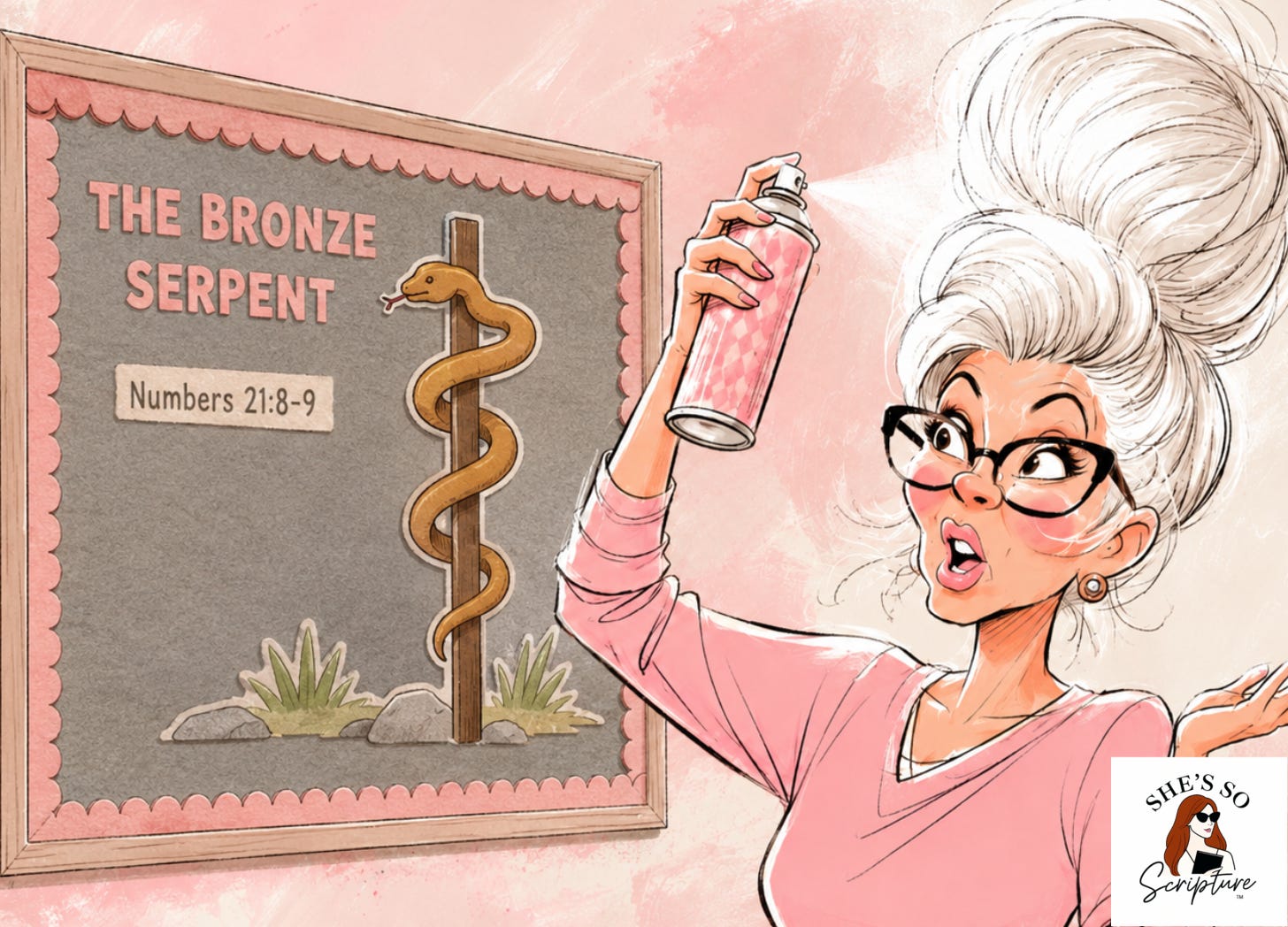
Picture Miss Patty in her Sunday school classroom, perfume cloud holding strong, felt board ready, walking your seven-year-old self through Numbers 21 like it was a morality tale with a weird prop. The Israelites complained. God sent snakes. Moses made a metal snake. People looked at it. They lived. The end. Pass the goldfish crackers.
And honestly, that little summary is technically accurate. But it’s so theologically thin you could read your phone through it. Because tucked inside this strange wilderness story is one of the most fabulous previews of the cross in the entire Old Testament, a warning about how we turn good gifts into idols, and a Hebrew wordplay that Miss Patty absolutely did NOT have time for between snacks and the puppet show.
So grab your coffee. We’re going back to Numbers 21, and we’re bringing the rest of the Bible with us.
The Setup Miss Patty Glossed Over
Numbers 21 picks up with Israel doing what Israel had been doing for forty years now. Kvetching. Complaining. They’re skirting around Edom because Edom won’t let them pass through, and the long way around is, well, long. Hot. Tedious. So kvetch they did:
“Why have you brought us from Egypt to die in the wilderness, because there is no bread, no water, and our very spirits detest the despicable food?” (Numbers 21:5, TLV)
Despicable food. They’re talking about manna. The actual bread that fell from heaven every morning. The miracle they didn’t have to plant, harvest, or pay for. They called it despicable. If that doesn’t preach about how quickly we get bored with grace, I don’t know what does.
Then comes verse six, and this is where it gets serious.
“So Adonai sent poisonous serpents among the people, and they bit the people and many of the people of Israel died.” (Numbers 21:6, TLV)
The Hebrew here calls them nachash saraph, fiery serpents. Saraph is the same root as seraphim, the burning ones who surround the throne of God in Isaiah 6. The word saraph means burning, fiery, scorching.
So whether the bite produced a burning sensation or the snakes themselves had a fiery appearance, the text is doing something deliberate. These are not just any snakes. They’re fiery ones.
And here’s the link you likely weren’t taught. The story echoes the deeper biblical pattern of distrusting God’s provision that began back in Genesis. Israel grumbled against God’s provision in the wilderness the same way humanity distrusted God’s provision in the garden. That old pattern slithers back in like it pays rent.
The Strange Cure
The people repent. They go to Moses. Moses prays. And God’s answer is, frankly, odd.
“Make yourself a fiery snake and put it on a pole. Whenever anyone who has been bitten will look at it, he will live.” (Numbers 21:8, TLV)
Stop and feel how strange this is for a second. God just gave Israel the second commandment a few books ago. You shall not make for yourself a carved image. And here He is, telling Moses to forge a metal serpent and put it on a pole. The very symbol associated with what was killing them. Lift it up where everyone can see it.
Why would God do that?
Because God was providing healing through the very image associated with the judgment they were experiencing. He didn’t tell them to look at a healthy person who hadn’t been bitten. He didn’t tell them to fight the snakes themselves. He told them to look at the lifted-up serpent in faith and live.
There’s a reason this is going to matter in a minute.
The Word Hezekiah Used
Fast forward about seven hundred years. King Hezekiah is on the throne in Judah, and he’s tearing down idolatry across the kingdom. High places, sacred pillars, Asherah poles. And then we get this little verse that doesn’t get preached enough.
“He also broke in pieces the bronze serpent that Moses had made—for up to those days Bnei-Yisrael were still burning incense to it—it was called Nehushtan.” (2 Kings 18:4, TLV)
Wait. What? They kept it? For seven hundred years? And they were burning incense to it? Worshiping the very thing God had used as a means of healing?
Yes. And Hezekiah called it Nehushtan, which is a brilliant little Hebrew burn.
The word is a play on nachash, meaning serpent, nechoshet, meaning bronze or copper, and possibly nichesh, meaning to practice divination. So Nehushtan basically means “that bronze thing,” stripping it of the spiritual mystique Israel had attached to it. Hezekiah looked at the relic that was supposed to point to God’s mercy, watched Israel burn incense to it like a charm, and smashed it.
Here’s the principle, and it’s piercing. The very thing God used in your life can become the thing that pulls your worship away from Him if you forget what it pointed to. Israel kept the symbol. They lost the substance. They worshiped the gift instead of the Giver. And Hezekiah — king, reformer, professional destroyer of foolishness — grabbed a hammer and handled it.
What good gift in your life have you started worshiping instead of the One who gave it? A ministry. A marriage. A church tradition. A spiritual experience you keep trying to recreate. A theological framework. A pastor. A book. Even something God genuinely used in your life can become a Nehushtan if you keep burning incense to it long after God has moved you somewhere else.
Hezekiah didn’t destroy the bronze serpent because it was bad. He destroyed it because it had become an idol. Those are different things, and discerning the difference is a whole spiritual practice.
And Then Yeshua Pulls Up to Nicodemus
Now we land in John 3, in the most quoted chapter in the Bible. Nicodemus, a Pharisee and teacher of Israel, comes to Yeshua at night. Yeshua starts talking about being born from above. Nicodemus is confused. And right before Yeshua delivers John 3:16, the verse every Christian knows, He says this:
“Just as Moses lifted up the serpent in the desert, so the Son of Man must be lifted up, so that whoever believes in Him may have eternal life!” (John 3:14-15, TLV)
Yeshua looked at Israel’s respected teacher and said, you remember that strange story in Numbers 21? That was pointing forward to something greater.
And the parallels are stunning when you actually slow down and look at them.
Israel was dying because of sin and rebellion. Humanity is dying under the power of sin and death. The Israelites looked in faith at the lifted-up bronze serpent and lived. Humanity looks to Yeshua, lifted up on the cross, and lives.
The Israelites didn’t have to earn healing. They didn’t have to prove they were sorry enough. They looked in trust at what God had provided, and they lived.
And that’s the gospel. You don’t fix yourself. You don’t earn your healing. You look to the One who bore our sin and took the curse upon Himself, who was lifted up before the world, and you live.
Paul unpacks this explicitly in 2 Corinthians 5:21 when he says God made Yeshua, who knew no sin, to be sin on our behalf, so that in Him we might become the righteousness of God. And Galatians 3:13 says Messiah redeemed us from the curse of the law by becoming a curse for us.
The cross is more than a picture of punishment. It is Messiah willingly bearing the curse and overcoming death on our behalf. The lifted-up serpent in the wilderness becomes a prophetic shadow of the lifted-up Messiah bringing life to those who trust in Him.
Miss Patty might have told you this story was about obedience or looking to God when you’re in trouble. And sure, those things are in there. But the story is doing so much more than that. It’s showing you a pattern that reaches all the way to Messiah. The curse being overcome. Death turned backward. The invitation to look and believe and live.
Verse Mapping Aid: Nachash, Saraph, and Nehushtan
Let’s map the Hebrew words doing heavy lifting in this passage, because they’re theologically loaded.
Nachash (נָחָשׁ) – serpent. This is the word used for the serpent in Genesis 3 and for the fiery serpents in Numbers 21. The root can also be connected to divination or enchantment, adding a layer of spiritual danger to the imagery. The nachash becomes associated throughout Scripture with deception, rebellion, and death.
Saraph (שָׂרָף) – burning, fiery. Used to describe the serpents in Numbers 21:6 and 21:8. The same root appears in Isaiah 6:2, where the seraphim, the burning ones, surround God’s throne. The connection creates a fascinating thematic echo between fire, holiness, and judgment.
Nechoshet (נְחֹשֶׁת) – bronze, copper. The material Moses used to make the serpent. Bronze in Scripture is often associated with judgment and purification. The bronze altar was where sacrifices were burned. The bronze laver was where priests washed before approaching God.
Nehushtan (נְחֻשְׁתָּן) – the wordplay Hezekiah used in 2 Kings 18:4 when he destroyed the bronze serpent. The name plays on nachash (serpent), nechoshet (bronze), and possibly nichesh (divination). Hezekiah reduced the object to what it had become: just a piece of bronze people were worshiping instead of the God who gave it meaning.

My Final Thoughts
I’ve been thinking about Nehushtan a lot lately. About how easily we take the things God uses in our lives and turn them into the things we cling to instead of Him. It happens in very subtle ways. A spiritual discipline that once drew you to God becomes the box you use to measure everyone else’s faithfulness.
A worship song that broke you open becomes the standard you demand every service replicate. A theological truth that set you free becomes the litmus test you use to exclude people from the table.
We keep the symbol. We lose the substance.
And maybe that’s why Yeshua pointed Nicodemus back to this story. Because the bronze serpent was never the point. The point was always trust. The kind of trust that looks to what God has provided and believes He alone can bring life.
The bronze serpent was used by God once as a means of healing. Then it sat for centuries until it became a stumbling block. Don’t turn God’s gifts into Nehushtan. Don’t reduce the living God to a relic you burn incense to.
Look to Yeshua. Keep looking. And live.
If this study stirred something in you, share it with a friend who needs to hear that the cure for what’s killing them isn’t found in trying harder but in looking to the One who was lifted up for them.
And if it left you wanting to go slower and deeper into the Word, I’ve got you! Paid subscribers get access to live Bible studies, extended studies, devotionals, theological teaching, spiritual formation practices, and a community that wants depth without pressure or performance. If you’re ready to step further into the Word, you’re welcome inside.
👉🏻 Join The Vault.
If a paid subscription isn’t feasible right now but this space has blessed you, you can leave a one-time tip here. Every gift helps sustain this work. 💕

About the Author
Diane Ferreira is a Jewish believer in Yeshua, a published author, speaker, seminary student, wife, and proud mom. She is the founder of She’s So Scripture and She Opens Her Bible. She is the author of several books, including The Proverbs 31-ish Woman, which debuted as Amazon’s #1 New Release in Religious Humor, as well as Holy, Hormonal and Holding On.
She is currently pursuing her graduate degree in Jewish Studies in seminary, with her favorite topics being the early church and Biblical Hebrew. Diane writes and teaches from a unique perspective, bridging her Jewish heritage with vibrant faith in the Messiah to bring clarity, depth, and devotion to everyday believers.
When she’s not writing, studying, or teaching, you’ll find her curled up with a good book, crocheting something cozy, traveling, or playing her favorite video games.
Tree of Life (TLV) – Scripture taken from the Holy Scriptures, Tree of Life Version*. Copyright © 2014,2016 by the Tree of Life Bible Society. Used by permission of the Tree of Life Bible Society.
JUST YESTERDAY I was talking to my husband in the car about this very story. I am thankful that God “sent” you with this message today. It also spoke deeply to me about not complaining, and keeping my eyes SOLELY on Jesus Christ as Savior, Healer, Deliverer - I’ll follow where He leads by His Holy Spirit.
Excellent. I think what is missing here is something the family of God ignores too often. Creativity and life. Creativity is about always doing something new, never do the same thing twice. Make everything unique. And life is constantly growing, never staying the same, but getting better. I can't tell you how many things the Lord has showed me as methods to draw closer to Him, that He later said, "You gotta change. you're relying on the method now." It's a key part of our being made in the image of God. Creativity scares people a lot. But what a wonderful life it is. And the cross is much better than the snake on a pole.