

What Your Sunday School Never Told You - Miss Patty's Version of the Mountain Was Missing an Entire Conversation

The Transfiguration sometimes gets reduced to"Jesus glows, Moses and Elijah show up, Peter says something awkward as usual." But Luke tells us exactly what they were talking about and the Greek word he uses changes the whole scene.
Miss Patty loved this one. Bright light, good friends, Peter says something dumb, the end. Nobody in that felt board universe ever asked what Moses and Elijah were actually talking to Him about.
Turns out Luke did! Luke’s the only one of the three Gospel writers who tells us the subject of the conversation, and it is not just small talk. Here’s the whole scene, straight from the text:
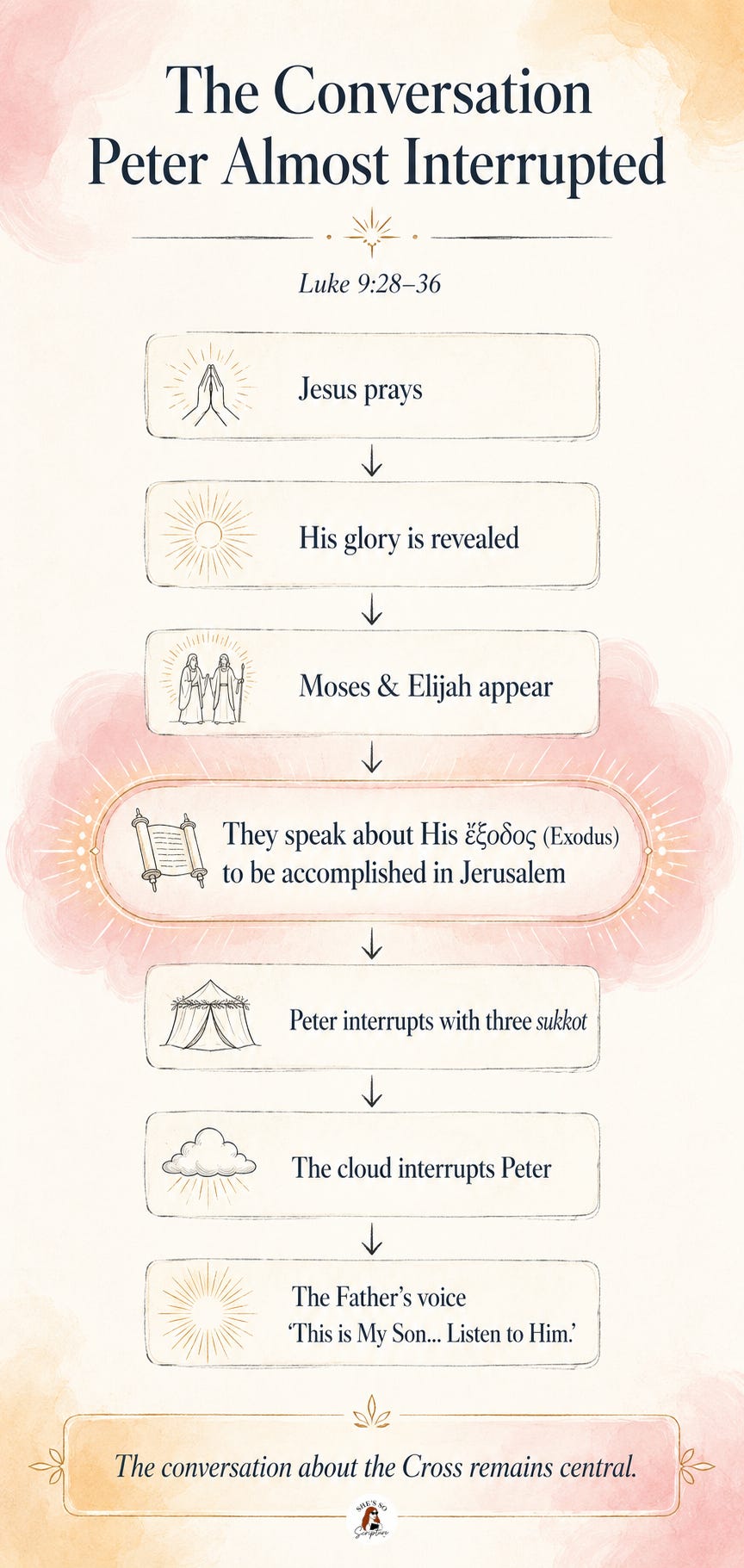
Now about eight days after these sayings, He took along Peter, John, and James, and went up on the mountain to pray. And as He was praying, the appearance of His face became different, and His clothing became white and flashing with lightning. And behold, two men were talking with Him, who were Moses and Elijah, appearing in glory, speaking of His departure which He was about to bring to fulfillment at Jerusalem. Now Peter and his companions had been overcome with sleep; but when they were fully awake, they saw His glory and the two men standing with Him. And as these were leaving Him, Peter said to Yeshua, “Master, it is good for us to be here; let us make three sukkot, one for You, and one for Moses, and one for Elijah”—not realizing what he was saying. While he was saying this, a cloud formed and began to overshadow them; and they were afraid as they entered the cloud. Then a voice came out of the cloud, saying, “This is My Son, My Chosen One; listen to Him!” And when the voice had spoken, Yeshua was found alone. And they kept silent, and reported to no one in those days any of the things they had seen.¹
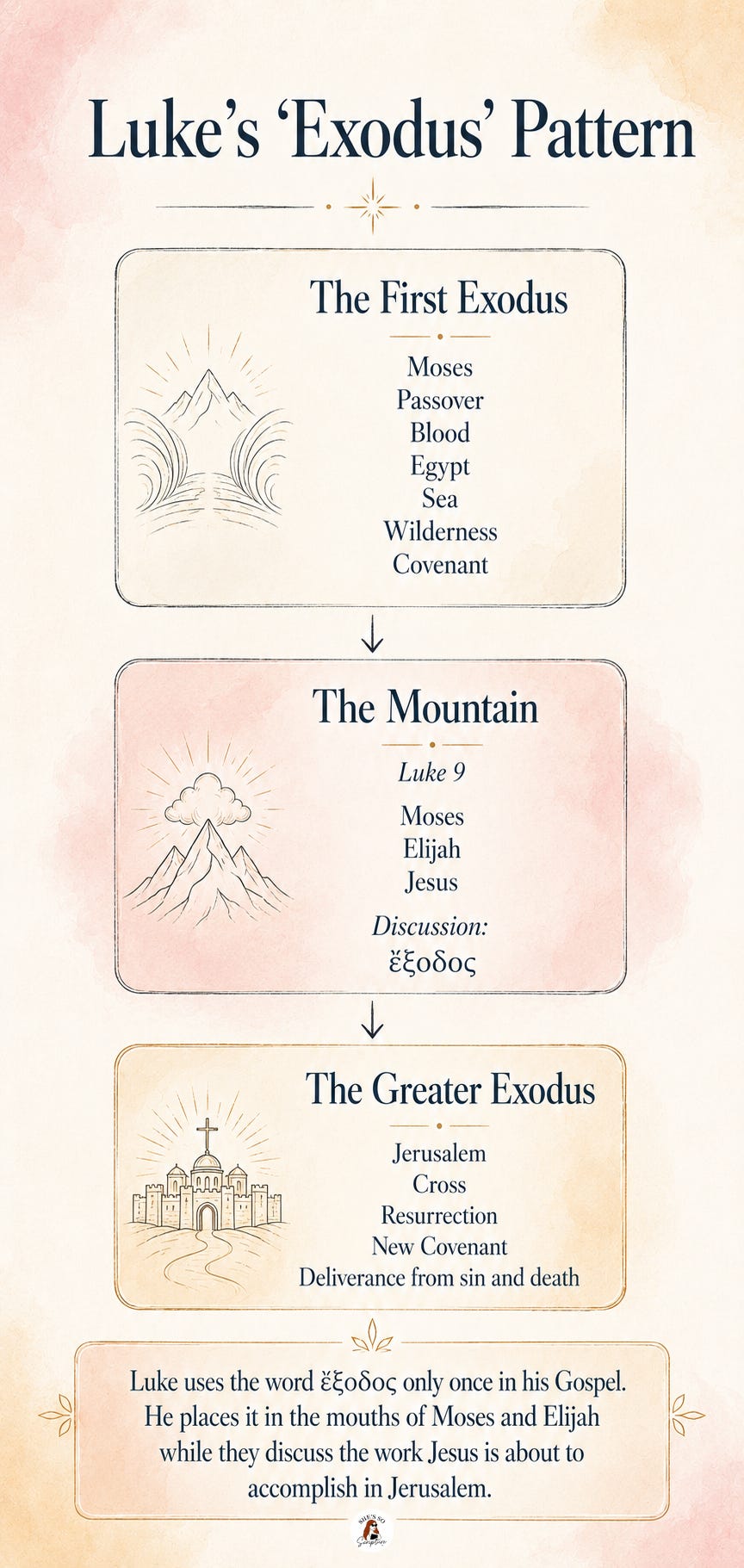
Departure… that’s the English word most translations use, including the one I use.² It’s a nice, safe, funeral-home word. It’s exactly the kind of word you’d find on a sympathy card next to a watercolor dove. Nobody flinches at “departure.” But behind that English word is a Greek one, and the Greek one is exodos.
Yes. That exodos!
A Word Luke Chose On Purpose
Luke could have described Yeshua’s coming death in more ordinary language. Instead, he chose a word that was already saturated with Israel’s greatest redemption story.
Exodos is what you call it when God rolls up on the most powerful empire on earth and tells Pharaoh to let His people go, Pharaoh says no, and then keeps saying no through nine plagues until the tenth one finally breaks him.
It’s the blood on the doorposts that meant the angel of death passed over your house instead of the one next door. It’s a sea that had no business splitting, splitting. It’s Pharaoh’s army, the best-trained military machine of its day, drowning in water that had just been dry ground twenty minutes earlier. It’s a people who had never known a single day of freedom walking out of Egypt with nothing but what they could carry and a God who went ahead of them in a pillar of fire so they wouldn’t lose their nerve in the dark.
The word is not just some euphemism for death. It’s a word that’s seen some stuff; plagues, blood, a sea that obeyed and a slave nation that walked out free.
Moses is standing on that mountain. Moses, the man who lived that very word. And Elijah is standing there too, the prophet of a God who never stopped fighting for His people even when they’d forgotten Him. And the two of them are talking with Yeshua about His own exodos. His own way out, through His own blood, on the other side of His own Egypt.
I think it’s one of the main reasons Luke tells us who was on that mountain.
Why Peter’s Response Was So Wrong It Required an Interruption
Here’s where it gets really good.
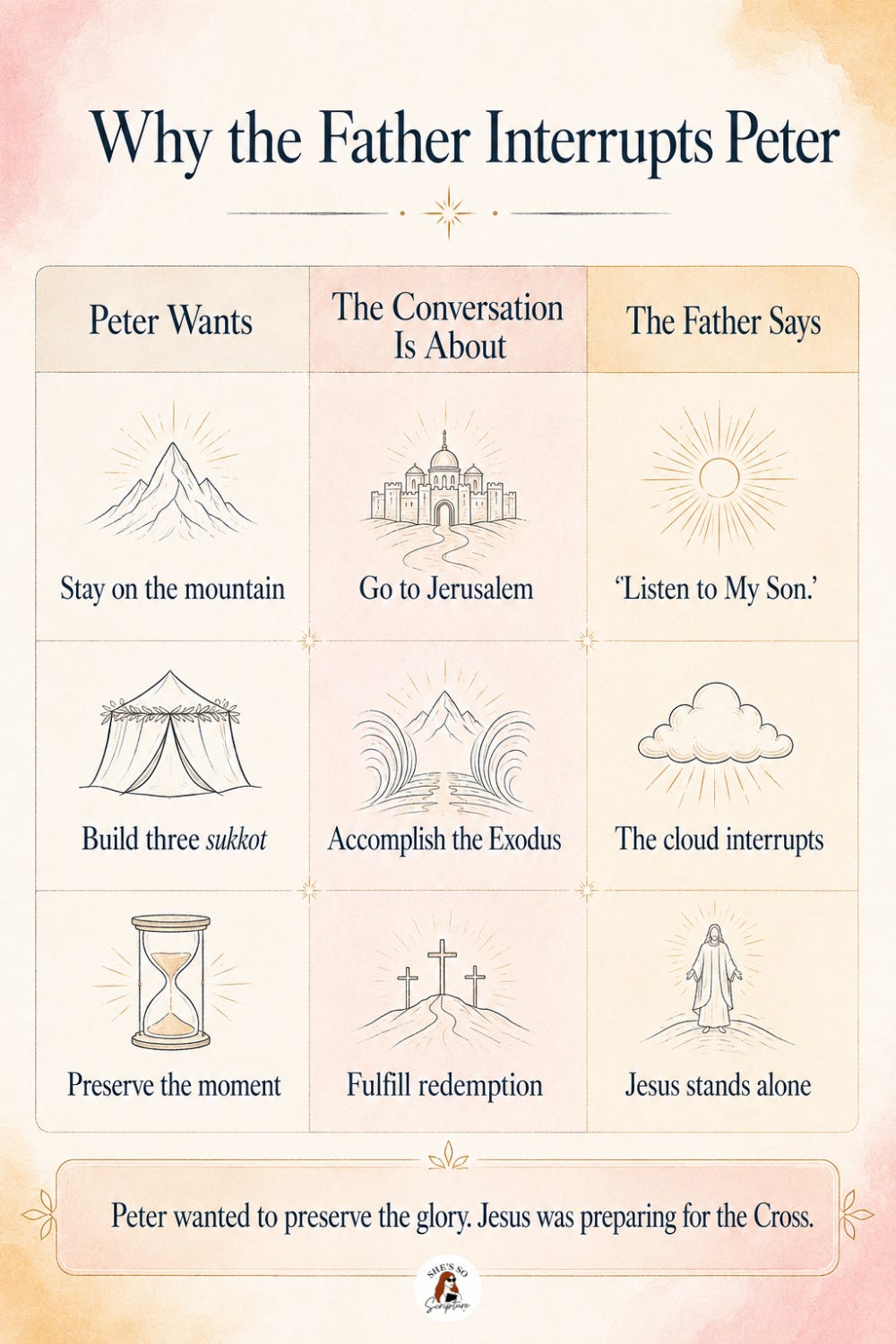
Peter catches the tail end of this conversation. He had just woken up, sees the glory, and does what every single one of us would probably do standing in front of something that overwhelming. He tries to manage it. “Let us make three sukkot,” Peter says, “one for You, and one for Moses, and one for Elijah.”
Bless his heart. He’s basically trying to build a gift shop at the foot of a burning bush.
Now let me point to the word sukkot. Sukkot. Not just “shelters” in some generic camping sense. The word Peter reaches for is the exact word for the temporary booths Jewish families still build every fall for the Feast of Tabernacles, Sukkot, the festival commemorating the wilderness wandering after the first exodus.³
It’s a harvest festival that stretches all the way into the age to come. Zechariah has a vision of the nations going up to Jerusalem in the future to keep this very feast before the King.⁴
So Peter isn’t just being “that guy” who always says something awkward at the family BBQ. He’s trying to stay on the mountain when the conversation is about the road to Jerusalem. He’s trying to preserve the moment instead of following where it’s leading.
And here’s the part Miss Patty’s version always skips: while he was saying these things, a cloud formed and overshadowed them.⁵ Not after he wraps up his little proposal. While he was still talking. God doesn’t let him land the pitch. A voice comes out of the cloud: “This is My Son, My Chosen One; listen to Him!”
Which, when you’ve just watched a man try to put Moses, Elijah, and Yeshua on equal footing under three separate roofs like they’re all getting participation ribbons, is not a subtle correction. That’s a heavenly “Peter… go sit down.”
Verse Mapping Aid: Exodos (ἔξοδος)
The Greek word Luke uses in verse 31 is exodos (ex-OD-os), built from ex (”out of”) and hodos (”way” or “road”).
But a first-century Jewish ear didn’t hear that word the way we’d hear an exit sign over a door. They heard the story their whole calendar was built around. Passover, the plagues, the sea, the wilderness, all of it lived inside that one word. It’s the word that came to represent the entire story of Israel walking out of slavery, and it’s also the word that became the traditional Greek title of the second book of Moses.
Luke uses it exactly once in his whole Gospel.⁶ Once. And he saves it for this mountain, in the mouths of two men who knew exactly what deliverance costs.
It’s hard to imagine Luke choosing that word without expecting his readers to hear Israel’s foundational redemption story echoing behind it.
Two Men Who Already Knew About Mountains
Here’s a detail in this narrative that’s worth looking deeper at before we move along. Moses met God on a mountain and came down with a glow-up so hard he had to veil his face.⁷ Elijah met God on a mountain too, though God skipped the wind and the earthquake and the fire and showed up in the quiet after, which I honestly love more.⁸ Both men have their own mountain story already. Both know exactly what it costs to stand that close to God and come back down again.
There’s more going on with these two than just the Exodus thread. Moses and Elijah are the Torah and the Prophets standing together in one place. Both had strange, unrepeatable departures from this life.⁹ Both point forward to the Messiah. The Exodus connection is one among several, not the whole picture.
So when they show up on this mountain, mid-conversation about a deliverance that hasn’t happened yet, they are two men whose lives uniquely prepared them to understand the conversation taking place.
And they still don’t get roofs built over them. Only the Son does.
My Final Thoughts
I used to read this story like it was basically the Bible’s version of a special effects scene. Light, glory, a couple of famous cameos, a nervous disciple saying the wrong thing at the wrong time. A nice moment before the story moves on to the harder chapters.
But once you know what that word actually embodies, and once you know what Peter was offering to build over it, this mountain stops being just a scenic backdrop. It becomes the moment the whole story tells you exactly where it’s headed. Not away from Egypt this time. Toward Jerusalem, toward a cross, toward an exodos that none of the three men standing on that mountain could have pulled off if you tried to swap their names around.
Moses brought a people out of slavery to Pharaoh. Yeshua was about to bring a people out of something Pharaoh never had the security clearance to enslave them to in the first place.
Dig Deeper
If you want to keep digging into this:
Exodus 34:29-35 (Moses’ face after meeting with God)
1 Kings 19:9-13 (Elijah’s mountain, and the sound of sheer silence)
Zechariah 14:16-19 (Sukkot and the nations, in the age to come)
Hebrews 3:1-6 (Moses as a servant in the house, Yeshua as Son over it)
Luke 9:51 (”He set His face to go to Jerusalem”)
What jumps out at you first? What the word exodos actually carries, the cloud interrupting Peter mid-pitch, or the fact that Moses and Elijah already had their own mountain résumés before this one? Tell me in the comments, I want to know where your brain went.
FAQs
What does exodos mean in Luke 9:31?
Exodos is the Greek word Luke uses for Jesus’ “departure” at the Transfiguration. It’s the same word behind the title of the book of Exodus. It signals that Jesus’ coming death in Jerusalem would be a second, greater deliverance.What were Moses and Elijah talking to Jesus about at the Transfiguration?
Luke tells us specifically: they were discussing His exodos… His coming death and resurrection in Jerusalem, and not just appearing as a vague show of glory.
If this cracked something open for you, send it to a friend who thinks the Transfiguration is just the “Jesus glows” story. They’re going to want the rest of it too.
And if you’re the kind of person who wants to keep going slower and deeper into moments like this one, that’s exactly what happens inside the Chavurah. Live studies, extended teaching, a community of people who want depth without pressure or performance.
If a paid subscription isn’t feasible right now but this space has blessed you, you can leave a one-time tip here. Every gift helps sustain this work. 💕

About the Author
Diane Ferreira is a Jewish believer in Yeshua, a published author, speaker, seminary student, wife, and proud mom. She is the founder of She’s So Scripture and She Opens Her Bible. She is the author of several books, including The Proverbs 31-ish Woman, which debuted as Amazon’s #1 New Release in Religious Humor, as well as Holy, Hormonal and Holding On.
She is currently pursuing her graduate degree in Jewish Studies in seminary, with her favorite topics being the early church and Biblical Hebrew. Diane writes and teaches from a unique perspective, bridging her Jewish heritage with vibrant faith in the Messiah to bring clarity, depth, and devotion to everyday believers.
When she’s not writing, studying, or teaching, you’ll find her curled up with a good book, crocheting something cozy, traveling, or playing her favorite video games.
Footnotes
Luke 9:28–36, Tree of Life Version (TLV).
The TLV renders the Greek ἔξοδος as “departure” in Luke 9:31. The ESV, NASB, CSB, NIV, and most major English translations likewise choose “departure,” while the NRSV/NRSVue retains the more literal “exodus.”
The biblical legislation for Sukkot appears in Leviticus 23:33–44 and Deuteronomy 16:13–17, where the feast is explicitly tied to Israel’s wilderness sojourn.
Zechariah 14:16–19.
Luke 9:34, TLV. The Greek participle construction (λαλοῦντος αὐτοῦ, “while he was saying these things”) indicates the cloud formed during Peter’s speech, not after it concluded.
ἔξοδος appears at Luke 9:31 and does not recur in Luke’s Gospel. The word does appear in Hebrews 11:22, where it refers to the historical Exodus from Egypt, and in 2 Peter 1:15, where it refers to the author’s approaching death.
Exodus 34:29–35.
1 Kings 19:9–13.
Moses died on Mount Nebo and was buried by God himself, with no one knowing the location of his grave (Deuteronomy 34:5–6). Elijah did not die in the ordinary sense but was taken up in a whirlwind (2 Kings 2:11).
Tree of Life (TLV) – Scripture taken from the Holy Scriptures, Tree of Life Version*. Copyright © 2014,2016 by the Tree of Life Bible Society. Used by permission of the Tree of Life Bible Society.
I was always got “shocked and amazed” reactions mixed with hospitality vibes from St. Peter. They’d been asleep or at least that is how their state is described. “Is this happening or is this a dream?” I think about how St. Peter in Acts doesn’t know if his being released by an angel is real or not until after it’s all over. I’m still trying to study if “sleep” is a cultural reference before major spiritual events.
Wouldn’t that same Cloud have been experienced in the tabernacle once a year by the high priest? If so, you have Moses/Torah (tablets in the ark) in the cloud in the tabernacle. God’s voice is heard. Then when they “wake up?” they see the God-man. Now they have seen this person in a divine display. His coming death isn’t extracted from him, but he lays it down.
Wow! This is incredibly profound! I took notes!❤️