


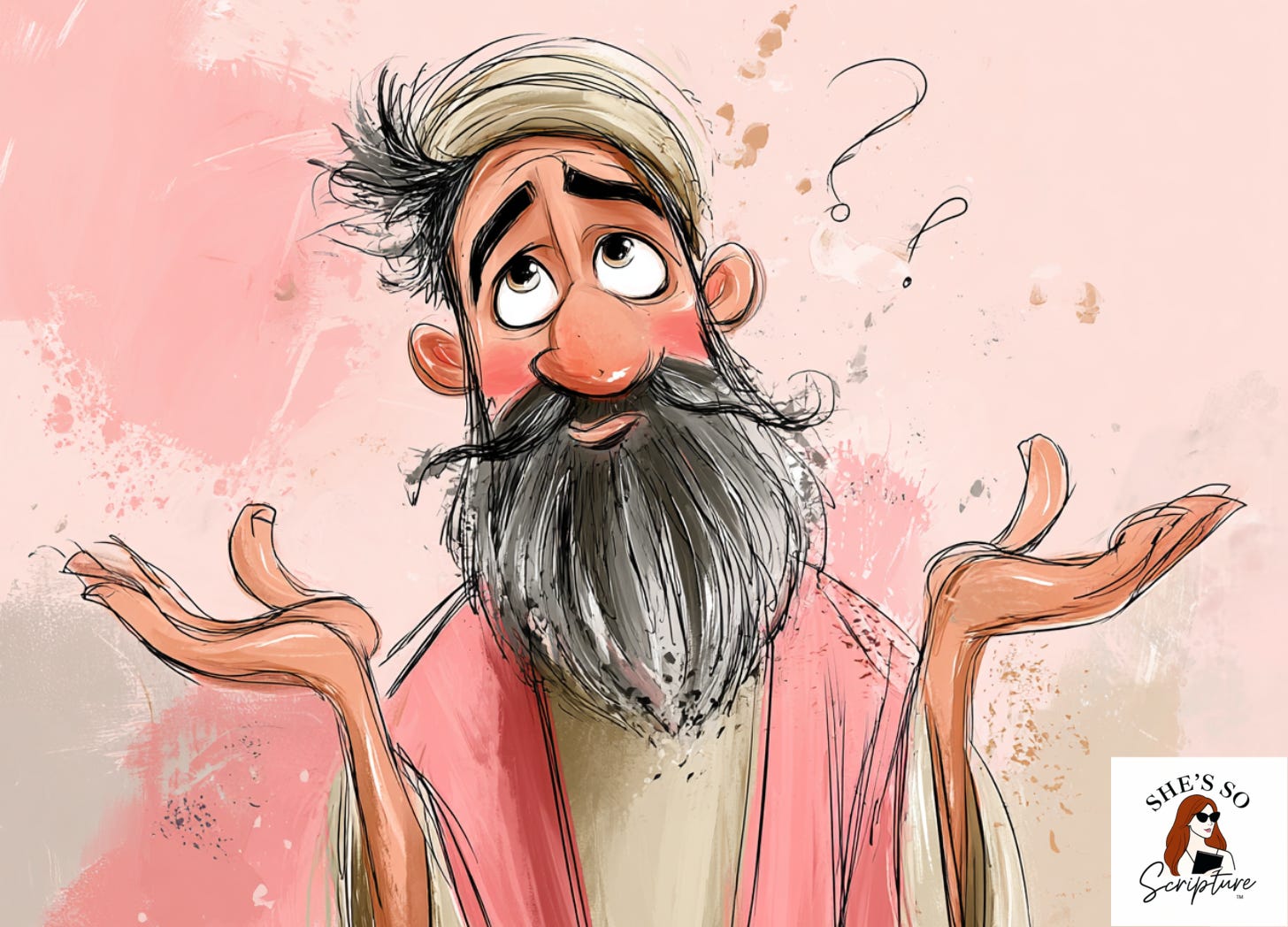
Somewhere along the way, Thomas got stuck with a nickname that refuses to die.
“Doubting Thomas.”
Every time his name comes up in a sermon, the lesson usually sounds something like this: Don’t be like Thomas. Just believe.
But if you actually read the resurrection story carefully, Thomas is not behaving unusually.
He is behaving exactly like the other disciples did. The only difference is timing.
Here’s the scene in John 20. Jesus has already appeared to the disciples, but Thomas was not in the room that night.
So when the others tell him what happened, he responds like this:
“Unless I see the nail marks in His hands, and put my finger into the mark of the nails, and put my hand into His side, I will never believe.” John 20:25 (TLV)
Sunday school usually pauses right there and gives Thomas a spiritual side-eye.
But let’s slow down, because earlier in the same chapter, the other disciples didn’t believe the resurrection reports either.
Mary Magdalene tells them the tomb is empty. They run to check.
When Jesus finally appears to them, the text says:
“He showed them His hands and His side.” John 20:20 (TLV)
That detail really matters.
The disciples believed AFTER they saw the same evidence Thomas asked for.
Thomas is not asking for more proof. He’s asking for the same proof.
What We Already Know About Thomas
Here’s something that rarely comes up in sermons about Thomas. This isn’t the first time he appears in John’s Gospel, and his earlier appearances paint a very different picture than “the doubter.”
In John 11:16, when Yeshua announces He’s going back to Judea to see Lazarus, the disciples push back. They know there’s danger. People in that region had recently tried to stone Yeshua. The trip could get them killed.
Thomas is the one who speaks up and says:
“Let us also go, so we may die with Him.” John 11:16 (TLV)
That is not the voice of a skeptic. That’s a man who has already counted the cost and decided he’s going anyway. Thomas was willing to walk into death beside Yeshua before anyone else in the room had finished doing the math. But sure. Let’s keep calling him the doubter.
And in John 14:5, during the Last Supper, when Yeshua says He’s going away to prepare a place, Thomas is the one who asks, “Lord, we do not know where You are going. How do we know the way?”
That question isn’t doubt. It’s the kind of honest, direct engagement that refuses to nod along and pretend to understand something when he doesn’t. Everyone else in that room was probably thinking the same thing. Thomas just had the nerve to say it out loud.
Thomas consistently shows up as someone who says exactly what he’s thinking. He doesn’t perform understanding he doesn’t have. He doesn’t fake courage he hasn’t yet found. And he doesn’t pretend to believe something he hasn’t yet experienced for himself. That’s not a character flaw. That’s consistency. And honestly, most of us could use a little more of it.
So when we arrive at John 20 and Thomas says he needs to see what the others have already seen, he’s doing exactly what he’s done the entire Gospel. He’s being Thomas.
Verse Mapping Aid
The Greek word often translated “doubt” in this story is ἀπιστία (apistia), meaning unbelief or lack of trust. But John never actually uses that word to label Thomas.
Instead, when Jesus appears eight days later, He says, “Do not become unbelieving, but believing” (John 20:27). The word behind “faithless” is ἄπιστος (apistos), meaning unbelieving or without trust.
The verb “become” (γίνου) suggests movement toward a condition rather than a fixed identity. Yeshua addresses the direction Thomas is heading, not who he permanently is.
“Stop being faithless, but believe.” John 20:27 (TLV)
There’s a significant difference between calling someone a doubter and telling someone to stop moving in the direction of unbelief. One is a label, the other is a redirection. And Yeshua chose the redirection.
And Thomas responds immediately:
“My Lord and my God!” John 20:28 (TLV)
That is the strongest confession of Yeshua’s identity in the entire Gospel of John.
The so-called doubter ends up making the clearest declaration.
The Eight Days and the Jewish Context
There’s something else happening in this passage that often gets overlooked. The text tells us that Yeshua appeared to Thomas eight days after the first appearance to the other disciples.
Eight days isn’t a random detail. The number eight carries associations with new beginnings, with covenant, with what comes after completion. Circumcision happens on the eighth day. The dedication of the Tabernacle concluded on the eighth day.
So eight days after the other disciples received their encounter, Thomas receives his, and what follows is the most theologically significant confession in the entire Gospel. John isn’t being casual with his timeline here.
There’s also a cultural layer worth noticing. In Jewish law, the testimony of a single witness wasn’t considered sufficient to establish a matter. Deuteronomy 19:15 requires two or three witnesses. When the disciples told Thomas what they’d seen, he was hearing a report. When he stood face to face with the risen Messiah, he had his own encounter.
Thomas wasn’t rejecting their testimony. He was waiting for his own. And in a tradition that valued personal witness and the weight of direct encounter, that posture makes complete sense. He wasn’t being difficult. He was being Jewish.
The Part Sunday School Didn’t Emphasize
Thomas is the honest one.
The other disciples believed because they saw the risen Messiah standing in front of them. Thomas simply had not had that encounter yet.
When he does, his response is immediate and profound.
There’s no long debate. No reluctant surrender.
Just worship.
And that moment becomes the theological climax of the entire Gospel.
John has spent twenty chapters revealing who Yeshua is, and the clearest confession comes from the man history decided to label a doubter.
Twenty chapters of signs, teachings, miracles, and theological dialogue, and the highest Christological statement in the book belongs to Thomas. John didn’t put that confession in Peter’s mouth or John’s. He gave it to the one everyone writes off. If that doesn’t tell you something about how God works, I don’t know what will.
My Final Thoughts
Thomas does not need a reputation repair campaign. He needs a context check.
He asked for evidence the other disciples had already received. When he encountered the risen Messiah, he responded with one of the most powerful declarations in Scripture.
Sometimes the people we call doubters are simply the ones who are honest enough to say what everyone else is quietly wondering.
And Yeshua did not shame Thomas for that.
He met him there.
Bible Study Questions
How do Thomas’s earlier appearances in John 11:16 and John 14:5 reshape the way you read his response in John 20?
What is the significance of Yeshua using the word apistos as a redirection rather than John labeling Thomas with apistia as an identity?
Why does it matter that the other disciples also needed to see Yeshua’s hands and side before they believed?
How does the Jewish standard of requiring two or three witnesses (Deuteronomy 19:15) provide context for Thomas’s request?
What is the significance of Thomas’s confession “My Lord and my God” being the strongest Christological statement in John’s Gospel?
Reflection Questions
When have you been labeled for a single moment of honest questioning rather than seen for the full picture of your faithfulness?
How does Thomas’s willingness to say what he didn’t yet understand challenge the way you engage with Scripture and community?
Where in your life are you waiting for your own encounter with God rather than relying solely on someone else’s testimony?
How does knowing that Yeshua met Thomas in his honesty rather than shaming him change the way you bring your own questions to God?
Action Challenges
Read John 11:16, John 14:5, and John 20:24–29 together and trace the consistency of Thomas’s character throughout the Gospel.
Study the role of witnesses in Jewish law (Deuteronomy 17:6 and 19:15) and consider how that framework applies to Thomas’s experience.
Identify one honest question you’ve been afraid to voice in your faith community and bring it to God in prayer this week.
Reflect on a time when someone met you in your doubt rather than shaming you for it, and consider how you can offer that same grace to someone else.
If this study stirred something in you, share it with a friend who’s been apologizing for asking honest questions and needs to hear that Yeshua never shamed Thomas for his.
And if it left you wanting to go slower and deeper into the Word, I’ve got you!
Paid subscribers get access to live Bible studies, extended studies, devotionals, theological teaching, spiritual formation practices, and a community of women who want depth without pressure or performance.
If you’re ready to step further into the Word, you’re welcome inside.
If a paid subscription isn’t feasible right now but this space has blessed you, you can leave a one-time tip here. Every gift helps sustain this work. 🤍

About the Author
Diane Ferreira is a Jewish believer in Yeshua, a published author, speaker, seminary student, wife, and proud mom. She is the founder of She’s So Scripture and She Opens Her Bible. She is the author of several books, including The Proverbs 31-ish Woman, which debuted as Amazon’s #1 New Release in Religious Humor, as well as Holy, Hormonal and Holding On.
She is currently pursuing her graduate degree in Jewish Studies in seminary, with her favorite topics being the early church and Biblical Hebrew. Diane writes and teaches from a unique perspective, bridging her Jewish heritage with vibrant faith in the Messiah to bring clarity, depth, and devotion to everyday believers.
When she’s not writing, studying, or teaching, you’ll find her curled up with a good book, crocheting something cozy, or playing her favorite video games.
Thank you so much Abby! I’m glad!!
This is absolutely beautiful and I lost count how many times I has chill bumps because of the beautiful heart of Thomas and the incredibly gentle and lovingly & understanding heart of Yeshua. This is all things I never knew or noticed and I appreciate this so very much. This has touched me deeply forever!!!