


Ok, confession time.. For a long time, whenever I read the book of Numbers, my eyes glazed over somewhere around verse four of chapter one. A list of names and census numbers is not exactly the kind of thing that makes you want to cancel dinner plans and stay home with your Bible. I thought this was the “skip ahead” section. The theological warm-up act before the real stuff.
I was wrong. Spectacularly and fabulously wrong.
Bamidbar, the Hebrew name for the book of Numbers, means “in the wilderness.” And the wilderness, as it turns out, is exactly where God does some of His most precise, most intentional, most staggeringly beautiful work. Not in spite of the desert. In the middle of it.
What looks like a military census is actually a theology of belonging. What looks like camping logistics is actually a picture of the holy dwelling in the center of God’s people. And what looks like ancient administrative record-keeping is actually God saying, with extraordinary specificity: everyone has a name, a place, and a purpose. No one is an afterthought. No one is interchangeable. No one wanders without assignment.
Church, that should probably make us pause for a second.
Torah: Numbers 1:1–4:20
The Census That Was Never Just About Numbers
The portion opens with a date. The first day of the second month, the second year after the Exodus. It’s been exactly one month since the Tabernacle was completed. God is dwelling in the middle of the camp. And now, of all things, He orders a census. Names. Tribes. Numbers.
So the question worth considering before we even get to verse two is: why does God begin here? Why does the book of the wilderness open not with a journey but with a count?
Numbers 1:1–2 (TLV):
In the wilderness of Sinai, on the first day of the second month in the second year from the Exodus from the land of Egypt, Adonai spoke to Moses in the Tent of Meeting saying, “Do a head count of all the community of Bnei-Yisrael by their families and their ancestral house, with a total of every male one by one.”
The phrase translated as “do a head count” in the TLV comes from the Hebrew root nasa, which means to lift up. In the ancient Near Eastern world, a census taken by a king was an act of ownership and protection. A king counts what belongs to him, and in counting it, he declares responsibility for it. So notice what that means here. God isn’t acquiring data. He’s making a declaration. Every name recorded is, in some sense, a name lifted.
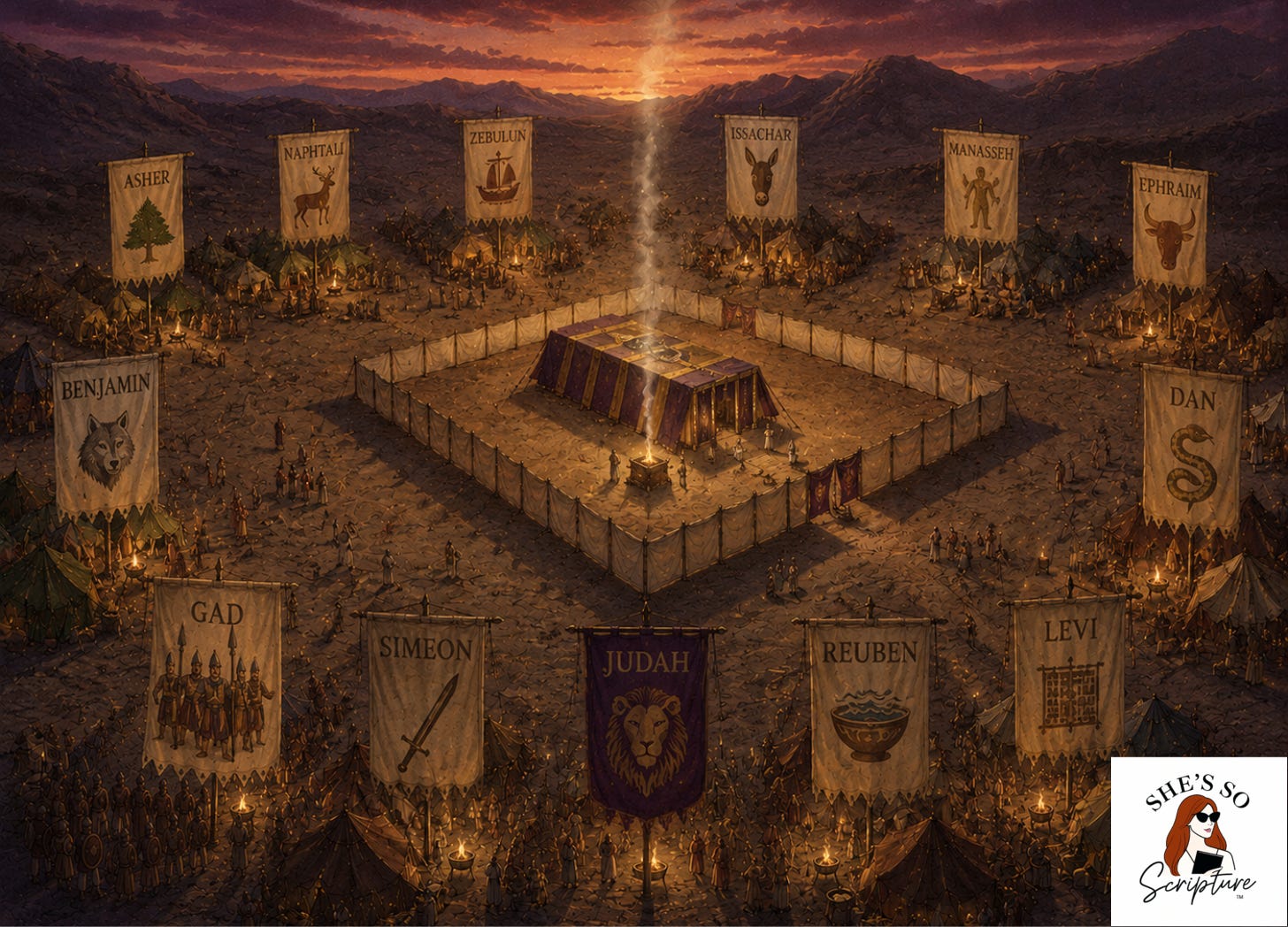
Then comes the structure. Twelve tribes. Twelve leaders. Each tribe counted, numbered, assigned a position in the camp. Judah leads the march to the east. Reuben on the south. Ephraim to the west. Dan takes the rear. The Levites occupy the center, surrounding the Tabernacle.
The names of the twelve tribal representatives listed in verses 5 through 15 are worth pausing on. Biblical scholars (such as Robert Alter) have noted that virtually none of these men appear anywhere else in the biblical narrative, and that not one of their names carries the theophoric suffix “yah,” the Hebrew shorthand for the Lord that became so common in later Israelite naming.
Scholars like Jacob Milgrom have seen this as one possible indicator that the list reflects an authentically ancient tradition. That’s not a slam-dunk dating argument on its own, naming patterns vary for all kinds of reasons, but it is the kind of detail that resists the charge that someone invented these names later. These men feel genuinely embedded in a particular moment. The text just gives you the names as they were.
Numbers 1:50–53 (TLV):
Instead, you are to appoint the Levites over the Tabernacle of the Testimony, over all its implements and all pertaining to it. They are to carry the Tabernacle and all its utensils, tend to it and camp around it. Whenever the Tabernacle sets out, the Levites are to dismantle it, and whenever the Tabernacle is pitched, the Levites are to set it up... The Levites are to camp around the Tabernacle of the Testimony, so that there will be no wrath unleashed on the community of Bnei-Yisrael.
Did you catch that? The Levites camp around the Tabernacle to protect the rest of the community from wrath. The holy dwelling of God in the midst of a sinful people requires a buffer, a mediating tribe whose entire vocation is proximity to the sacred on behalf of everyone else. That’s not just some minor logistical detail. That’s the entire shape of Israel’s theology of the priesthood.
Notice also the small Hebrew word that introduces verse 49, the verse where God exempts the Levites from the census. The TLV renders it “however.” But the Hebrew uses the word ‘akh, which adds emphasis, almost like the text is underlining the statement. It means not just “but” or “except” but something closer to “only” or “nevertheless, and hear me clearly on this.” God isn’t slipping in a footnote to the census instructions. He’s drawing a bright line with force. The Levites are not merely uncounted. They are set apart with intention, with weight, with the full emphasis of ‘akh behind it.
The Camp as Theology
Chapter 2 gives us the marching order of the tribes around the Tabernacle. Read it and you’re reading a diagram of the cosmos as Israel understood it: God at the center, the mediating tribe surrounding Him, and the twelve tribes arranged around them like a living frame.
This wasn’t just arbitrary. In the ancient world, the arrangement of a camp reflected the values of the people. The Israelite camp arrangement proclaimed, with every morning’s sunrise, that God is the center. Not the strongest tribe. Not the most prestigious family. Not the military commander. God.
There’s also a quiet piece of biblical architecture built into this arrangement that’s easy to miss.
The tribe of Levi won’t be counted in the military census. They’re set apart for sacred service, not conscription. So how does Israel maintain the sacred number of twelve tribes? The answer goes all the way back to Jacob’s deathbed in Genesis 48, where he adopted Joseph’s two sons, Ephraim and Manasseh, as his own. “They shall be mine,” he told Joseph, “as Reuben and Simeon are mine.”
That deathbed blessing becomes structural here in the wilderness two generations later: Joseph’s two sons, Ephraim and Manassah, step into the numerical gap left by Levi’s removal, and the twelve is preserved. A patriarch’s dying words are doing their thing right in the middle of the desert. That is how this God operates.
Chapters 3 and 4 drill down into the Levitical responsibilities with astonishing precision. The Kohathites carry the most holy objects: the Ark, the table, the menorah, the altars. But here’s the detail that should stop you in your tracks: they are not allowed to see or touch the holy objects directly. Aaron and his sons cover everything first.
Numbers 4:15 (TLV):
When Aaron and his sons have finished covering the Sanctuary and all its holy implements, and when the camp is ready to move out, after this the sons of Kohath may come to do the carrying. But they must not touch the holy items or they will die. These are the task of the sons of Kohath with regard to the Tent of Meeting.
Think about that for a sec. The Kohathites are the carriers of the holiest objects in Israel. This is their calling, their inheritance, their vocation. And they STILL cannot look at what they carry. Aaron and his sons cover everything first, and only then do the Kohathites come near. What does that tell us about proximity to God? What does it mean that the people closest to the sacred are also the ones most carefully protected from it?
The text holds two things at once that don’t immediately resolve and it makes zero apologies for it. God dwells among His people. And God is holy beyond casual approach.
The Tabernacle is the architecture of that tension, not its solution. On its own terms, the system is complete: it works, it does what God commanded it to do, and that is enough for us to take seriously. Those of us reading across the whole of Scripture will find ourselves asking later questions about what all this mediation is ultimately moving toward. But the Torah doesn’t require us to answer that question to be worth studying. It’s worth sitting in the tension a while.
Haftarah: 1 Samuel 20:18–42
Covenant Loyalty in the Wilderness of Betrayal
Our Haftarah brings us into one of the most emotionally raw scenes in all of Scripture: David and Jonathan, caught between the murderous jealousy of Saul and the covenantal loyalty they’ve sworn to each other.
The connection to Bamidbar may not be obvious at first. But look more carefully. The Torah portion is all about assigned positions. Everyone has a place. Every tribe has a role. The camp has a center. The Haftarah shows us what happens when someone is forced out of their place, and what covenant loyalty looks like when it has to operate in the wilderness.
1 Samuel 20:18 (TLV):
Then Jonathan said to him, “Tomorrow is the New Moon. You’ll be missed because your seat will be empty.”
David’s seat is empty because Saul wants him dead. But Jonathan, the king’s son, has made a covenant with David. And that covenant holds even when it costs Jonathan his father’s approval, his own political future, and his safety at the dinner table.
The word that pulses through this passage is the Hebrew chesed (kheh-sed), loyal love. Jonathan asks David to show him the loyal love of God. And he does. He schemes and signals and risks everything so that David can escape. The arrows are a code, but they’re also a picture that true covenant loyalty speaks even when it can’t shout.
1 Samuel 20:41–42 (TLV):
As soon as the lad was gone, David emerged from the south side and fell on his face to the ground and bowed down three times. Then they kissed each other and wept together, though David wept more. Then Jonathan said to David, “Go in the shalom that we both have sworn to each other in the Name of Adonai saying: ‘May Adonai be between me and you, and between my offspring and your offspring, forever.’”
This is not a sentimental farewell. This is a covenant farewell. Jonathan isn’t just saying goodbye. He’s binding the future to what God has already witnessed between them. The covenant isn’t voided by exile. David’s seat being empty doesn’t mean his place is gone.
That’s the tie that connects the Haftarah to the Torah. Even in the wilderness, even when the camp arrangement has been disrupted, even when Saul is on the throne and David is running for his life, the covenant holds. God’s assignments don’t get canceled because circumstances get hard.
Besorah: Mark 12:28–34
The Shema at the Center of Everything
A Torah scholar walks up to Yeshua in the middle of a heated theological debate and asks Him to cut through all of it: which commandment is the most important?
And Yeshua answers with the Shema.
Mark 12:29–31 (TLV):
Yeshua answered, “The first is, ‘Shema Yisrael, Adonai Eloheinu, Adonai echad. Hear, O Israel, the Lord our God, the Lord is One. And you shall love Adonai your God with all your heart, and with all your soul, and with all your mind, and with all your strength.’ The second is this, ‘You shall love your neighbor as yourself.’ There is no other commandment greater than these.”
This isn’t a new teaching. Yeshua is quoting Deuteronomy 6:4 and Leviticus 19:18. He’s a first-century Jewish rabbi doing exactly what first-century Jewish rabbis did: finding the unifying principle of Torah and naming it clearly. Every Torah scholar in earshot would have recognized both citations immediately.
What’s remarkable is the Torah scholar’s response. He doesn’t push back… he affirms it. And then he does something extraordinary: he says that loving God and loving neighbor is greater than all burnt offerings and sacrifices. He’s an expert in Temple law, and he’s saying the Temple system itself is secondary to the heart behind it.
Mark 12:34 (TLV):
When Yeshua saw that he had answered wisely, He said to him, “You are not far from the kingdom of God.” And no one dared any longer to question Him.
Not far. Those two words have haunted interpreters for centuries. Was the scholar in or out? And I think Yeshua’s answer is intentionally open. The man understood the center. He knew that God is one, that love is the organizing principle, that the entire elaborate system of sacrifices exists to serve a relationship, not replace it. He was oriented correctly.
Here’s where it meets Bamidbar. In the Torah portion the entire camp is organized outward from the Tabernacle. Every tribe, every assignment, every role in the Levitical system exists in relation to the center. Yeshua, standing in Jerusalem, is asked to name that center. And He does it in six Hebrew words. Shema Yisrael, Adonai Eloheinu, Adonai echad.
The scholar who heard it recognized it immediately. Not far, Yeshua told him. Which raises the question: what is the distance between understanding the center and actually living from it?
Thematic Threads
Order as theology. At first glance the census is administrative. Tribes, numbers, assignments. But look at the shape of the camp: everything arranged around the Tabernacle, every position defined by its relationship to the center. What if the census isn’t just logistics? What if the arrangement of the camp is itself a confession about who God is? When Yeshua names the Shema as the first commandment, He’s inviting the same question: what is at the center, and is everything else arranged accordingly?
Belonging as gift. Every person counted in the census has a name and a place. David’s seat is empty but his covenant is not canceled. The Torah scholar is not far from the kingdom. There’s a consistent thread through all three readings: God doesn’t misplace His people. Even in the wilderness, even in exile, even in the middle of theological debate, there is a place for those who are His.
Mediation and access. The Kohathites carry what they cannot see. The priests cover before the Levites approach. The whole structure of the Tabernacle is built around the problem of holiness and proximity: how do you draw near to what is genuinely beyond approach? That question doesn’t go away when you close the book of Numbers. It runs through the whole of Scripture. And it’s worth asking again every time you come to prayer: what does it mean that access to God is possible at all?
Verse Mapping Aid
Paqad (פָּקַד): To Number, to Visit, to Oversee
The word that opens the census in Numbers 1 is paqad (pronounced pah-KAHD). Most English translations render it simply as “number” or “count,” and that’s technically accurate. But paqad carries a far richer range of meaning than math.
Paqad is the same word used when God “visited” Sarah and she conceived Isaac (Genesis 21:1). It’s used when Joseph tells his brothers that God will “visit” them and bring them out of Egypt (Genesis 50:24-25). It’s used when God “takes note” of the Israelites’ suffering and moves to deliver them (Exodus 4:31). The word contains the idea of intentional, personal attention: to see, to visit, to oversee, to hold accountable, to appoint.
So when God says to Moses, in the wilderness of Sinai, “paqad the community,” He’s doing something more layered than military bookkeeping. This is a real census with real numbers, and the text doesn’t pretend otherwise. But the word chosen to describe it is one that also means to visit with personal attention, to hold in intentional regard, to appoint with purpose. The counting and the seeing are happening simultaneously. Every man numbered is a man held in God’s specific regard.
The census is a census. The numbers are real. But when you notice that the same word is used here as when God visits Sarah, when He remembers Joseph’s brothers in Egypt, when He takes note of suffering and moves toward it, something opens up. What kind of counting is this? What kind of God counts this way? The text doesn’t answer that directly. It just gives you the word and lets you really sit with it.
My Final Thoughts
Bamidbar begins in the wilderness. That should not be lost on any of us. God doesn’t wait until His people are in the Promised Land to organize them, assign them, and take up residence in their midst. He does it in the desert. Before the victory. Before the inheritance. Before things look anything like what was promised.
The Tabernacle is already standing. The cloud is already hovering. God is already among them. And now He turns His attention to saying, with very specific Hebrew vocabulary: I see each one of you. You have a name. You have a place. You have a tribe. You have a purpose in this season. Even this season.
Jonathan understood something about this when he wept with David by the stone Ezel. The camp had been disrupted. David’s seat was empty. But the covenant hadn’t changed, and the God who witnessed it hadn’t moved. The Torah scholar understood it when he recognized that the Shema isn’t a rule to follow but a center to organize everything else around.
God isn’t waiting for your circumstances to settle down before He assigns you a place. He’s doing it in the wilderness. He’s doing it while the desert is still dry and the destination is still a promise. Paqad. He’s visiting you. He sees you. You’ve been counted, and it’s not a number. It’s a name.
Hebrew Letter Lesson: Nun (נ)
Pronunciation: noon (rhymes with “spoon”)
Name meaning: Fish, or to sprout, to propagate
Numerical value: 50
The name of the letter nun is associated in ancient Hebrew with the word for fish, and the older pictographic forms of the letter do resemble a fish or a serpent in motion. What the rabbis and Jewish mystics do with that image is, honestly, more midrashic and devotional than strictly linguistic, but it’s beautiful and worth considering.
The fish is a creature of constant motion through a fluid environment. It doesn’t resist the current. It moves through it, navigates within it, lives inside the very medium that would drown something else. And rabbinically, nun has long been connected to the concept of ne’emanut, faithfulness, and to the soul’s capacity to remain vital even when fully submerged in difficulty.
I’ll be honest with you: these connections are devotional reflection, not linguistic science. But good devotional reflection rooted in real vocabulary is its own kind of teaching, and the Jewish tradition has always known that. So hold it with that understanding.
The Israelites in the wilderness didn’t get to stay still. The cloud moved and they moved. The Tabernacle was designed to be packed up and carried. There’s something in the shape of Bamidbar itself that rhymes with what the rabbis say about nun: this is a letter, and a book, and a season of life, about learning to move faithfully through territory that won’t hold still.
A Little Nugget
Nun is the only letter that, when written in its final form at the end of a word (nun sofit), hangs below the line. The rabbis say this represents humility: the soul that bends low in faithfulness is the soul God lifts up. Whether or not you take that as linguistic fact, it is exactly what the wilderness teaches.
Nun Sofit (ן): The Letter at the End
Hebrew has two forms of the letter nun. The regular nun (נ) appears at the beginning or middle of a word. But when nun falls at the very end of a word, it takes a completely different shape: nun sofit (ן). Where the regular nun tucks in, the sofit form drops straight down below the baseline of the text, extending further than any other letter on the line.
The rabbis have reflected on this at length. Most letters stay within the lines, contained, bounded. But nun sofit descends. It goes lower than everything around it. And the teaching that grows up around this is that the soul willing to go lower, to bend further, to extend beyond what is comfortable, is the soul that God lifts. You don’t read the descent as loss. You read it as posture.
There is something worth noticing in that image for a wilderness season. The Israelites in Bamidbar are not on top of things. They are not positioned triumphantly. They are in the desert, moving when the cloud moves, camping when it stops, carrying a Tabernacle through terrain that offers nothing stable. They are, in the shape of nun sofit, extended below the line. And God is in the middle of it.
Remember: this is devotional reflection on the shape of a letter, not a linguistic claim. But it’s the kind of reflection the Jewish tradition has always made room for, because sometimes a shape teaches what a definition can’t.
Application
Where in your life are you in a “wilderness” season, moving through something fluid and uncertain? Nun invites you to ask: am I moving with faithfulness, or am I fighting the current?
The fish doesn’t need solid ground. It’s built for the water it lives in. What has God equipped you to navigate that you’ve been treating as a problem to escape?
This week, when you feel like you’re in over your head, return to the Shema. The center holds. Adonai echad. One God. Everything else can be arranged around that.

Weekly Practice
Each morning this week, before you check your phone or open your calendar, say the Shema aloud: Shema Yisrael, Adonai Eloheinu, Adonai echad. Let it be the first orientation of your day. Then ask yourself: what is the center today? Not the loudest thing, not the most urgent thing, but the center. Spend two minutes in silence, letting everything else find its place around that.
If you’re new to saying it aloud, here’s the phonetic pronunciation: Sheh-MAH Yis-rah-EL, Ah-doe-NYE Eh-lo-HAY-noo, Ah-doe-NYE Eh-KHAD. Say it slowly. Say it like you mean it. The words are ancient but the prayer is present tense.
Download This Portion
Download a printable version of this Torah portion along with the study and reflection questions for your study binder!
Bible Study Questions
1. Numbers 1:50-53 describes the Levites’ role as camping around the Tabernacle to prevent wrath from coming on the community. What does this tell us about the relationship between holiness and proximity? How does this Levitical role foreshadow Yeshua’s priestly function?
2. The camp arrangement in Numbers 2 places the Tabernacle at the center, with every tribe arranged around it. What theological statement does this physical arrangement make? How might your own life reflect (or fail to reflect) this kind of God-centered ordering?
3. Numbers 4:15 warns that the sons of Kohath must not touch the holy objects or they will die. Why does God build such intense structure around the holy? What does this tell us about the nature of holiness itself?
4. In 1 Samuel 20, Jonathan’s loyalty to David costs him his father’s approval and his place at the table. What does this scene reveal about what it looks like to honor a covenant when it’s expensive? Where does Scripture call us to that same kind of costly faithfulness?
5. The Torah scholar in Mark 12 affirms Yeshua’s summary and adds that love surpasses burnt offerings and sacrifices. How does this affirmation reflect the Hebrew prophetic tradition (see Hosea 6:6, Micah 6:8)? What does it mean that a Torah expert was “not far” from the kingdom?
Reflection Questions
6. The Hebrew word paqad carries a range of meanings including to count, to visit, to take note of with personal attention. When has God’s attentive regard in your life looked less like a grand intervention and more like being quietly noticed in the wilderness?
7. Jonathan and David’s covenant holds even when David is forced out of his assigned seat. Is there an area of your life where God’s covenant promises feel like they’re on hold because circumstances have disrupted the arrangement? What would it look like to trust those promises like David trusted Jonathan?
8. Yeshua tells the Torah scholar he’s “not far” from the kingdom. What do you think is the difference between understanding the center of the kingdom and actually being in it? Is there a movement from knowledge to commitment that you’re being invited to make?
Action Challenges
9. Draw a simple diagram of your life as it currently is: your relationships, your work, your commitments, your daily rhythms. Put God’s name in the center. Now look honestly at the diagram. What is actually at the center? What needs to be rearranged?
10. Practice the Shema each morning this week. Write it on a notecard: Shema Yisrael, Adonai Eloheinu, Adonai echad. Place it where you’ll see it first thing. Notice what shifts when God is named as the center before your day begins.
11. Think of one relationship in your life where you’ve been called to covenant faithfulness and it has been costly. Write that person’s name down and pray specifically for them this week. Ask God what faithfulness to them looks like right now, in this season.
Want to Go Deeper?
If this study stirred something in you, share it with a friend who’s navigating a wilderness season and needs to know that God’s assignments don’t expire in the desert.
And if it left you wanting to go slower and deeper into the Word, I’ve got you! Paid subscribers get access to live Bible studies, extended Torah studies, audio lessons, devotionals, theological teaching, spiritual formation practices, and a community of women who want depth without pressure or performance. If you’re ready to step further into the Word, you’re welcome inside.
If a paid subscription isn’t feasible right now but this space has blessed you, you can leave a one-time tip here. Every gift helps sustain this work. 💕

About the Author
Diane Ferreira is a Jewish believer in Yeshua, a published author, speaker, seminary student, wife, and proud mom. She is the founder of She’s So Scripture and She Opens Her Bible. She is the author of several books, including The Proverbs 31-ish Woman, which debuted as Amazon’s #1 New Release in Religious Humor, as well as Holy, Hormonal and Holding On.
She is currently pursuing her graduate degree in Jewish Studies in seminary, with her favorite topics being the early church and Biblical Hebrew. Diane writes and teaches from a unique perspective, bridging her Jewish heritage with vibrant faith in the Messiah to bring clarity, depth, and devotion to everyday believers.
When she’s not writing, studying, or teaching, you’ll find her curled up with a good book, crocheting something cozy, traveling, or playing her favorite video games.
Tree of Life (TLV) – Scripture taken from the Holy Scriptures, Tree of Life Version*. Copyright © 2014,2016 by the Tree of Life Bible Society. Used by permission of the Tree of Life Bible Society.
Your teachings are so rich and dense yet fully "digestible". It's a feast! 🙌🏻🙏🏻
Diane, your articles and guides are so approachable and such a gift. This one is timely for me today - thank you! R