


Shalom my friends,
Va’eira picks up right where Shemot left off, and the timing couldn’t be worse.
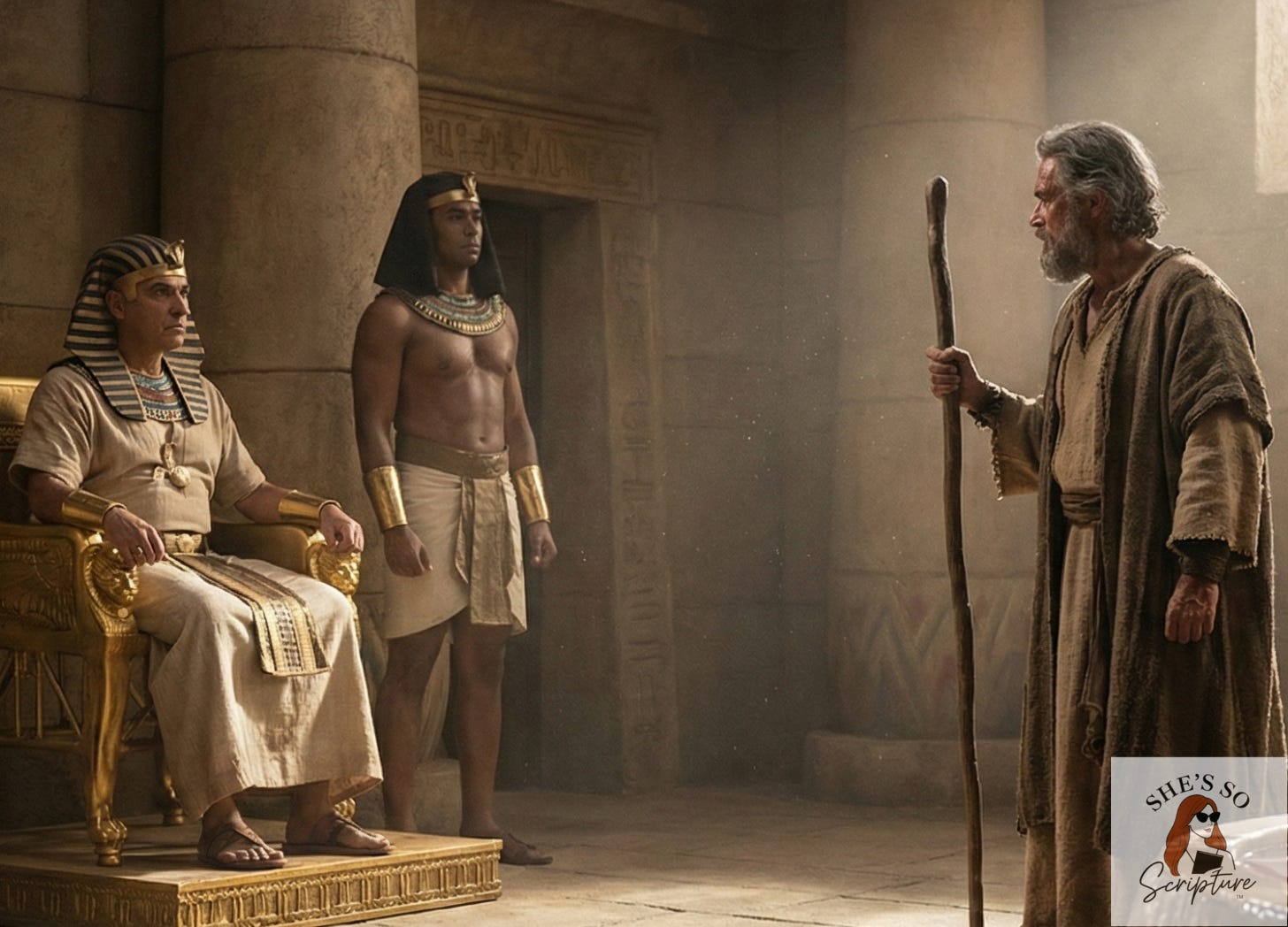
Moses has gone to Pharaoh.
Things did not improve. In fact, they got worse.
The people are discouraged. Pharaoh is angry. Moses is frustrated. And God responds not by fixing the situation immediately, but by explaining Himself.
Va’eira is the portion where God slows the story down and says, in essence, “Let Me remind you who I am.”
Torah: Exodus 6:2–9:35
Knowing God Before Seeing Freedom
Va’eira opens with one of the most important theological moments in the Torah.
“God spoke to Moses and said to him, “I am יהוה. I appeared to Abraham, Isaac, and Jacob as El Shaddai, but I did not make Myself known to them by My name”
Exodus 6:2-3 JPS Tanakh
That distinction matters more than we usually give it credit for.
When God says, “I appeared to Abraham, Isaac, and Jacob as El Shaddai,” He’s reminding Moses how the patriarchs primarily experienced Him.
El Shaddai (אֵל שַׁדַּי) is often translated “God Almighty,” and that translation makes sense. This name emphasizes God’s power, His provision, and His sufficiency. Abraham, Isaac, and Jacob knew God as the One who could do what He promised, even when the promise itself was still far off.
They lived by trust. They walked by faith. They believed God was strong enough to make it happen, even if they never saw the fulfillment in their lifetime.
That’s El Shaddai. The promise-maker. The sustainer. The God who says, “I will.”
But then God says something that should make us pause.
“but I did not make Myself known to them by My name.”
Adonai is the Jewish way of speaking the divine name, the Tetragrammaton, Yod-Heh-Vav-Heh, often written as LORD in English Bibles. This name is tied to God’s eternality, His covenant faithfulness, and His self-existence. It’s the name connected to the burning bush. “I Am Who I Am.”
This is the shift happening in Va’eira.
The patriarchs knew God as the One who promises. Israel is about to know Him as the One who delivers. El Shaddai says God is powerful enough. Adonai says God actually shows up and does what He said He would do.
God hasn’t changed. The relationship is deepening.
Israel is moving from believing God can act to watching Him act. And that’s why this revelation comes before the plagues. Before the miracles. Before the freedom.
God wants His people to know who He is, not just what He can do.
This doesn’t mean the patriarchs never heard God’s name. It means they never experienced what that name would come to represent.
The name revealed here is tied to faithfulness, fulfillment, and follow-through. The patriarchs received promises. Israel is about to see those promises acted upon.
God then lays out His intentions clearly. He will bring Israel out. He will redeem them. He will take them as His people. He will be their God.
It is a beautful declaration. And Israel cannot hear it.
Scripture tells us they do not listen because of crushed spirit and harsh labor. That detail really matters. Faith is not absent here. Exhaustion is.
God doesn’t scold them for their silence. He turns back to Moses and sends him again.
Moses, understandably, is not feeling very confident. He argues that if Israel wouldn’t listen, Pharaoh certainly isn’t going to! God doesn’t debate Moses’ insecurity. He reasserts His authority.
Then the plagues begin.
It’s tempting to read the plagues as punishment alone, but the text tells us something deeper. Over and over, God says these signs exist so that Egypt will know who He is.
Each plague confronts Egypt’s sense of control. Water, land, livestock, health, weather, and time itself fall outside Pharaoh’s authority. Egypt’s gods are exposed as powerless, and Pharaoh’s illusion of sovereignty cracks a little more each time.
And yet, Pharaoh hardens his heart.
Sometimes the most sobering part of Va’eira is not God’s power… it’s human resistance. Pharaoh watches the evidence pile up and still refuses to yield. Power without humility always ends the same way.
Va’eira reminds us that redemption is not only about release, it’s about revelation. God is making Himself known to Israel and Egypt at the same time.
Haftarah: Ezekiel 28:25–29:21
When Pride Meets Reality
Ezekiel’s prophecy mirrors Va’eira with uncomfortable precision.
God speaks against Egypt and Pharaoh, calling out arrogance that borders on delusion. Pharaoh sees himself as the source of the Nile, the giver of life, the center of power.
God totally dismantles that illusion.
The Haftarah emphasizes that Egypt’s downfall is not random. It is corrective. Power that refuses accountability eventually collapses under its own weight.
But tied to this judgment is promise.
God speaks of restoring Israel, planting them securely in their land, and revealing Himself as faithful. Judgment and restoration move together here, just as they do in Exodus.
The message is consistent. God opposes pride, but He is committed to His people.
Besorah: Matthew 7:1–12
Living Under God’s Authority, Not Our Own
In Matthew 7, Yeshua shifts the conversation inward.
Do not judge hypocritically.
Deal with your own blindness first.
Treat others the way you want to be treated.
This teaching fits Va’eira better than it might seem at first glance.
Pharaoh refuses to examine himself. He blames circumstances. He resists accountability. He demands control. Yeshua calls His followers into a different posture.
Humility. Self-awareness. Trust.
Yeshua is not removing discernment. He is removing arrogance. Life under God’s authority looks different than life built on self-importance.
Just as Egypt’s power structures are exposed in Va’eira, Yeshua exposes internal power struggles that distort how we treat others.
My Final Thoughts
Va’eira is the portion where God explains Himself before He delivers His people.
Israel is too crushed to listen. Moses is overwhelmed. Pharaoh is entrenched. And God remains steady.
He reveals His name. He asserts His authority. He begins dismantling systems built on fear and pride.
Va’eira reminds us that freedom is not immediate, and faith does not always feel strong. Sometimes obedience looks like showing up again and again after disappointment.
God doesn’t require emotional readiness. He requires willingness.
And He’s patient enough to keep revealing Himself until the lesson finally takes root.
Va’eira leaves us with a sobering question.
What happens when God makes Himself known, and we still refuse to yield?
Because knowing God’s name is only the beginning. Trusting what that name means is where transformation starts.
Hebrew Letter of the Week: מ (Mem)
Sound: “M”
Numeric Value: 40
Meaning: Water, chaos, transition, hidden depth, formation through movement
Mem is associated with water, and that symbolism matters more than it first appears. Water in Scripture can bring life, but it can also overwhelm. It nourishes, cleanses, and reshapes, often at the same time.
That makes Mem a perfect letter for Va’eira.
This portion is full of water imagery. The Nile turns to blood. Frogs come up from the water. Egypt’s source of life becomes a source of judgment. God is confronting what Egypt trusts most and revealing that even creation itself answers to Him.
The number forty also fits here. Forty is the number of testing, transition, and formation. Think flood, wilderness, fasting. Nothing stays the same after forty. Mem reminds us that God often uses disruption to bring clarity.
How to Write Mem
מ
(final form: ם)
Mem is written as an enclosed shape, almost like a container.
Begin at the top and draw the right side downward.
Curve around the bottom and come back up the left side.
Close the letter at the top.
The final form, ם, appears at the end of a word and is fully sealed.
Visually, Mem represents something hidden beneath the surface. Depth that is not immediately visible. That’s exactly what Va’eira is doing. God is revealing who He is beneath layers of fear, power, and resistance.
Study Questions
Torah: Exodus 6:2–9:35
Why does God emphasize His name at this point in the story?
What does it mean that the patriarchs knew God differently than Israel is about to?
Why are the Israelites unable to hear Moses’ message?
How do the plagues challenge Egypt’s understanding of power and control?
Why do you think Pharaoh continues to resist even as evidence accumulates?
What does Va’eira teach about obedience when results are delayed?
Haftarah: Ezekiel 28:25–29:21
How does Ezekiel’s description of Pharaoh echo the Exodus narrative?
Why is pride such a central issue in God’s confrontation with Egypt?
How does judgment function as correction rather than destruction here?
Where do you see promise woven into this prophecy?
Besorah: Matthew 7:1–12
Why does Yeshua connect judgment with self-examination?
How does this teaching contrast with Pharaoh’s refusal to reflect?
What does the Golden Rule reveal about life under God’s authority?
How does trust shape the way we relate to others?
Reflection Questions
Where might exhaustion be affecting your ability to hear God clearly?
How do you typically respond when obedience seems to make things harder at first?
What systems or assumptions might God be challenging in your life?
Where is God asking you to trust His authority rather than assert your own?
What does it look like for you to truly yield instead of merely complying?
Action Challenges
Spend time this week reflecting on God’s name as revealed in Exodus 6 and what it means for your current situation.
Identify one area where pride may be preventing growth and invite God to reshape it.
Practice restraint in judgment by intentionally examining your own reactions first.
Read one of the plague narratives slowly and note what it reveals about God’s character.
Release one outcome you have been trying to control and place it deliberately in God’s hands.
Download the Portion
Download a printable version of this Torah portion along with the study and reflection questions for your study binder!
If this study stirred something in you, share it with a friend who might need it too.
And if it left you wanting to go slower and deeper into the Word, I’ve got you!
Paid subscribers get access to extended studies, devotionals. theological teaching, spiritual formation practices, and a community of women who want depth without pressure or performance.
If you’re ready to step further into the Word, you’re welcome inside.
If a paid subscription isn’t feasible right now but this space has blessed you, you can leave a one-time tip here. Every gift helps sustain this work. 🤍

What does the Golden Rule reveal about life under God’s authority? So in all things, do to others what you would want them to do to you—for this is the Torah and the Prophets. The imperative is that we should do to others as we want them to do to us but this means to me that the responsibility is solely on me to do right regardless of whether they do to me as I would want them to, this is key. This is a hard thing, but when I look at Philippians 2:2-5 that is exactly how Yeshua lived! If he didn't he never would have died for me. He was/is totally selfless, it was never about Him but with Him it was always about me/us! His desire to bring us into the presence of God the only way he could, by sacrificing himself for my sake. I am to let that mindset, the mindset of Christ be in me, that is my choice, He doesn't force that on anyone, else there would be no free will to choose. Oh Abba Father, You know my weaknesses, give me the strength and wisdom to choose rightly, to seek to acquire the mind of Yeshua! To be present with you always! Amen!