


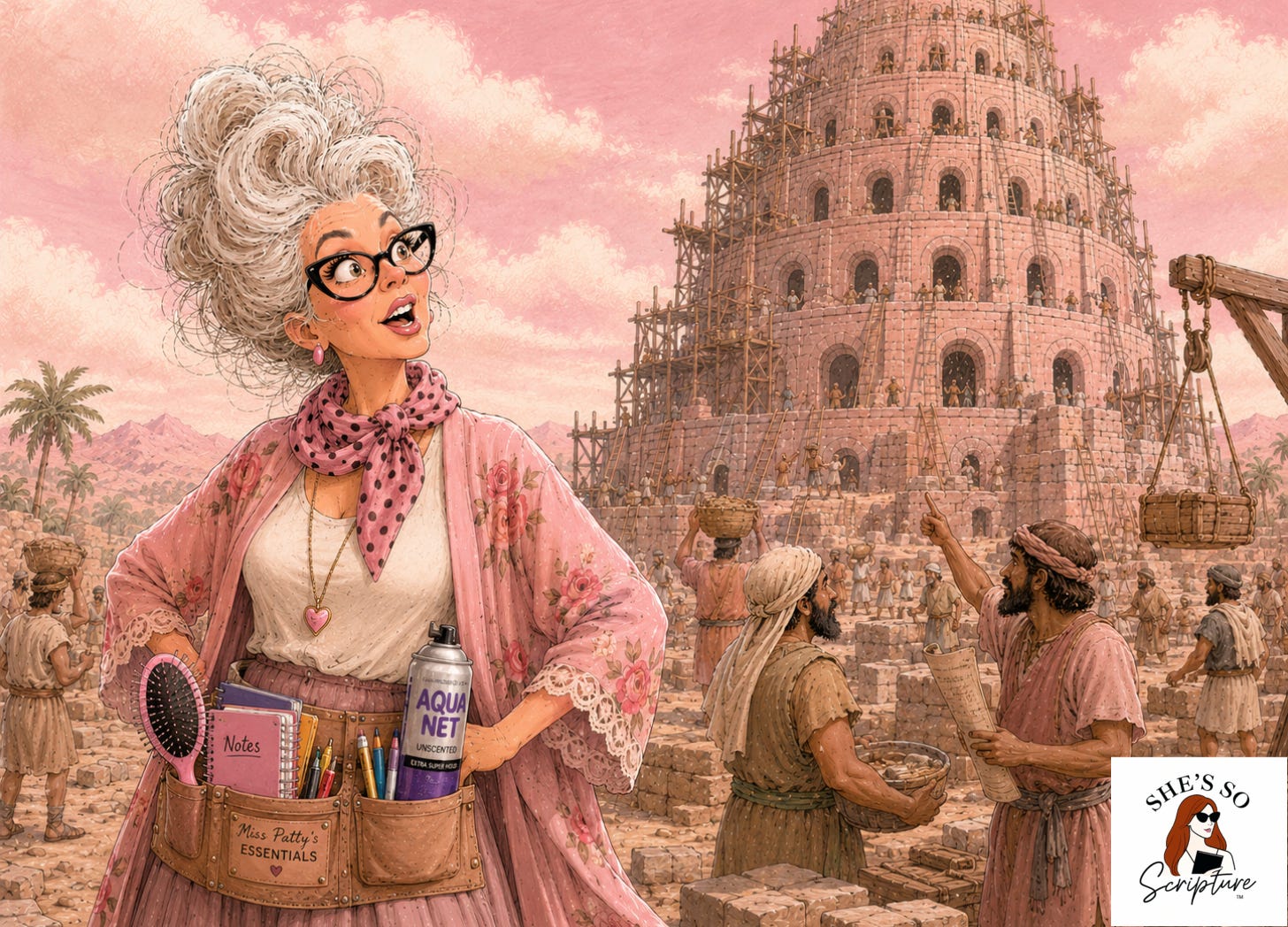
Miss Patty taught this one with total confidence. She had the felt board out. She had the little brick tower that went up, up, up, and then God knocked it down. Pride. Ambition. The end. She probably tied it to a sermon illustration about not getting too big for your britches and sent everyone home with a Rice Krispy treat.
And honestly? She wasn’t entirely wrong. Pride is absolutely in this story. But she stopped at the surface, packed up her Aqua Net, and left before the really wild part.
Because the Tower of Babel is not just a morality tale about human ambition. It’s the opening chapter of a cosmic drama that doesn’t resolve until Acts 2. And if you’ve never seen that thread running through the scriptures, you’ve only been reading half a story.
Let’s fix that.
The Tower of Babel - The Story You Think You Know
Genesis 11 opens with the whole earth sharing one language. Humanity settles in the land of Shinar, which is ancient Babylonia, present-day Iraq. They start building. Not just a city, but a tower with its top in the heavens. Their stated goal is chilling in its honesty:
“let us make a name for ourselves, lest we be scattered over the face of the whole earth.” (Genesis 11:4, TLV)
God comes down, assesses the situation, and does something unexpected. He doesn’t destroy the tower. He doesn’t even really punish the people in any obvious way. He confuses their language, and they scatter.
Most Sunday school versions end the story there. God disrupted human pride. Lesson learned.
But the text itself is asking you a question you’re probably not asking back.
Why does this matter so much?
Why is language confusion the response?
And why does this come after Genesis 10, which already lists the nations with their own languages?
The narrative feels out of order because Moses is absolutely rearranging the story on purpose. He gives you the nations already scattered in Genesis 10, then in Genesis 11 he basically says, “Now let me explain how everybody ended up speaking different languages and falling apart.”
The disorder of the nations is not the mystery. Babel is. Genesis 10 shows you the fallout. Genesis 11 shows you the rebellion that caused it.
And here is what many readers miss… the scattering at Babel may not be just a punishment. Later biblical texts seem to look back at Babel as a turning point in how God relates to the nations.
The Part Miss Patty Definitely Did Not Cover
Flip to Deuteronomy 32. Moses is near the end of his life, singing what scholars call the Song of Moses. He looks back at history and says this:
“When the Most High gave the nations their inheritance, when He divided all of Adam’s children, He set the boundaries of the peoples according to the number of the sons of Israel. For the Lord’s portion is His people; Jacob is the lot of His inheritance.” (Deuteronomy 32:8-9, TLV)
Now here’s where the passage starts getting really interesting. Some ancient manuscripts say “sons of God” or “divine beings” instead of “sons of Israel,” and a lot of scholars think that older reading actually makes more sense in the Babel context because Israel didn’t even exist yet.
Which means if Moses is talking about the division of the nations after Babel, “sons of Israel” would be a very strange thing to say there.
Either way, the passage connects the division of the nations with God’s ordering of the peoples of the earth.
Seventy nations appear in Genesis 10. Seventy people go down to Egypt with Jacob in Genesis 46. That parallel does not feel accidental one bit.
But notice what Deuteronomy 32:9 adds. While the nations are divided and scattered, God keeps one people uniquely for himself. Jacob. Israel. The Lord’s own portion.
This isn’t just a neat little morality tale about pride and teamwork gone wrong. Humanity is openly resisting God’s purposes, trying to secure its own name, its own unity, and its own version of order apart from Him.
Babel is humanity saying, “We’ll build the world our way, actually.” The result is the division of the nations.
Humanity scatters in rebellion, and God starts building a covenant people through whom He plans to bring blessing back to the very nations that just fractured themselves.
And then Genesis 12 opens immediately with Abraham.
Babel to Abraham isn’t a random transition. It’s the direct response.
The Hebrew Word You Need
The city is called Babel from the Hebrew root balal (בָּלַל), meaning to mix, confuse, or mingle, and Scripture never lets you forget it. This is Babylon before it becomes Babylon. The name starts here, but the theology of it keeps echoing through the rest of the Bible.
By the time you get to the prophets, Daniel, and Revelation, Babylon is no longer just a geographic location. It becomes the symbol of humanity organizing itself in defiance of God while trying to look powerful, unified, and self-sufficient doing it.
And look at what the people at Shinar actually say:
“Let us make a name for ourselves.”
That is the heartbeat of Babel. Humanity grasping for glory, permanence, security, and identity apart from God.
But Scripture keeps answering Babel with the same response:
You do not establish the name. God does.
Right after Babel fractures the nations, God calls Abraham and says in Genesis 12:
“I will make your name great.”
Notice the difference. Babel tries to seize a name. Abraham receives one.
And ultimately that thread runs all the way to Philippians 2 where the Name above all names is not achieved through human self-exaltation but through humility, obedience, and self-emptying. Babel climbs upward trying to become divine. Yeshua descends in obedience and is exalted by the Father.
The Bible has been answering Babel for a very long time.
Verse Mapping Aid
Word: Balal (בָּלַל)
Pronunciation: bah-LAL
The root verb balal means to mix, mingle, or confuse. It’s used in culinary contexts in the Torah for mixing flour with oil in grain offerings. But here in Genesis 11, it becomes the name of a city and the theological shorthand for everything that happens when humanity decides to build its own identity apart from God.
The name Babel is a play on this word, though the Babylonians themselves understood “Babel” to mean “gate of god.” The irony is sharp: they thought they were building a gateway to the divine. God saw a mixing up, a confusion, a monument to displaced name-making.
The same root appears in Isaiah 64:6 in a different but related sense, describing things that are intermixed and disordered. When you trace balal through the Hebrew Bible, you find it consistently describing things that have been combined in a way that produces disorder rather than order.
Babel wanted unity. What they produced was balal.

Pentecost/Shavuot Is Not a Side Story
Here is what nobody told you: Pentecost/Shavuot begins the healing of Babel.
At Babel, one language became many. Nations were divided and scattered. The human family fractured along the lines of language, culture, and geography.
At Pentecost/Shavuot, the Ruach ha-Kodesh falls on a room full of Jewish disciples in Jerusalem, and they begin speaking in every language of the nations. Acts 2:4 in the TLV says:
“They were all filled with the Ruach ha-Kodesh and began to speak in other tongues as the Ruach enabled them to speak out.”
The crowd that gathered was a list of nations. Parthians, Medes, Elamites, residents of Mesopotamia, Cappadocia, Pontus, Asia, Egypt, Rome. Luke’s long list of nations likely echoes the Table of Nations from Genesis 10 being gathered again in Jerusalem.
Babel said: let us make a name for ourselves.
Pentecost/Shavuot said: here is the Name.
The languages didn’t disappear at Shavuot/Pentecost. The Spirit didn’t erase the nations. What began to be healed was the division itself. People from every nation, every language, every background heard the mighty works of God in their own tongue. Not because the languages were erased, but because the Spirit made them transparent to the truth.
That’s architecture. That is God continuing a restoration story that stretches all the way back to Genesis 11.
My Final Thoughts
The Tower of Babel is not merely a warning against ambition. It’s a turning point in the story of how God begins reclaiming what was lost in Eden and fractured in Shinar.
It sets up Abraham.
It sets up Israel.
It sets up the promise that through one people, all the nations of the earth would be blessed.
And Shavuot/Pentecost is the moment that promise starts going global.
Miss Patty’s felt board showed you a tower that fell. What she didn’t show you is the thread that runs from that tower straight through to a room in Jerusalem where every language in the world heard the gospel at the same time.
You were never just reading a story about a building. You were reading the beginning of a rescue operation.
Dig Deeper
These passages connect directly to what we covered today. Pause there for a moment and notice the pattern taking shape.
Genesis 10:1-32 — The Table of Nations. Read it as a map of what got scattered at Babel, and notice that 70 nations are listed.
Genesis 12:1-3 — God’s call to Abraham comes immediately after the Babel narrative. This is not a coincidence. This is the response.
Deuteronomy 32:8-9 — The Song of Moses looks back at Babel and describes what God was actually doing when he divided the nations.
Psalm 82 — God presides over a divine assembly and pronounces judgment. This psalm sits in the background of the Deuteronomy 32 worldview.
Acts 2:1-11 — Read the list of nations present at Pentecost/Shavuot alongside Genesis 10. Luke is doing something very deliberate with that geography.
Revelation 7:9-10 — The end of the story. Every nation, every language, every people gathered before the throne. Babel’s scattering fully reversed.
Let’s Talk in the Comments
What’s a Bible story you were taught as a standalone moral lesson that you’ve since discovered is part of a much bigger pattern?
And did you catch the Babel-to-Abraham connection before today, or is that new for you? I genuinely want to know.
If this study stirred something in you, share it with a friend who’s been reading the Bible as a collection of separate stories instead of one massive, connected rescue mission.
And if it left you wanting to go slower and deeper into the Word, I’ve got you! Paid subscribers get access to live Bible studies, extended studies, devotionals, theological teaching, spiritual formation practices, and a community of people who want depth without pressure or performance. If you’re ready to step further into the Word, you’re welcome inside.
👉🏻 Join The Vault.
If a paid subscription isn’t feasible right now but this space has blessed you, you can leave a one-time tip here. Every gift helps sustain this work. 💕

This is what we’re building here. Women who actually engage the text and don’t apologize for it.
If that’s “extra,” we’re fine with that.
In fact… we put it on a t-shirt.
“She’s not extra. She’s exegetical.”
You can get yours here.
About the Author
Diane Ferreira is a Jewish believer in Yeshua, a published author, speaker, seminary student, wife, and proud mom. She is the founder of She’s So Scripture and She Opens Her Bible. She is the author of several books, including The Proverbs 31-ish Woman, which debuted as Amazon’s #1 New Release in Religious Humor, as well as Holy, Hormonal and Holding On.
She is currently pursuing her graduate degree in Jewish Studies in seminary, with her favorite topics being the early church and Biblical Hebrew. Diane writes and teaches from a unique perspective, bridging her Jewish heritage with vibrant faith in the Messiah to bring clarity, depth, and devotion to everyday believers.
When she’s not writing, studying, or teaching, you’ll find her curled up with a good book, crocheting something cozy, traveling, or playing her favorite video games.
Tree of Life (TLV) – Scripture taken from the Holy Scriptures, Tree of Life Version*. Copyright © 2014,2016 by the Tree of Life Bible Society. Used by permission of the Tree of Life Bible Society.
I love the connections. I can honestly say I have never made the connection between the scattering of the nations and languages and Acts 2. So cool. Thank you.
I never made this connection! 🤯. It makes perfect sense, though…and kind of a “duh!” that it is so often missed!
This makes Shavuot/Pentecost mean even more.
It is so beautiful how intentional and systematical God is in redemption throughout Scripture.