



Close your eyes for a moment and imagine it.
The Tabernacle stands at the center of the Israelite camp, its linen curtains shimmering white in the desert sun. Inside, dressed in robes of blue, purple, and scarlet, the High Priest prepares to enter the presence of God. On his chest — heavy with gold, woven with precision, and set with twelve gleaming stones — rests the breastplate. Pressed close to his heart.
And tucked inside that sacred breastplate? Two mysterious objects the Bible calls the Urim and Thummim.
A nation waits. A king needs an answer. A people need to know what God would have them do. And so the High Priest stands before the Lord — carrying the people on his chest, bearing their questions in his hands — and he seeks.
What were these objects? What did they do? And perhaps most important for those of us who study Scripture today: what does this ancient, mysterious practice of seeking God’s will tell us about how we are to approach Him now?
That is what we are going to explore together.
What Do Urim and Thummim Mean in Hebrew?
Before we can understand what the Urim and Thummim did, we need to understand what they are called… because in Hebrew, names are never accidental.
The word Urim (אוּרִים) comes from the Hebrew root אוֹר (“or”) meaning light. It is the same root word used in Genesis 1:3, when God spoke the first words of creation:
“Then God said, “Let there be light!” and there was light.”
Genesis 1:3, TLV
Light, in Hebrew thought, is never merely physical brightness. It carries the weight of revelation… of God making something known that was hidden, illuminating a path through the darkness. When Israel needed to know God’s will, they turned to an instrument literally named Illumination.
אוּרִים
Urim
“Lights” or “Illuminations”
Root: אוֹר (or) — the same root as Genesis 1:3, “Let there be light.” God’s guidance as divine illumination.
The word Thummim (תֻּמִּים) comes from the root תָּם (“tam”) meaning wholeness, completeness, blamelessness, or truth. This is the same root used to describe Job, of whom God Himself said he was “blameless and upright” (Job 1:8), and of Noah, who was “righteous” and “blameless in his generation” (Genesis 6:9).
תֻּמִּים
Thummim
“Perfections,” “Truth,” or “Integrity”
Root: תָּם (tam) — wholeness and blamelessness. Used of Job (Job 1:8) and Noah (Genesis 6:9). God’s guidance as perfect truth.
Together, Urim and Thummim paint us a breathtaking picture: Lights and Perfections.
God’s guidance is both illuminating and perfect. His word doesn’t lead us into darkness or error. When He speaks, He speaks as the God who is Light (1 John 1:5) and Truth (John 17:17).
And this is no coincidence. In John 8:12, Yeshua declares:
“I am the light of the world. Whoever follows Me will never walk in darkness, but will have the light of life.”
John 8:12, TLV
The Urim was not pointing to a stone. It was pointing to a Person.
The High Priest’s Breastplate: A Sacred Dwelling Place
To understand the Urim and Thummim, we need to understand where they lived.
God gave Moses precise instructions for the vestments of the High Priest; garments that were not just ornamental but deeply theological. Among the most sacred of these was the Hoshen (חֹשֶׁן), the breastpiece of decision, also translated as the breastplate of judgment.
חֹשֶׁן
Hoshen
“Breastpiece of Decision” or “Breastplate of Judgment”
The sacred pouch worn over the High Priest’s heart, set with twelve stones representing the twelve tribes of Israel. The dwelling place of the Urim and Thummim.
The instructions for this breastplate are given in extraordinary detail in Exodus 28. God told Moses:
“Also put the Urim and the Thummim within the breastplate of judgment, so they will be on Aaron’s heart when he goes in before Adonai. Aaron will bear the judgment of Bnei-Yisrael on his heart before Adonai continually.”
Exodus 28:30, TLV
Notice the emphasis: over his heart. The High Priest didn’t carry the people’s need for guidance in his hands, or on his shoulders, or at his side. He carried it over his heart.
This was deliberate.
The twelve stones on the breastplate bore the names of the twelve tribes… every family of Israel resting on the chest of the one who stood before God.
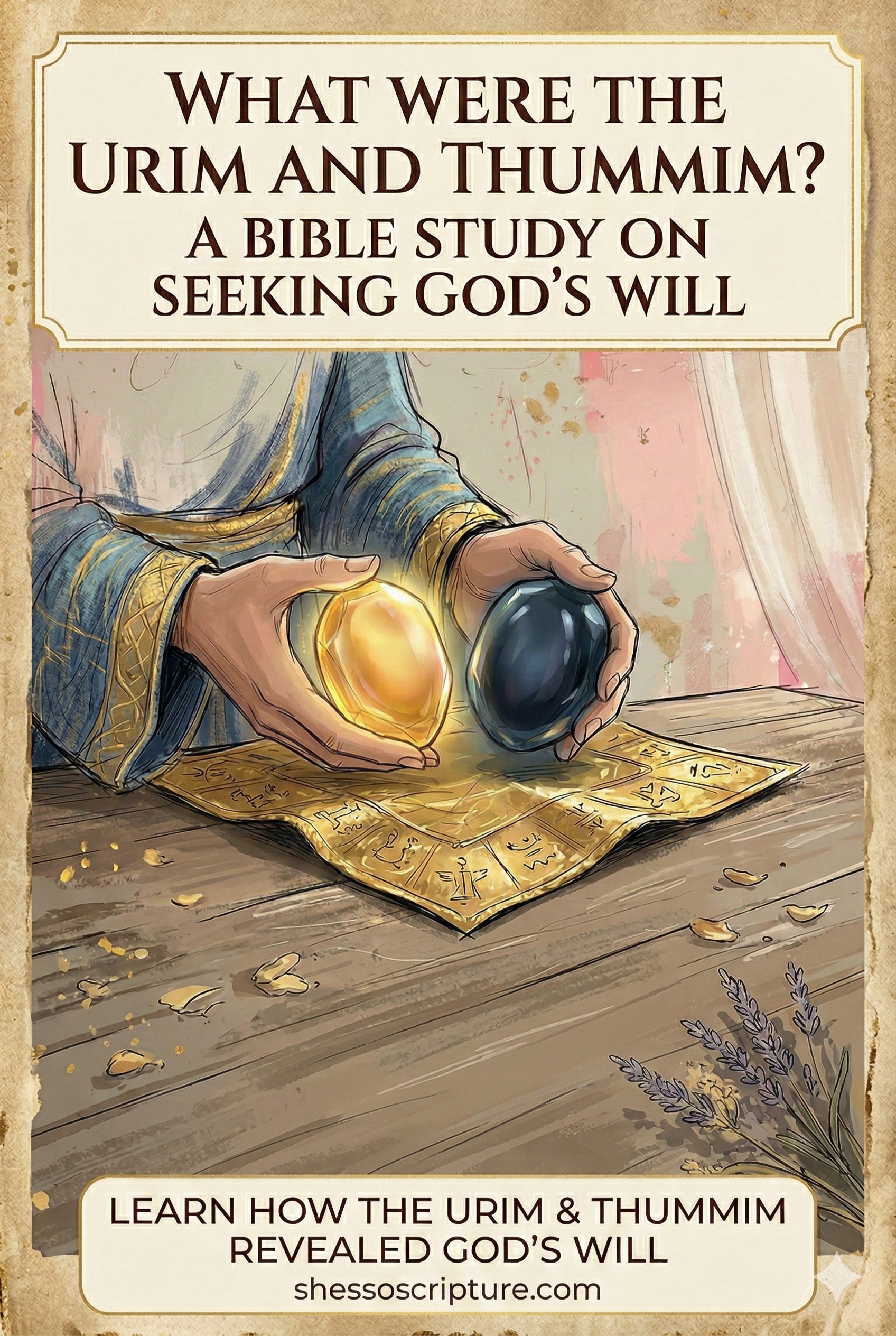
The Urim and Thummim were placed inside this breastplate; tucked into a pouch, hidden from view, held close.
What exactly were they?
Here the Bible is intentionally silent, and scholars have offered several theories over the centuries. Some believe they were two polished stones, one representing “yes” and one representing “no.”
Others suggest they were flat tablets, perhaps of wood or bone, with words or symbols inscribed.
The Talmudic tradition holds that the Urim and Thummim were a piece of parchment inscribed with the divine name of God… the very Name that illuminates and perfects.
The Beautiful Mystery
God never tells us exactly what the Urim and Thummim looked like. Some scholars suggest this was intentional; the power was never in the objects themselves, but in the God who answered through them. The method was hidden; the One who spoke through it was revealed.
They were also connected to the Ephod (אֵפוֹד)… the sacred vest or apron worn beneath the breastplate. Throughout the historical books of the Old Testament, when we read that someone “inquired of God” using the Ephod, scholars understand this to mean they were consulting the Urim and Thummim. The two were inseparable.
Inquiring of the Lord: The Urim and Thummim in Action
The Urim and Thummim appear at key turning points in Israel’s story, moments when the stakes were high, when human wisdom was not enough, when the people desperately needed to know what God would have them do.
Let’s walk through these moments together.
Aaron’s Consecration — Leviticus 8:8
The first recorded use comes when Aaron is consecrated as High Priest. Moses places the breastplate on him and then, fittingly, sets the Urim and Thummim within it (Leviticus 8:8). They are given to the priest before the priest ever performs a single priestly duty. Seeking God’s will is not an afterthought. It is foundational.
Joshua’s Leadership — Numbers 27:21
When Moses commissions Joshua as his successor, God gives a striking instruction: Joshua is to stand before Eleazar the High Priest, who will “inquire for him by the judgment of the Urim before Adonai” (Numbers 27:21).
The leader of God’s people was not to trust his own instincts alone. Even Joshua…mighty, faithful Joshua…was to seek God through His appointed means.
Saul and Jonathan — 1 Samuel 14:37–41
In the heat of battle, Saul inquires of God whether to pursue the Philistines. But God doesn’t answer, because there is unconfessed sin in the camp. The Urim and Thummim are used to identify who’s at fault, and the process points to Jonathan, who had unknowingly broken his father’s rash vow.
This passage gives us a crucial insight: the Urim and Thummim were not a mechanical oracle that always dispensed a tidy answer. God was sovereignly present in the process, and sometimes His answer was silence.
God’s Silence to Saul — 1 Samuel 28:6
This may be the most sobering mention of the Urim and Thummim in all of Scripture:
“When Saul inquired of Adonai, Adonai did not answer, neither by dreams nor by Urim or prophets.”
1 Samuel 28:6, TLV
Saul sought God’s guidance through every available means and received only silence. This was not because the Urim and Thummim had failed. It was because Saul had spent years turning away from the God he was now desperately trying to reach. Seeking God is sacred, but it requires a heart that has been walking with Him, not merely running to Him in crisis.
The Return from Exile — Ezra 2:63
This is the final biblical mention of the Urim and Thummim. After the Babylonian exile, some men could not prove their priestly lineage. The governor told them they could not eat of the most holy things “until there stood up a kohen with Urim and Thummim” (Ezra 2:63). The Urim and Thummim are invoked as the ultimate authority for settling what human records could not resolve.
And then they are never mentioned again in Scripture.
Lost With the Temple — But Not the Voice
The Urim and Thummim were lost when Solomon’s Temple was destroyed by Babylon in 586 BC. Rabbinical tradition confirms they were absent from the Second Temple; present in the chamber but silent, as if waiting.
But here is what the loss of the Urim and Thummim does NOT mean: it does not mean God stopped speaking.
In the very era when the Urim and Thummim fell silent, the voices of the classical prophets grew louder — Isaiah, Jeremiah, Ezekiel, Daniel. God did not withdraw His guidance from His people. He shifted His method.
He moved from objects to voices, from breastplate to burning hearts, from sacred stones to sacred words written on scrolls.
And then He did something more magnificent still. The writer of Hebrews opens his letter with these words, read on Shabbat in many Messianic Jewish congregations:
“At many times and in many ways, God spoke long ago to the fathers through the prophets. In these last days He has spoken to us through a Son, whom He appointed heir of all things and through whom He created the universe.”
Hebrews 1:1–2, TLV
The Urim and Thummim were one portion, one way. The Son is the fullness.
The One Who Bears Us on His Heart
Everything we have seen in the High Priest and the Urim and Thummim — the breastplate, the heart, the seeking, the intercession — points forward to One greater than Aaron.
The book of Hebrews is the great commentary on the Old Testament priesthood, and it tells us plainly who the High Priest of our seeking is:
“Therefore, since we have a great Kohen Gadol who has passed through the heavens, Yeshua Ben-Elohim, let us hold firmly to our confession. For we do not have a kohen gadol who is unable to sympathize with our weaknesses, but One who has been tempted in all the same ways — yet without sin. Therefore, let us draw near to the throne of grace with confidence, so that we may receive mercy and find grace to help us in time of need.”
Hebrews 4:14–16, TLV
Read that again slowly. We have a Kohen Gadol… a High Priest. And He has not merely entered the Tabernacle. He has passed through the heavens.
Aaron bore the names of twelve tribes on his chest. Yeshua bears your name before the Father… not on a stone, but in the wounds of His hands, written on His heart.
The Urim meant light, and Yeshua declares: “I am the light of the world” (John 8:12).
The Thummim meant truth and perfection, and Yeshua declares: “I am the way, the truth, and the life” (John 14:6).
The Urim and Thummim were not the destination. They were the signpost.
From Stones to Spirit
We no longer need sacred objects to know the will of God — we have been given something far greater. ‘But when the Spirit of truth comes, He will guide you into all the truth. He will not speak on His own; but whatever He hears, He will speak. And He will tell you what is to come.’ — John 16:13, TLV
The Holy Spirit, given at Pentecost (Shavuot), is the living fulfillment of what the Urim and Thummim could only point toward. Not an object pressed to a chest, but a Presence dwelling within… illuminating, guiding, perfecting, whispering the very will of God to those who have ears to hear.
What the Urim and Thummim Teach Us About Seeking God’s Will Today
We may not carry sacred stones in a breastplate. But we are still called to the same sacred act: seeking.
The Urim and Thummim remind us that seeking God’s will was never casual in Israel. It was not something the people did on a whim, in a hurry, or as a last resort after exhausting every human option. Seeking God’s will through the Urim and Thummim required:
The right person. Only the High Priest could inquire through the Urim and Thummim. Not because God was inaccessible to ordinary Israelites, but because the structure God established reflected the seriousness of the act. Seeking required a mediator who was set apart, consecrated, and prepared.
The right posture. The one seeking stood behind the High Priest, who stood facing the Holy Ark… oriented entirely toward God. Before a question could be asked, both the priest and the questioner had to position themselves in the direction of His presence.
The right heart. The silence given to Saul was not a failure of the Urim and Thummim. It was a revelation of Saul’s heart. God’s willingness to speak was inseparable from the seeker’s willingness to listen and obey.
We now approach something even more wonderful than what Israel had. We don’t come through a High Priest who enters a tent, but through the High Priest who has entered the very presence of the eternal God and lives to intercede for us (Hebrews 7:25).
We have the Word of God, living and active (Hebrews 4:12). We have the Holy Spirit, our Counselor and Guide (John 16:13). We have the community of believers, the body of Messiah, through whom God so often speaks.
And we have the invitation: draw near with confidence.
What would it look like to approach seeking God’s will with the same sacred intentionality the High Priest brought to the Urim and Thummim? To orient ourselves toward Him before we speak? To come not with demands but with open hands? To trust that the God who answered Israel still answers, still illuminates, still perfects, still speaks?
That is the invitation hidden in two ancient Hebrew words.
Urim. Thummim. Lights. Perfections.
He is still both.
Selah — A Moment to Seek
The Hebrew word selah appears throughout the Psalms… an ancient instruction to pause, to still, to let what has just been said settle into the soul. Before you move on, take a moment here.
Pause and Reflect
Is there an area of your life right now where you are desperately seeking God’s will but maybe approaching it in haste, or in fear, rather than in the sacred posture of someone who trusts that He will answer? The High Priest bore the names of the tribes over his heart. You are known. You are carried. You are not inquiring of a God who is distant or indifferent. What would it look like this week to bring one specific question to Him; slowly, intentionally, with an open and obedient heart?
Frequently Asked Questions About the Urim and Thummim
What were the Urim and Thummim used for?
The Urim and Thummim were sacred objects carried by the High Priest of Israel inside the breastplate of judgment (Hoshen). They were used to seek God’s will and receive divine guidance on matters of national importance… such as whether to go to war, or to identify guilt or innocence. Only the High Priest could use them, and they functioned as a divinely appointed means of inquiry rather than mere fortune-telling.
Where are the Urim and Thummim mentioned in the Bible?
The Urim and Thummim appear in Exodus 28:30, Leviticus 8:8, Numbers 27:21, Deuteronomy 33:8, Joshua 7, 1 Samuel 14:37–41, 1 Samuel 28:6, and Ezra 2:63. The Ezra passage is the final biblical mention. Scholars also believe references to “inquiring of God” through the Ephod in the historical books imply the use of the Urim and Thummim.
What happened to the Urim and Thummim?
The Urim and Thummim were lost when Solomon’s Temple was destroyed by Babylon in 586 BC. Rabbinical tradition confirms they were absent from the Second Temple. Their disappearance coincided with the rise of the classical prophets, suggesting that God shifted His means of speaking to His people… ultimately culminating in the revelation of His Son, Yeshua, and the gift of the Holy Spirit.
What do the words Urim and Thummim mean in Hebrew?
Urim (אוּרִים) comes from the Hebrew root or (אוֹר), meaning light or illumination, the same root used in Genesis 1:3. Thummim (תֻּמִּים) comes from the root tam (תָּם), meaning perfection, wholeness, or truth. Together they mean Lights and Perfections, describing God’s guidance as both illuminating and perfect.
Are the Urim and Thummim connected to Jesus?
In a profound way, yes. Yeshua (Jesus) is described in Hebrews as our Great High Priest who intercedes for us before the Father. Where the Urim pointed to divine light, Yeshua declares ‘I am the light of the world’ (John 8:12). Where the Thummim pointed to perfection and truth, Yeshua declares ‘I am the way, the truth, and the life’ (John 14:6). The Urim and Thummim were a shadow; Christ is the substance.
If this study stirred something in you, share it with a friend who might need it too.
And if it left you wanting to go slower and deeper into the Word, I’ve got you!
Paid subscribers get access to live Bible studies, extended studies, devotionals. theological teaching, spiritual formation practices, and a community of women who want depth without pressure or performance.
If you’re ready to step further into the Word, you’re welcome inside.
If a paid subscription isn’t feasible right now but this space has blessed you, you can leave a one-time tip here. Every gift helps sustain this work. 🤍

Tree of Life (TLV) – Scripture taken from the Holy Scriptures, Tree of Life Version*. Copyright © 2014,2016 by the Tree of Life Bible Society. Used by permission of the Tree of Life Bible Society.
Today, if we ask the Lord directly to teach us how to hear His voice and verify it, He will give you a personal method which works for you. Just ask him. I've written about this a lot. It's one of the reasons the Holy Spirit was given to us.
This is such an interesting topic. I’ve read references to the Urim and Thummim before, but I don’t think I’ve ever really slowed down to understand what they were or what they reveal about Israel’s dependence on God for direction.