


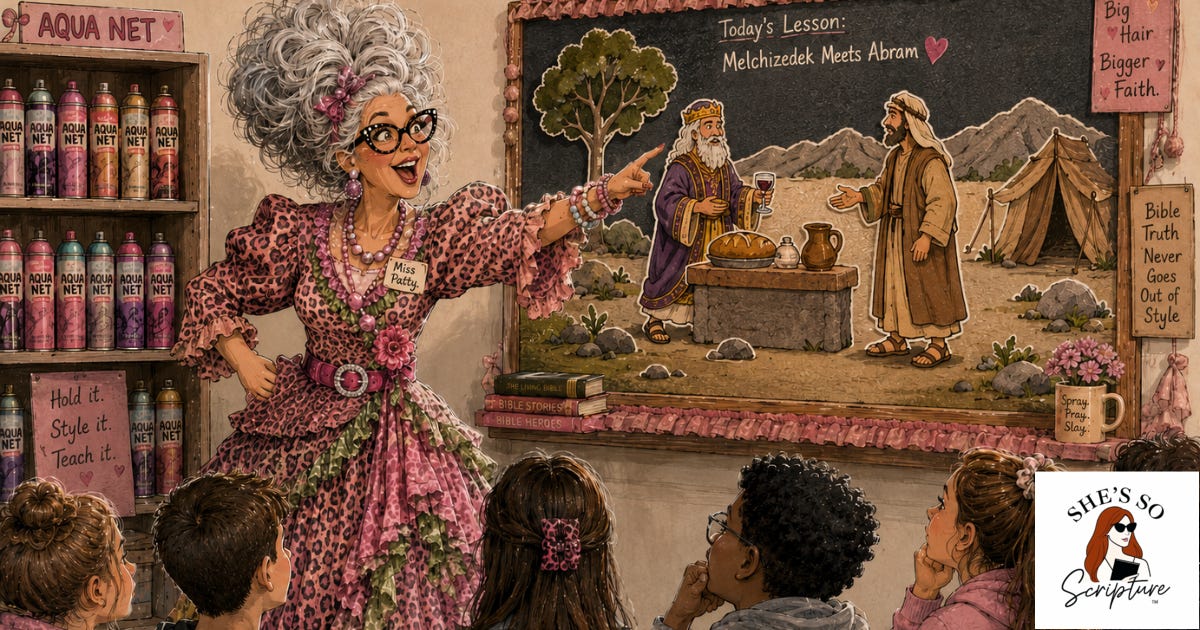
If you grew up in church, you know Miss Patty covered exactly one Melchizedek fact in fourteen years of Sunday School, and it was usually mumbled somewhere between the felt board Noah’s Ark and the snack table. “He was a mensch... a very nice man. He brought Abraham bread.” And then we moved on like a guy showing up out of nowhere, blessing the father of our faith, and then vanishing off the page was just a Thursday.
It was not just a Thursday. Genesis handed us one of the strangest, most theologically loaded characters in the entire Bible, gave him a handful of verses, and then let him go dark.
Psalm 110 brings him up again, and many centuries after that, Hebrews finally unfolds why any of it mattered. Miss Patty skipped the setup for one of the longest running threads in the whole Bible… must have been the Aqua Net.
The King Who Showed Up With No Introduction
Right after Abram wins a battle he had no business winning, a king named Melchizedek walks out to meet him. Genesis tells it plain:
“Then Melchizedek, king of Salem, brought out bread and wine—he was a priest of El Elyon. He blessed him and said, ‘Blessed be Abram by El Elyon, Creator of heaven and earth, and blessed be El Elyon, who gave over your enemies into your hand.’ Then Abram gave him a tenth of everything.” (Genesis 14:18-20, TLV)
No backstory. No “and this was the son of.” Abram, the man carrying the covenant promises, hands this stranger-priest a tenth of the spoils from the battle he just won. Genesis doesn’t stop to explain him. It just lets his authority stand there, unbothered, like it expects you to notice.
Two Kings Walk Out to Meet Abram, and Only One of Them Matters
Here’s a detail Miss Patty completely skipped. Melchizedek isn’t the only king who comes out to greet Abram after the battle. The king of Sodom shows up too, offering Abram all the recovered goods in exchange for the people back. Abram takes the blessing from Melchizedek and refuses everything from the king of Sodom, swearing an oath by “the LORD, God Most High, Creator of heaven and earth,” that Sodom will never get to say, “I made Abram rich.”
Notice what just happened. Melchizedek blessed Abram in the name of El Elyon, God Most High, and a few verses later Abram uses that exact title, but attaches it to the LORD, the covenant name of Israel’s own God. Abram isn’t treating El Elyon as some unrelated local deity he’s politely nodding at. He identifies Melchizedek’s God as his own God in his own oath. That’s the text quietly confirming that this mysterious priest-king isn’t operating outside the story God is telling, he’s inside it.
A Name Worth Slowing Down On
The Hebrew name Malki-Tzedek is old enough that scholars have proposed a few different ways to parse it.1 Hebrews itself translates the name as “king of righteousness,” and that’s the canonical meaning Hebrews builds into its priesthood argument.
The first part, malki, comes from the Hebrew word melech (מֶלֶךְ), meaning “king.” The ending -i (ִי) is a possessive suffix that means “my.” So malki literally means “my king.”
The second part, tzedek, means “righteousness” or “justice.”
Put together, Malki-Tzedek means “My King is Righteousness” or more personally, “My King of Righteousness.” This adds a very personal layer to the title.
It doesn’t just describe what kind of king he is, it expresses a relationship. It reminds us that righteousness isn’t just a concept; it’s tied to a Person. When we say Yeshua is in the order of Malki-Tzedek, we’re not only affirming His role as a righteous king and priest, we’re declaring, He is my King of Righteousness.
Hebrews doesn’t stop with his personal name either. It also reads his title, king of Salem, as “king of peace,” so the man walks into the story carrying righteousness and peace before he ever says a word. Salem is related to the same Hebrew root as shalom (ש־ל־ם -sh-l-m), the word often translated peace, but carrying the broader sense of wholeness, completeness, and well-being.
That is why Hebrews can read “king of Salem” as “king of peace.”So even before we know a single fact about this man, his name and his title are already preaching, at least according to the interpretation Scripture gives us the authority to use.
No Birth Certificate, No Death Certificate, No Problem
Here’s where Sunday School really left the building. Hebrews describes Melchizedek as “without father, without mother, without genealogy, having neither beginning of days nor end of life,” and then adds the phrase Miss Patty definitely never mentioned… that he is “resembling the Son of God.”
That last part matters. Hebrews isn’t saying Melchizedek had no actual parents, or that Yeshua was somehow modeled after him chronologically. It’s saying Genesis gives him no genealogy, and in a Bible where priestly service depended entirely on proving your lineage, that silence is doing definitely doing some heavy theological lifting.
Under Israel’s priestly system, lineage determined eligibility, and after the exile, priests who couldn’t verify their family line in the records were actually excluded from serving, according to Ezra. Melchizedek shows up with none of that at all, and Hebrews uses the gap on purpose.
Some early Jewish interpreters identified Melchizedek with Shem, Noah’s son, still alive in Abraham’s day.2 Others took a more mysterious view. The Qumran community went so far as to picture him in an exalted end-times role as judge and redeemer.
Scripture itself never settles the question, and neither will I, but the mystery here has fascinated Jewish readers for a very long time.
The Priesthood That Outranked Levi Before Levi Existed
Once the Law came through Moses, the priesthood and the throne were ordinarily kept distinct offices. Israel’s kings sometimes carried out priest-adjacent roles, David wore a linen ephod, Solomon led the dedication of the Temple, but priestly service itself belonged to Aaron’s line, and the boundary was real enough that King Uzziah got struck with a skin disease for trying to burn incense himself.
Which makes Melchizedek even more startling, because centuries before Sinai, centuries before Aaron, and centuries before David’s own one line bombshell in Psalm 110 (v 4), this man is already holding both titles at once without apology.
Here’s the part Hebrews really wants you sitting with. Abraham’s great-grandson Levi, the one whose descendants would become the entire priesthood, wasn’t born yet when this meeting happened. But Hebrews argues that because Levi was still in Abraham’s body, so to speak, when Abraham paid that tithe from the battle spoils, Levi effectively paid tithes to Melchizedek too, through his own ancestor.
Which means the entire Levitical priesthood, before it even existed, already bowed to this man’s priesthood. That is some serious rabbinic-style reasoning, and it’s exactly how Hebrews builds its case that Melchizedek’s priesthood outranks the one Israel would later live under.
Hebrews isn’t playing Bible trivia here. If the priesthood changes, the whole way mediation works has to be reconsidered, which is why Melchizedek becomes such a big deal in the argument.
That’s the setup for Psalm 110:4, where David, traditionally understood as the psalmist, writes:
“Adonai has sworn, and will not change His mind: ‘You are a kohen forever according to the order of Melchizedek.’”
A priesthood that was never dependent on bloodline in the first place. Yeshua came from Judah, not Levi, which means He was not qualified to serve as a priest under the Levitical system. According to Hebrews, He isn’t sneaking around the rules. He’s fulfilling a priesthood that outranked those rules before they ever existed.

Bread, Wine, and a Table Yet to Come
Melchizedek didn’t bring animals to the meeting. He brought bread and wine, priestly hospitality for a man returning from war. Many Christians have also read that detail typologically, seeing in Genesis an early whisper of the table language that later gathers around Messiah, a Jewish rabbi holding bread and wine, telling His friends this is Him. Genesis itself doesn’t spell that connection out. It’s a reading the church has held for a very long time, and one worth holding with open hands rather than with certainty.
Verse Mapping Aid
Malki-Tzedek (מַלְכִּי־צֶדֶק) — a Hebrew name old enough to invite more than one scholarly reading. Hebrews 7:2 gives us the interpretation Scripture itself uses for its argument: king of righteousness, king of Salem read as king of peace.
My Final Thoughts
Miss Patty had fourteen years and one felt board to cover the whole Bible, so I’m not dragging her too hard. But Melchizedek deserved more than a footnote before snack time. He isn’t important because Scripture tells us a lot about him. He’s important because Scripture tells us just enough, and lets later revelation show why the silence mattered.
Dig Deeper
Genesis 14:18-24, Psalm 76:2, Psalm 110:4, Hebrews 5:5-10, Hebrews 7:1-17, Ezra 2:61-63, Matthew 26:26-28, 1 Peter 2:9
Let’s Talk in the Comments
Before today, did you know Melchizedek shows up in Genesis, gets picked back up in Psalm 110, and then Hebrews spends two whole chapters unpacking why that mattered?
Of everything here, the two kings meeting Abram at the same moment, the name Hebrews reads as king of righteousness, or Levi paying tithes before he was even born, which one is settling with you the most right now? Tell me below, I read every single one.
If this study stirred something in you, share it with a friend!
Want to go slower and deeper into the Word? Paid subscribers get access to live Bible studies, extended studies, devotionals, theological teaching, spiritual formation practices, and a community of people who want depth without pressure or performance. If you’re ready to step further into the Word, you’re welcome inside.
If a paid subscription isn’t feasible right now but this space has blessed you, you can leave a one-time tip here. Every gift helps sustain this work. 💕

About the Author
Diane Ferreira is a Jewish believer in Yeshua, a published author, speaker, seminary student, wife, and proud mom. She is the founder of She’s So Scripture and She Opens Her Bible. She is the author of several books, including The Proverbs 31-ish Woman, which debuted as Amazon’s #1 New Release in Religious Humor, as well as Holy, Hormonal and Holding On.
She is currently pursuing her graduate degree in Jewish Studies in seminary, with her favorite topics being the early church and Biblical Hebrew. Diane writes and teaches from a unique perspective, bridging her Jewish heritage with vibrant faith in the Messiah to bring clarity, depth, and devotion to everyday believers.
When she’s not writing, studying, or teaching, you’ll find her curled up with a good book, crocheting something cozy, traveling, or playing her favorite video games.
Footnotes:
See “Melchizedek,” in Anchor Yale Bible Dictionary, ed. David Noel Freedman; also Brown, Driver, and Briggs, Hebrew and English Lexicon of the Old Testament, s.v. צֶדֶק. Hebrews 7:2 supplies the interpretive meaning used in the New Testament argument.
Targum Pseudo-Jonathan on Genesis 14:18; Babylonian Talmud, Nedarim 32b. Both reflect Jewish traditions identifying Melchizedek with Shem.
So good! I love where you leave it. ;)
I knew those things but held them more like separate pieces of knowledge. The way you put or brought them together makes it real in a new way, deeper, I would even say awesome. In myself it makes me bow before the Lord. The Scripture that comes to mind: O the depth of the riches and wisdom and knowledge of God! How unsearchable his judgments and how inscrutable are his ways! (Romans 11:33) I love the King James: “and his ways past finding out!” Shalom