


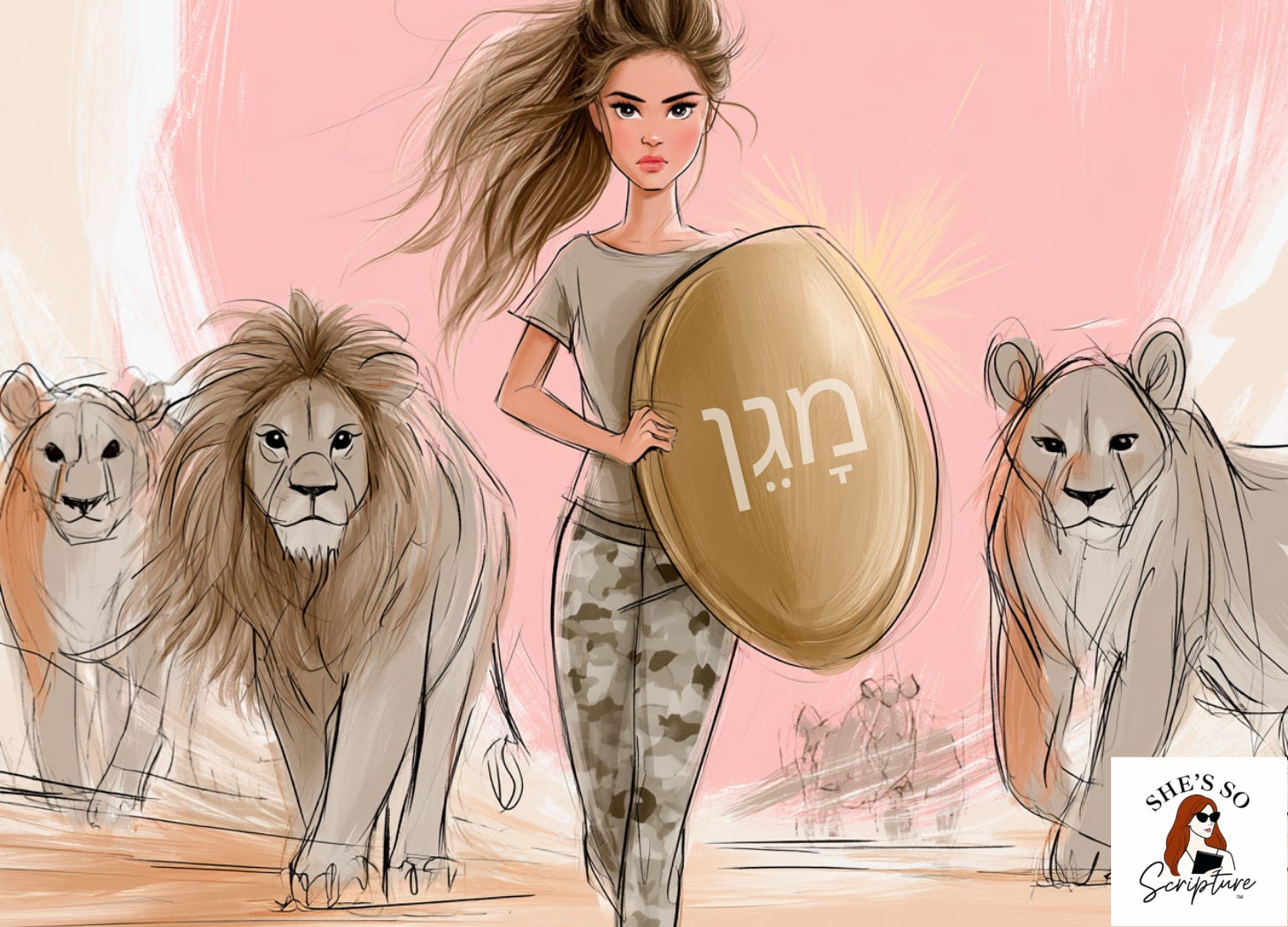
You’ve probably seen the word “shield” so many times in your Bible that it stopped registering. It became furniture. Background. One of those words that slides right past you on the way to the next verse.
But I want you to slow down on this one. Because the Hebrew word behind it is magen (מָגֵן, pronounced mah-GEN), and it shows up about 63 times in Scripture, and once you understand what it actually means and where it comes from, it will change how you see “God is my shield” from here on out.
Not because the meaning is complicated. Because it’s personal. Way more personal than we usually let it be.
The Word Magen Itself
Magen is related to the Hebrew root ganan (גָּנַן), which evokes the image of providing cover, protection, and defense. That root gives this word its weight. When Scripture reaches for magen, it’s reaching for something active, something that gets between you and the threat.
The magen was a shield carried into battle, used for active protection. It wasn’t something you planted in the ground and stood behind. It was something that moved with you, responded to the threat, went where you went.
Think about that. The image Scripture uses for God’s protection isn’t a wall you stand behind. It’s a shield that moves.
Where It First Appears: Genesis 15:1
The first time magen appears in Scripture, it’s not a soldier picking up a piece of equipment. It is God speaking to a frightened man in the middle of the night.
And, as always, context matters. Abraham had just come out of a battle. He rescued his nephew Lot, defeated four kings, turned down the king of Sodom’s reward, and now he’s alone in the dark wondering what comes next. The enemies he defeated might regroup. He has no heir. He’s old and tired and probably more scared than he’s letting on.
And into that specific moment, God says this:
“Do not fear, Abram. I am your shield, your very great reward.” — Genesis 15:1 (TLV)
Not: I will give you a shield. Not: I will send protection.
I AM your shield.
God identifies Himself as the magen. The shield is not an object God provides. The shield is a person. It’s Him. Standing between Abraham and everything threatening to undo him.
That’s the theological foundation this word is built on, and every other occurrence in Scripture carries that weight.
Magen in the Psalms: David Writes from the Floor
Magen appears more than 20 times in the Psalms alone, and the writers don’t use it casually. They use it when they are in actual trouble.
Psalm 3 is one of the most incredible examples. The superscription tells you exactly when David wrote it. “A Psalm of David, when he fled from Absalom his son.”
A quick note on numbering: because the TLV follows Hebrew numbering that counts the superscription as verse 1, the verse you may know as Psalm 3:3 in English Bibles appears as Psalm 3:4 in Hebrew numbering. Same words, different numbering. Worth knowing so you’re not confused when you look it up.
“A Psalm of David, when he fled from his son Absalom. ADONAI, how many are my foes! Many are rising up against me! Many are saying to my soul: ‘There is no deliverance for him in God.’ Selah But You, ADONAI, are a shield around me, my glory and the lifter of my head.” — Psalm 3:1-4 (TLV)
Let that context land for a second. David isn’t writing from victory. He is running from his own son. Absalom, the son David loved and mourned and refused to execute even after his crimes, has taken the throne, and David is fleeing Jerusalem on foot, barefoot, weeping. His own people are saying God has abandoned him.
And in the middle of that specific, humiliating, gut-wrenching night, he calls God his magen.
A shield around me. Not just in front of me. The Psalm describes surrounding protection, God between David and whatever is closing in.
I want to be clear that’s the teaching picture Scripture invites here, not a claim buried in the root of the word itself. But what a picture it is. David chose this word on his worst night, and he meant every syllable of it.
Magen Avraham: The Shield That Became a Prayer
Here’s where it gets extraordinarily beautiful for anyone who has spent time around Jewish liturgy, and I want to bring you into this because it rewires how you read the whole of Scripture.
The Amidah is the central standing prayer of Jewish worship, prayed three times daily. It opens with a blessing called the Avot, the prayer of the patriarchs. It names Abraham, Isaac, and Jacob before God. And for centuries, observant Jews have concluded that first blessing with these words:
“Baruch Atah Adonai, Magen Avraham. Blessed are You, Lord, Shield of Abraham.”
Not “God of Abraham.” Not “Father of Abraham.” Shield of Abraham.
The sages chose this word deliberately. They were pointing back to Genesis 15:1, to that original night when God showed up in the dark and said I am your magen. And they decided that was the foundational thing to say about who God is. Not His power. Not His sovereignty. His protective nearness to a specific person in a specific moment of fear.
That is the God they pray to every morning. That is the God we pray to.
The Magen David: More Than a Symbol
You’ve seen the Star of David. It’s on the Israeli flag, on synagogues, on jewelry, woven into Jewish identity worldwide. Its Hebrew name is Magen David, the Shield of David.
The name itself is a whole theological statement. It doesn’t say “star of David” or “seal of David.” It says shield. The name points back to the same word, the same theological reality: David’s protection came from God. His victories weren’t his own. Whatever covered him in battle wasn’t metal and wood.
Medieval Jewish texts used “Magen David” as a name for God as the protector of David’s lineage, pointing directly back to David’s own confessions in the Psalms that the Lord was his surrounding defense. The symbol gained prominence over centuries of Jewish history, especially in Jewish communities in Europe, and later became strongly associated with Jewish identity and the modern State of Israel.
When you see that six-pointed star, you’re looking at a visual shorthand for an ancient theological conviction: the God of Israel shields His people. Personally. Actively. Not from a distance.
The Thread to Ephesians 6
Paul’s imagery in Ephesians 6 reflects the Roman military world his readers inhabited, but it also resonates deeply with the biblical tradition of God as shield and protector that runs from Genesis through the Psalms.
“Above all, take up the shield of faith with which you will be able to extinguish all the flaming arrows of the evil one.” — Ephesians 6:16 (TLV)
“Above all” — the shield gets special emphasis. It’s not just one piece among equals. It’s the piece Paul singles out.
The Greek word he uses here is thureos, the large full-body Roman shield. This is total coverage. And the theological logic is the same one the whole Hebrew Bible has been building: you don’t manufacture your own protection. You position yourself behind someone who is already standing between you and the threat.
Faith is the posture that does that. Faith is what puts you where God already is.
Verse Mapping Aid
Magen (מָגֵן) — Pronounced mah-GEN. Noun, masculine. Related to the root ganan (גָּנַן, gah-NAN), which carries the sense of covering, defending, or protecting. The word describes a shield used in battle for active defense. Its Greek counterpart in Ephesians 6:16 is thureos (θυρεός), the large full-body Roman shield, which amplifies the image of comprehensive protection rather than replacing the Hebrew concept behind it.
Magen occurs about 63 times in the Hebrew Bible, appearing first in Genesis 15:1 where God uses it as a self-description to Abraham: “I am your shield.” It appears more than 20 times in the Psalms, functioning repeatedly as a title for God in moments of genuine crisis.
Key passages include Genesis 15:1 (the covenantal foundation), Psalm 3 (David calling God his shield during the Absalom rebellion), Psalm 18:2 (God as shield, strength, and fortress in the same verse), Psalm 84:11 (God as sun and shield), Psalm 119:114 (God as hiding place and shield), and Deuteronomy 33:29 (Moses’ final blessing over Israel calling God their magen).
My Final Thoughts
Abraham wasn’t afraid of just nothing. David wasn’t exaggerating. The threat was real, the fear was real, the enemy was real. And into every single one of those real moments, God shows up and says I am your magen.
He doesn’t minimize the danger. He inserts Himself into it.
The magen moves with you. It goes where you go. It responds in real time. And the name the Jewish people chose to give their most recognizable symbol, the name they close their oldest prayer with, the image that echoes in Paul’s letter to a church in the Roman world, it’s all pointing to the same thing.
God is not a strategy you employ in hard times. He’s not a resource you access when the other options run out. He is a shield already positioned around you. The question is whether you’re going to keep trying to fight from outside of it.
Dig Deeper
Spend time with these passages and trace how magen functions across different contexts and seasons of Scripture.
Genesis 15:1 gives you the covenantal foundation and the first occurrence.
Psalm 3 rewards slow reading when you keep David’s context, fleeing Absalom, fully in view.
Psalm 18:2, 31, and 35 give you three appearances in the same poem, building a layered portrait of divine protection.
Psalm 84:11 calls God both a sun and a shield, a pairing worth meditating on.
Psalm 119:114 puts hiding place and shield side by side.
Deuteronomy 33:29 gives you Moses’ final blessing over the whole nation.
And Ephesians 6:10-18 reads differently now that you know what’s behind it.
Discussion Questions
The word magen describes a shield that moves with you into battle rather than a wall you stand behind. How does that image change the way you picture God’s protection in your own life right now?
God’s first use of magen is in Genesis 15:1, spoken to a frightened Abraham in the dark. What does it mean to you that this word became the closing line of Jewish daily prayer for centuries afterward?
David wrote Psalm 3 while fleeing his own son. What situation in your own life makes it hardest to call God your shield? What would it look like to say it anyway?
Paul says to “take up” the shield of faith, which is active, a choice. What does it practically look like to position yourself behind God’s protection rather than trying to generate your own?
The name Magen David has carried its theological meaning for centuries, pointing to God as the one who shields His people. What does it mean to you personally that the same God who shielded Abraham and David is the one you pray to today?
If this study moved something in you, share it with a friend who is in a season where the threats feel very real and the protection feels very far away.
And if it left you wanting to go slower and deeper into the Word, I’ve got you! Paid subscribers get access to live Bible studies, extended studies, devotionals, theological teaching, spiritual formation practices, and a community that wants depth without pressure or performance. If you’re ready to step further into the Word, you’re welcome inside.
👉🏻 Join The Vault.
If a paid subscription isn’t feasible right now but this space has blessed you, you can leave a one-time tip here. Every gift helps sustain this work. 💕

About the Author
Diane Ferreira is a Jewish believer in Yeshua, a published author, speaker, seminary student, wife, and proud mom. She is the founder of She’s So Scripture and She Opens Her Bible. She is the author of several books, including The Proverbs 31-ish Woman, which debuted as Amazon’s #1 New Release in Religious Humor, as well as Holy, Hormonal and Holding On.
She is currently pursuing her graduate degree in Jewish Studies in seminary, with her favorite topics being the early church and Biblical Hebrew. Diane writes and teaches from a unique perspective, bridging her Jewish heritage with vibrant faith in the Messiah to bring clarity, depth, and devotion to everyday believers.
When she’s not writing, studying, or teaching, you’ll find her curled up with a good book, crocheting something cozy, traveling, or playing her favorite video games.
Tree of Life (TLV) – Scripture taken from the Holy Scriptures, Tree of Life Version*. Copyright © 2014,2016 by the Tree of Life Bible Society. Used by permission of the Tree of Life Bible Society.
I love how a shield while it goes with you to protect you also have to hold onto. We have to HOLD ON to HIM with faith and trust, we hold on to our Magen our protector our provider our ever present help in times of trouble!
"God identifies Himself as the magen. The shield is not an object God provides. The shield is a person. It’s Him. Standing between Abraham and everything threatening to undo him"
This is so powerful!
Thank You Father God for being my shield🙏🏾