


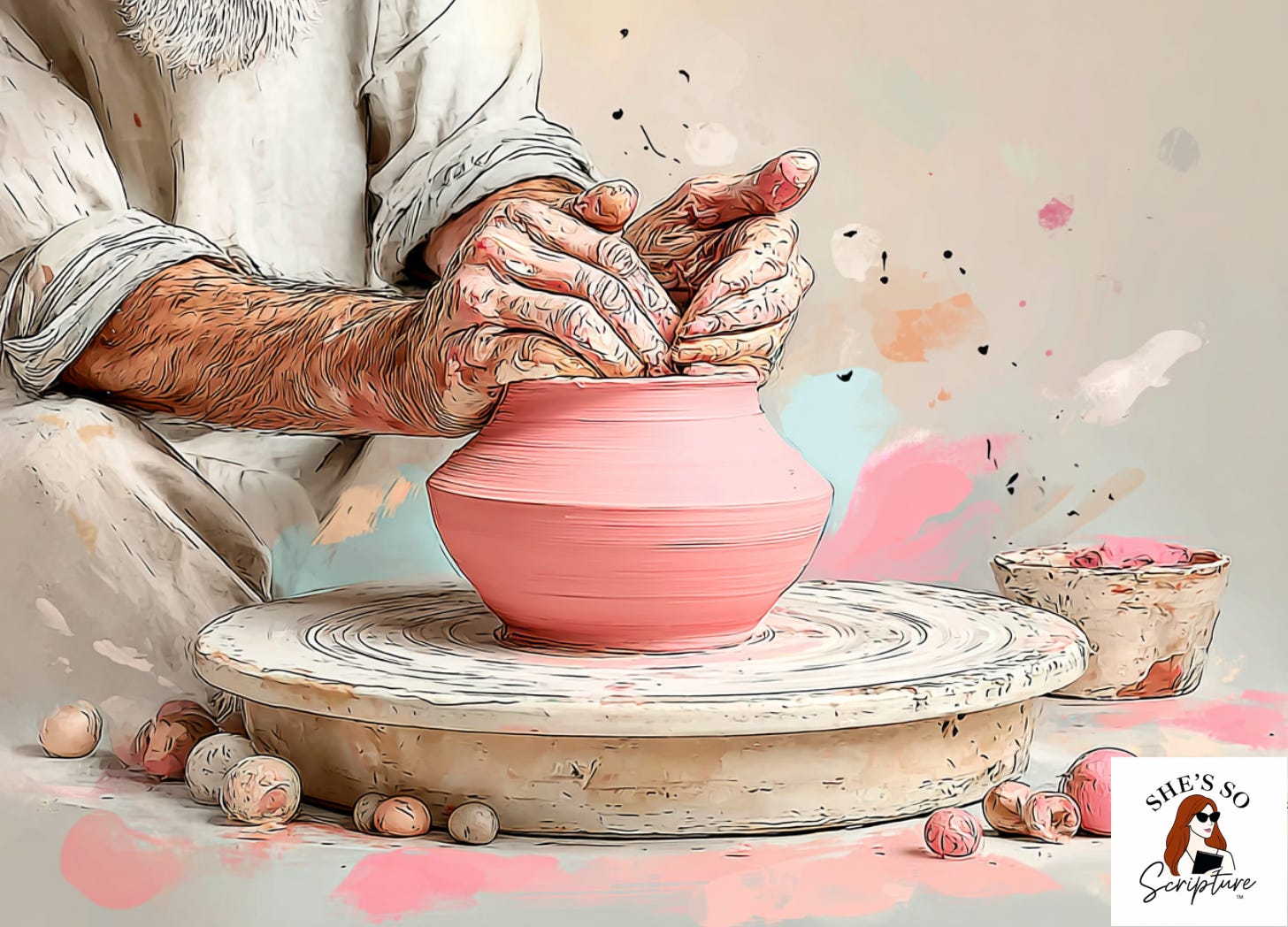
You’ve read Genesis 2:7 probably a hundred times.
“Then the Lord God formed the man out of the dust from the ground.” (TLV)
That word “formed” floats right past most readers without a second glance. Sounds like perfectly ordinary creation language. God made a thing. Moving on.
But it’s not ordinary at all.
The Hebrew word there is yatsar (יָצַר), and the moment you understand what it actually means, you’re going to read every single passage it shows up in with completely different eyes.
The Word
Yatsar (pronounced: yah-TZAR) is the verb of a craftsman. A deliberate, skilled, working-with-intention craftsman. It’s the kind of word Scripture uses for shaping or fashioning something with care, and it’s specifically tied to the imagery of a potter forming clay.
The related noun, yotzer (יוֹצֵר), means “potter.”
So when the text says God yatsar the man from the dust, it’s not describing a quick manufacturing process. It’s describing hands-in-clay, shaping-and-reshaping, attending-to-every-detail work. The kind of work you do when you genuinely care about what you’re making. The kind of work that leaves fingerprints on the finished product.
That’s the picture.
Where It Appears
The first time yatsar shows up in Scripture is Genesis 2:7:
“Then Adonai Elohim formed the man out of the dust from the ground and He breathed into his nostrils a breath of life — so the man became a living being.” (Genesis 2:7, TLV)
Notice that in Genesis 1, God speaks things into existence. He says “let there be,” and there is. The pace is sweeping, cosmic and commanding.
But here in Genesis 2, the emphasis shifts completely. Instead of divine speech, we get forming and breathing. The pace slows. The imagery becomes tactile. Personal.
The same God who spoke galaxies into existence got down in the dust to make you.
I don’t know what you do with that, but I’m genuinely not over it.
The Potter’s Complaint Department
If that wasn’t enough, now watch how Isaiah picks up this exact word and puts it to work.
Isaiah 64:7:
“But now, O Lord, you are our Father;
we are the clay, and you are our potter;
we are all the work of your hand.” (Isaiah 64:7, ESV)
That word “potter” is the noun form of yatsar. Yotzer. The one who forms.
Israel is crying out to God: You made us the way a potter makes a vessel. We are what Your hands produced. So please don’t abandon us.
That is a specific theological argument, and it’s a gutsy one. They’re not appealing to God as a generic creator. They’re invoking the intimacy of the craft. You didn’t manufacture us, God. You formed us. There’s a difference, and they’re betting everything on it.
Isaiah uses this image again and again because the potter metaphor does something no other creation metaphor quite does.
It insists on proximity.
A potter can’t form anything from across the room. The work requires closeness. You cannot do yatsar from a distance.
Jeremiah Gets Personal
Here’s where yatsar stops being a theological concept and becomes something that should genuinely stop you cold.
When God commissions Jeremiah, He opens with this:
“Before I formed you in the womb, I knew you, and before you were born, I set you apart — I appointed you prophet to the nations.” (Jeremiah 1:5, TLV)
Before I formed you in the womb.
Yatsar again.
The same word used for Adam in the dust. The same word tied to the potter and the clay. Now applied to one specific human being, in the dark of his mother’s womb, before he had a name anyone knew, there was a calling God gave him.
God’s forming work isn’t only cosmic. It’s individual. It’s personal. It’s happening in the dark, before anyone else knows you exist, and God is already at the wheel.
Jeremiah didn’t show up as raw material that God figured out what to do with later. He was being formed for a purpose from the very beginning.
And yes. That applies to you too.
Verse Mapping Aid
יָצַר — Yatsar
Pronunciation: yah-TZAR
Part of speech: Verb (active)
Root meaning: To form, fashion, or shape — with the kind of intentionality and skill associated with a craftsman working with their hands
Related noun: יוֹצֵר (yotzer) - potter; the one who forms
Appears in: Genesis 2:7 — God forming Adam from the dust Jeremiah 1:5 — God forming Jeremiah in the womb Isaiah 64:7 — Israel appealing to God as their potter Isaiah 29:16; 45:9 — warnings against the clay arguing with the potter
What makes it distinct: The word bara (בָּרָא) is used for God’s unique act of bringing something into existence. Yatsar is different. Yatsar is what you do with material that’s already there, shaping it with skill and purpose. Both describe God’s creative work. But yatsar is always hands-on. It always requires contact. There is no distant version of this word.
My Final Thoughts
Here’s what I keep coming back to with this word.
When we’re in seasons that feel like the wheel is spinning a little too fast, or the pressure feels like too much, we tend to read the potter passages as warnings. Stop fighting. Submit to the process. And there’s real truth in that.
But there’s something else I don’t want you to miss.
The whole metaphor only works because the potter stays at the wheel.
The potter doesn’t shape you and walk away. The potter doesn’t do the hard part and then go take a break while you figure out the rest. Yatsar describes ongoing, attentive, present work.
The same God who formed you from the beginning is still forming you right now, in this season, with this pressure, on this particular wheel.
You weren’t made from a distance.
And you’re not being shaped from a distance now.
Whatever this season is producing in you, the Potter has not stepped away from the work.
Bible Study Questions
In Genesis 2, God speaks other creation into existence but forms humanity with yatsar. What does that intentional change in emphasis communicate about how God relates to humanity?
How does Jeremiah 1:5’s use of yatsar shape your understanding of calling or purpose? What does it mean for your purpose to be something God was actively forming before you were born?
Isaiah 64:7 uses the potter image as a basis for prayer. What does it mean to appeal to God not just as Creator, but as the One whose hands actually shaped you?
Reflection Questions
When you imagine God forming you like a potter forms clay, what comes up for you? Does the image feel comforting, or does something in you resist it?
Is there an area of your life where you’re resisting that shaping right now?
How does knowing that yatsar involves intentional, hands-on forming change the way you view God’s presence in difficult seasons?
Action Challenges
Sit with Jeremiah 1:5 this week and read it slowly, inserting your own name where Jeremiah’s appears. Write down one thing you sense God may have been forming in you long before you recognized it as a gift or a calling.
Find something handmade this week and spend a few minutes reflecting on what it required of the person who made it. Let it be a tangible picture of what yatsar means.
Write a short prayer this week using the imagery of the potter and the clay. Not a plea to escape the process, but an honest conversation with the One who is still at the wheel.
If this study stirred something in you, share it with a friend who needs to know that the pressure she’s feeling right now isn’t God walking away… it’s God leaning in.
And if it left you wanting to go slower and deeper into the Word, I’ve got you! Paid subscribers get access to live Bible studies, extended studies, devotionals, theological teaching, spiritual formation practices, and a community of women who want depth without pressure or performance. If you’re ready to step further into the Word, you’re welcome inside.
👉🏻 Join The Vault.
If a paid subscription isn’t feasible right now but this space has blessed you, you can leave a one-time tip here. Every gift helps sustain this work. 💕


P.S. For the girls who love Jesus, Scripture, and a little holy cute in real life, my She’s So Scripture collection is here!
About the Author
Diane Ferreira is a Jewish believer in Yeshua, a published author, speaker, seminary student, wife, and proud mom. She is the founder of She’s So Scripture and She Opens Her Bible. She is the author of several books, including The Proverbs 31-ish Woman, which debuted as Amazon’s #1 New Release in Religious Humor, as well as Holy, Hormonal and Holding On.
She is currently pursuing her graduate degree in Jewish Studies in seminary, with her favorite topics being the early church and Biblical Hebrew. Diane writes and teaches from a unique perspective, bridging her Jewish heritage with vibrant faith in the Messiah to bring clarity, depth, and devotion to everyday believers.
When she’s not writing, studying, or teaching, you’ll find her curled up with a good book, crocheting something cozy, traveling, or playing her favorite video games.
Tree of Life (TLV) – Scripture taken from the Holy Scriptures, Tree of Life Version*. Copyright © 2014,2016 by the Tree of Life Bible Society. Used by permission of the Tree of Life Bible Society.
ESV - “Scripture quotations are from The ESV® Bible (The Holy Bible, English Standard Version®), copyright © 2001 by Crossway, a publishing ministry of Good News Publishers. Used by permission. All rights reserved.”
I haven’t been able to shake your reflection on yotzer—the idea of God forming us so personally. That image has stayed with me all week. I included this in my weekly roundup because it was just so powerful. Thank you for this.
Diane, oh, I loved this post! It’s so resonated with me and how I feel about our legacy the word that you just taught to us and talked to us about is why I put A Well-Crafted Legacy as the name of my page. I saw what crafted meant and was like yes hands-on, attentive, and doesn’t take His eyes off of and neither can we. You did a wonderful job of breaking it down so that we can understand exactly why the Word uses it the way it does and where I was. Very blessed. Be encouraged. Continue to write.❣️